

.png)
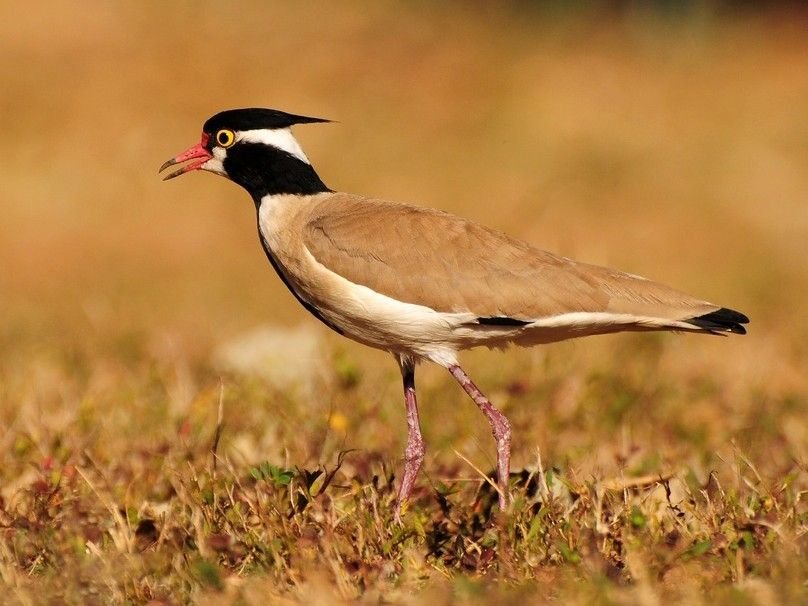
Black-winged Lapwing
Vanellus melanopterusA striking highland lapwing of East Africa, built for cool open grasslands and mountain country.
The Black-winged Lapwing (Vanellus melanopterus) is a distinctive plover of the African highlands. Its bold black-and-white plumage, broad white forehead and red legs make it one of Tanzania’s most recognizable upland lapwings. It favors open grasslands, short-grazed country and other open ground, especially at higher elevations.
Black-winged Lapwing Quick Facts
What Is the Black-winged Lapwing?
The Black-winged Lapwing (*Vanellus melanopterus*) is a medium-sized lapwing in the plover family Charadriidae. It is strongly associated with open, elevated grasslands where short vegetation and bare ground allow it to walk, scan and feed efficiently.
Two widely separated African populations are recognized, with the eastern population extending through the highlands of Ethiopia, Kenya and northern Tanzania. A separate population occurs much farther south in southern Africa.
In Tanzania, the species is an important bird of upland grasslands around the northern highlands and can be encountered in open landscapes associated with the Serengeti and Ngorongoro ecosystems.
How to Identify a Black-winged Lapwing
The Black-winged Lapwing is distinctive once its broad white forehead, red legs and bold black-and-white pattern are seen together.
- Forehead: Broad white forehead extending toward the eye-ring.
- Upperparts: Dark mantle and wings with bold black-and-white contrast.
- Underparts: Pale body with a contrasting dark breast and upper chest.
- Eyes: Dark eyes set within the strongly patterned head.
- Bill: Short, straight bill typical of a ground-foraging lapwing.
- Legs: Bright red legs, one of the clearest field marks.
Distinguishing from Other Lapwings
It can be separated from similar Tanzanian lapwings by its combination of red legs, a broad white forehead and a strong association with highland grassland. Crowned Lapwing and Blacksmith Lapwing are useful comparisons because their habitat and plumage can overlap.
Behavior & Social Life
The Black-winged Lapwing is a ground-dwelling bird of open country. It walks and runs while scanning for prey, pausing frequently to watch for danger. During the breeding season pairs defend suitable areas, while birds may gather more loosely when feeding conditions are favorable.
Daily Activity
- Foraging: Walks through short grass and bare ground, taking insects and other small prey.
- Vigilance: Frequently pauses upright to scan for predators and disturbance.
- Vocalization: Gives sharp, ringing lapwing calls during flight, alarm and territorial interactions.
Movement & Migration
The species is mainly associated with highland habitats and can make local or altitudinal movements as rainfall, fire, grazing and grass conditions change. It is not a classic long-distance migrant across Tanzania.
Habitat & Distribution
The Black-winged Lapwing mainly occupies open, elevated country rather than dense wetland vegetation or closed woodland. Short grassland is particularly important because it provides visibility and easy access to ground prey.
- High-elevation grassland and montane plains.
- Recently burned, grazed, mown or otherwise short grassland.
- Open agricultural or disturbed ground where feeding remains suitable.
- Broad upland valleys, plateaus and cool grass-covered slopes.
Distribution: The species has two disjunct African populations. The eastern population includes the highlands of northern Tanzania, while the separate southern population occurs in South Africa and neighbouring areas.
Tanzania Distribution
In Tanzania, documented records include sites in and around the Serengeti, Ngorongoro and the northern highlands, with photographs and observations from areas around Arusha and Kilimanjaro.
Black-winged Lapwing in Tanzania
Tanzania is one of the best countries for seeing the eastern African population of the Black-winged Lapwing, especially in cool upland grasslands and short open plains.
Serengeti National Park
Documented records from the Serengeti ecosystem include Black-winged Lapwings using open grassland and upland country.
Serengeti National Park birdingNgorongoro Crater
The crater and surrounding highlands provide open short grassland that suits this highland lapwing.
Ngorongoro Crater birdingArusha National Park
Highland landscapes around Mount Meru provide appropriate open habitats and form part of the northern Tanzania range.
Arusha National Park birdingKilimanjaro / Northern Highlands
Northern Tanzania’s elevated grasslands and open uplands are among the landscapes where the eastern population occurs.
Kilimanjaro birdingSafari Methods
- Game drives across open grassland and crater plains.
- Dedicated birdwatching on highland tracks, short-grazed grasslands and open slopes.
- Wildlife photography from a respectful distance, especially during calm morning conditions.
Best Time to See Them
Black-winged Lapwings are present year-round in suitable habitat. They are most active during the cooler morning and evening hours .
Diet & Feeding
The Black-winged Lapwing feeds primarily on insects and other small invertebrates found on or near the ground. Its open-country feeding strategy works especially well where grass is short and prey can be detected visually.
Food Sources
- Beetles and other insects.
- Grasshoppers and other orthopterans.
- Worms and other small soil invertebrates.
- Seeds and plant material taken opportunistically.
Foraging Behavior
It usually walks slowly, pauses to scan, then makes quick pecks or short runs toward prey. Open visibility is important, and feeding opportunities can improve where grazing or other disturbance creates short vegetation.
Breeding & Life Cycle
The Black-winged Lapwing breeds on open ground, where a simple scrape can blend into short grass, soil and broken vegetation. Adults become highly alert around nests and young.
Nesting
- Nest: A shallow scrape or lightly lined depression on open ground.
- Eggs: Usually 2–3 eggs in a simple ground nest.
- Incubation: Roughly four weeks, with parental incubation and care.
Chicks
The chicks are precocial and leave the nest soon after hatching. They follow the adults while feeding themselves, with the parents providing protection and alarm responses.
Conservation Status
The Black-winged Lapwing is currently assessed globally as Least Concern. Its broad African distribution keeps it outside the highest global threat categories, although its specialized highland habitat can be vulnerable locally.
Important pressures include conversion of upland grasslands to agriculture, settlement, changes in fire regimes and changes in grazing intensity. The species’ preference for short grass means habitat management must maintain an open structure without eliminating natural grassland diversity.
Conservation work should focus on retaining intact highland grasslands, maintaining ecologically appropriate grazing and fire patterns, and monitoring local populations where upland habitats are being rapidly transformed.
- Highland grassland loss or conversion.
- Changes in grazing and fire regimes that alter suitable short grassland.
Comparisons
The Black-winged Lapwing is best distinguished from other East African lapwings by its red legs, broad white forehead, black-and-white plumage and highland habitat.
| Feature | Black-winged Lapwing | Crowned Lapwing | Blacksmith Lapwing |
|---|---|---|---|
| Size | 29–31 cm | About 30–32 cm | About 29–31 cm |
| Legs | Red | Dark | Black |
| Forehead | Broad white forehead | White forehead with different crown pattern | White facial markings |
| Habitat | Highland grassland | Dry open grassland | Wetlands and adjacent grassland |
| Typical feeding | Insects and small invertebrates | Ground insects and other prey | Invertebrates in wet grassland |
| Diet | Rodent specialist | Reptiles, small mammals | Large gamebirds, mammals |
Did You Know?
Highland Specialist
It is closely associated with cool, elevated grassland in eastern Africa.
Red Legs
Bright red legs are one of its easiest field marks.
Grassland Bird
Short vegetation created by grazing, mowing or fire can provide excellent feeding ground.
Local Movements
Local or altitudinal movements may follow rainfall and changing grass conditions.
Ground Nester
Its eggs are laid in a simple scrape on open ground.
Eastern African Range
Northern Tanzania forms part of the eastern African population.
The Black-winged Lapwing belongs to a quieter side of the safari landscape: the open, elevated grasslands where birds rather than big mammals define the scene. Its red legs and crisp black-and-white pattern make it memorable, but its real story is ecological — a specialized highland bird tied to the condition of short, open grassland.
Gallery
Frequently Asked Questions
The Black-winged Lapwing (*Vanellus melanopterus*) is a medium-sized lapwing of the plover family, strongly associated with open highland grasslands in eastern Africa.
Documented Tanzanian records include the Serengeti, Ngorongoro and northern highland areas around Arusha and Kilimanjaro.
It mainly feeds on insects and other small invertebrates, with seeds and plant matter taken opportunistically.
No. The species is currently assessed globally as Least Concern, although local habitat changes can still affect populations.
Look for red legs, a broad white forehead, bold black-and-white plumage and an upland grassland setting.
It nests on the ground in a simple scrape, usually laying 2–3 eggs. The chicks are precocial and leave the nest soon after hatching.
It is not a classic long-distance migrant in Tanzania; local or altitudinal movements can occur as rainfall and grass conditions change.
Short, open highland grassland provides the visibility and ground access needed for feeding, nesting and predator detection.
References & Further Reading
- BirdLife South Africa / regional Red Data Book – Black-winged Lapwing (*Vanellus melanopterus*): distribution, ecology and conservation context.
- Tanzania Birds – Black-winged Lapwing: documented Tanzanian localities, field marks and breeding photographs.
- eBird – Black-winged Lapwing: identification, distribution and observation records.
- Birds of the World – Black-winged Lapwing: species account and natural history.
- Handbook of the Birds of the World / del Hoyo et al. – lapwing taxonomy and ecology.
- Wetlands International / waterbird literature – African lapwing population and habitat context.
- IUCN Red List – current global conservation assessment and range information.