

.png)
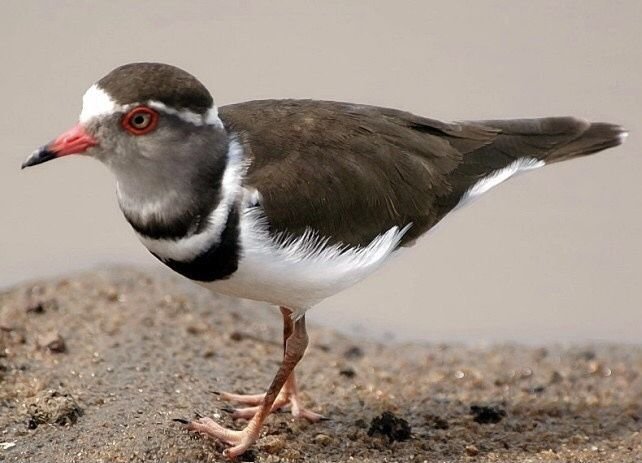
Three-banded Plover
Thinornis tricollarisA small, beautifully marked freshwater wader with a signature three-band breast pattern.
The Three-banded Plover (Thinornis tricollaris) is a compact plover of African freshwater wetlands, lake margins, rivers, pools and pans. Its broad white forehead, red legs and two black breast bands separated by white make it a memorable bird for Tanzania birdwatchers.
Three-banded Plover Quick Facts
What Is the Three-banded Plover?
The Three-banded Plover (Thinornis tricollaris) is a small African wader of the family Charadriidae. It is closely associated with freshwater wetlands, where it patrols exposed mud, gravel, sand and shallow margins while searching visually for prey.
Its name comes from the striking breast pattern: two dark bands are separated by a white band, creating a distinctive three-band effect across the upper breast. Modern taxonomies have moved the species from Charadrius tricollaris into the genus Thinornis; the older name remains common in checklists and references.
The species is resident and generally sedentary across much of eastern and southern Africa and Madagascar, making suitable wetland habitat especially important for local populations. In Tanzania it is a regular bird of several lakes, pans and other freshwater sites.
How to Identify a Three-banded Plover
This compact plover has a clean, high-contrast pattern that makes it easier to identify than many small wetland waders once its key features are learned.
- Head: Broad white forehead with a darker crown and contrasting face pattern.
- Breast: Two black breast bands separated by a white band, the defining feature behind its English name.
- Bill: Short, reddish bill with a darker tip in adults.
- Legs: Bright red to reddish legs that are conspicuous beside pale wetland margins.
- Body: Small, compact plover with a relatively long-winged, elongated profile.
- Juveniles: Less crisply marked, with the breast bands weaker than in adults.
Distinguishing from Similar Plovers
Three-banded Plover can be confused with Forbes's Plover, but the Three-banded has a broad white forehead and a more strongly banded breast. Forbes's Plover is generally darker-faced and has a different bill pattern, while the wetland setting is another useful clue.
Behavior & Social Life
Three-banded Plovers are usually encountered singly or in pairs, although small groups can gather where feeding habitat is concentrated. They move quickly along wetland edges, pausing to watch for tiny prey before making short, precise runs and pecks.
Daily Activity
- Foraging: Hunts mainly by sight, picking insects, worms and other small invertebrates from mud, sand and shallow wet areas.
- Movement: Walks and runs briskly along exposed margins, often staying close to open feeding ground.
- Alert behavior: Gives a sharp whistle and quickly moves away when disturbed, sometimes flying low over the wetland.
Migration & Local Movements
The species is generally resident and sedentary rather than a long-distance migrant. Local movements can still occur as birds respond to changing water levels, drying wetlands and the availability of feeding margins.
Habitat & Distribution
Three-banded Plovers are strongly associated with inland freshwater wetlands and the open margins around them.
- Lake shores with exposed mud, sand, gravel or shallow water.
- Rivers and streams where low-flow conditions create open feeding edges.
- Pans and pools that retain suitable shallow margins.
- Wetland flats with short vegetation and unobstructed ground for visual foraging.
Distribution: The species occurs widely in eastern and southern Africa and Madagascar. It is a resident, non-migrant species with a very large geographic range.
Tanzania Distribution
In Tanzania, documented records include Lake Manyara, Olasiti, Tarangire, Lake Eyasi, Arusha National Park and Ndutu, with breeding evidence also recorded at Tarangire. Recent eBird/Macaulay Library records include the Ngorongoro Crater and Iringa region.
Three-banded Plover in Tanzania
This wetland specialist can be found on suitable freshwater margins during Tanzanian birding and safari trips. The following sites are particularly useful documented locations.
Lake Manyara
Freshwater and alkaline wetland margins around Lake Manyara provide documented habitat and records for Three-banded Plover.
Lake Manyara safariTarangire National Park
Three-banded Plovers have been recorded around Tarangire wetlands, and eggs have been photographed near the Kuro airstrip area.
Tarangire safariNgorongoro Conservation Area
Recent photographic records from the Ngorongoro Crater confirm the species in this high-elevation wetland environment.
Ngorongoro safariArusha & Ndutu Wetlands
Documented records from Arusha National Park, Ndutu and nearby northern Tanzania wetlands add further opportunities for birdwatchers.
Arusha safariBirdwatching Methods
- Early-morning birding along quiet lake and pan edges when feeding activity is high.
- Slow wetland scans using binoculars to check exposed mud, gravel bars and shallow margins.
- Wildlife photography from a respectful distance, especially where birds are feeding on open shorelines.
Best Time to See Them
Because the species is resident, it may be encountered year-round where suitable habitat persists. Visibility is often best when water levels expose feeding margins and during calm morning birding sessions.
Diet & Feeding
The Three-banded Plover is a visual feeder that works exposed wetland margins, picking small animal prey from the surface or shallow substrate.
Food Sources
- Insects: A major part of the diet, especially small terrestrial and aquatic insects.
- Worms: Earthworms and other worm-like invertebrates taken from soft ground.
- Other invertebrates: Small aquatic and shoreline invertebrates encountered while foraging.
- Larvae and tiny prey: Small soft-bodied prey gathered around wet mud and shallow water.
Foraging Behavior
It relies heavily on vision, moving in short bursts before stopping to pick prey. Open shorelines are especially valuable because they allow the bird to spot prey while retaining clear sightlines for detecting danger.
Breeding & Life Cycle
Three-banded Plovers breed on or close to open ground near suitable wetlands. Their nesting strategy fits the exposed landscapes they use for feeding, where camouflage and attentive defense are important.
Nesting
- Nest: A simple scrape or shallow nest on open ground, often near a wetland margin.
- Eggs: Commonly two eggs, with cryptic markings that blend with the surrounding substrate.
- Incubation: Around four weeks, with both adults involved in the breeding process.
Chicks
Chicks are precocial, leaving the nest soon after hatching and following the adults while feeding independently on small invertebrates. Their survival depends heavily on camouflage, alert parents and access to safe wetland margins.
Conservation Status
The Three-banded Plover is currently assessed as Least Concern on the IUCN Red List.
BirdLife's current regional assessment also lists the species as Least Concern, while noting a decreasing regional population trend. The global population estimate is in the tens of thousands of mature individuals and the species retains a very large range.
Wetland condition nevertheless matters locally, particularly where shallow feeding margins are lost:
- Wetland alteration can remove exposed shores and shallow feeding habitat.
- Water-level changes may reduce the temporary mud and gravel margins the birds use for feeding and nesting.
Comparisons
Several small African plovers share wetland habitats. The Three-banded Plover is best separated by its combination of breast bands, face pattern, bill and red legs.
| Feature | Three-banded Plover | Forbes's Plover | Little Ringed Plover |
|---|---|---|---|
| Scientific name | Thinornis tricollaris | Charadrius forbesi | Thinornis dubius |
| Breast pattern | Two dark bands separated by white | Single darker breast band | Single black breast band |
| Forehead | Broad white forehead | Darker forehead | White forehead with dark face markings |
| Bill | Reddish with darker tip | Darker with reddish base | Dark bill |
| Typical habitat | Freshwater wetlands and exposed shores | Wet grassland, seasonal wetlands and open ground | Shallow freshwater and wet open ground |
| Movement | Resident, generally sedentary | Resident with local movements | Resident or locally mobile depending on population |
Did You Know?
Three Bands
Its name refers to two black breast bands separated by a white band, producing a striking three-band effect.
Freshwater Specialist
It is especially associated with inland rivers, pools, lakes, pans and other freshwater wetland margins.
Fast Runner
It often moves in short, quick bursts along the shore before stopping to pick prey.
Visual Hunter
Rather than probing deeply, it usually spots prey and makes quick pecking movements.
Resident Bird
It is generally resident and sedentary, although local movements can follow changing wetland conditions.
Tanzania Records
Documented Tanzanian records include Lake Manyara, Tarangire, Lake Eyasi, Arusha National Park and Ndutu.
At first glance the Three-banded Plover can look like just another small bird on a wetland edge. Then the pattern resolves: white forehead, red legs, and those two dark breast bands separated by white. It moves with quiet urgency, running, stopping and picking prey from the mud. Around Tanzania's lakes and pans, it is a reminder that even the smallest waders are tightly connected to the condition of the water's edge.
Gallery
Frequently Asked Questions
The Three-banded Plover (Thinornis tricollaris) is a small freshwater-wetland plover in the family Charadriidae, recognized by its two black breast bands separated by white.
Documented locations include Lake Manyara, Tarangire, Lake Eyasi, Arusha National Park, Ndutu, Olasiti and the Ngorongoro Crater.
It feeds mainly on insects, worms and other small invertebrates found around wetland edges and shallow water.
No. It is currently assessed as Least Concern globally, although habitat quality and wetland changes can affect local populations.
The English name refers to the two black breast bands separated by a white band, creating three contrasting bands across the breast.
It nests on open ground near suitable wetlands, generally laying two cryptically marked eggs in a simple scrape.
Look for the broad white forehead, reddish bill with darker tip, red legs and the distinctive pair of black breast bands separated by white.
Yes. It is generally resident and sedentary in Tanzania, although local movements can occur as water levels and feeding conditions change.
References & Further Reading
- BirdLife South Africa – Three-banded Plover (Charadrius tricollaris): current 2024 global and 2025 regional conservation assessment.
- Tanzanian Birds & Butterflies – Three-banded Plover species page: Tanzanian locations including Lake Manyara, Olasiti, Tarangire, Lake Eyasi, Arusha National Park and Ndutu.
- eBird – Three-banded Plover: identification, taxonomy and field characteristics; current taxonomy uses Thinornis tricollaris.
- BirdNET Taxonomy – Three-banded Plover: Thinornis tricollaris, habitat and behavior summary.
- Avibase – Taxonomic history showing the transition from Charadrius tricollaris to Thinornis tricollaris in current taxonomic concepts.
- Macaulay Library – Recent Tanzania records including the Ngorongoro Crater and Iringa region.
- BirdLife Africa resources – Wetland and waterbird conservation context relevant to inland waders.