

.png)
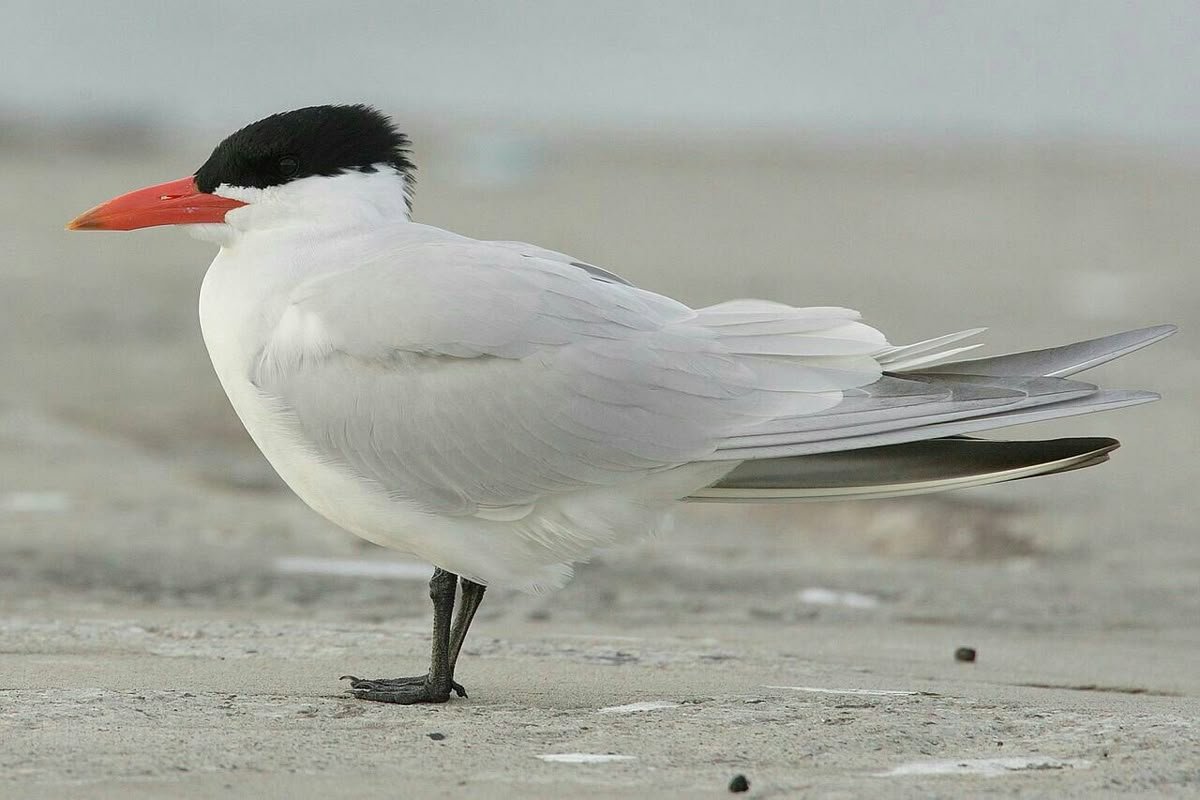
Caspian Tern
Hydroprogne caspiaThe world’s largest tern — a powerful fish hunter with a massive red bill and a commanding presence over water.
The Caspian Tern (Hydroprogne caspia) is the largest tern in the world. It combines a broad, powerful build with a huge red bill, black cap, pale grey upperparts and a dramatic white body. In Tanzania it can be encountered along the coast and at suitable inland wetlands, where it hunts fish and roosts on open shorelines.
Caspian Tern Quick Facts
What Is the Caspian Tern?
The Caspian Tern is a globally widespread but patchily distributed waterbird of the family Laridae. Its sheer size, huge red bill, black cap and strong, buoyant flight make it one of the easiest large terns to recognize. The species occurs around marine coasts, estuaries, large lakes and other productive waters.
The scientific name Hydroprogne caspia is currently accepted, while Sterna caspia appears in older literature as a synonym. The genus Hydroprogne is monotypic, containing only the Caspian Tern.
For birders in Tanzania, the species is especially interesting because it links coastal ecosystems with inland wetlands. It may rest on exposed shorelines or sandbars before launching into a forceful dive for fish.
How to Identify a Caspian Tern
The Caspian Tern is unmistakable at close range because of its combination of size, massive red bill and black cap. Its upperparts are pale grey, while the rump and tail are white and the underparts are largely white.
- Size: The largest living tern, with a notably powerful body and wings.
- Bill: Large, thick, bright red bill, often with a paler tip and darker subterminal band.
- Head: Black cap and nape in breeding plumage, becoming less extensive outside the breeding season.
- Upperparts: Pale grey back and wings contrasting with the white rump, tail and underparts.
- Flight: Strong, deliberate wingbeats with a broad-winged silhouette.
- Legs: Dark legs and feet, useful for distinguishing it from some other large terns.
Distinguishing from Similar Large Terns
In flight, the broad wings and deep wingbeats give it a heavier appearance than smaller terns. The outer primaries can look distinctly darker, contrasting with the pale inner wing and white body.
Behavior & Social Life
Caspian Terns are typically encountered alone or in small groups away from breeding colonies. They can appear calm while perched, but their flight is powerful and purposeful, especially when moving between feeding and roosting sites.
Daily Activity
- Foraging: Usually patrols over water, then dives or snatches fish from near the surface.
- Roosting: Uses beaches, sandbanks, islands, salt pans and other open shoreline sites.
- Vocalization: Gives a deep, harsh call that is noticeably heavier than the calls of many smaller terns.
Migration & Seasonal Movement
Over open water they scan for fish and may plunge dramatically from the air. At communal roosts they may stand among gulls and other terns, often choosing exposed sandbars, beaches, islands or other open surfaces. Many populations are migratory or seasonally mobile, and Tanzanian birds may shift between coastal and inland wetlands as conditions and food availability change.
Habitat & Distribution
The species uses a broad range of aquatic habitats, provided there is open water for feeding and exposed ground or other secure surfaces for resting. It can occur beside marine coasts as well as on large freshwater lakes and estuarine systems.
- Coastal waters Beaches, bays, estuaries and nearshore waters.
- Inland lakes Large lakes and productive freshwater shorelines.
- Lagoons & salt pans Shallow waters where fish and other prey can concentrate.
- River deltas Open channels, sandbars and wetlands, particularly where fish are abundant.
Tanzania is particularly important as part of the species’ East African coastal and inland wetland landscape. Documented Tanzanian records include the coast, Zanzibar waters and Lake Manyara, illustrating its ability to use both saltwater and freshwater environments.
Tanzania Distribution
Across Tanzania, habitat quality varies from saline and marine shorelines to productive freshwater lakes and river deltas. Open water, fish availability and secure roosting areas are the key ingredients for regular use.
Caspian Tern in Tanzania
Caspian Terns are recorded in Tanzania in both inland and coastal wetland systems. The following locations are especially useful starting points for birders, based on documented regional records.
Lake Manyara & Rift Valley Wetlands
Lake Manyara is a documented Tanzanian survey site for Caspian Terns and offers productive shallow waters, open shorelines and concentrations of fish-eating birds.
Lake Manyara birdingRufiji Delta & Coastal Wetlands
The Rufiji Delta has produced notable Caspian Tern counts, illustrating the species’ use of Tanzania’s large coastal wetland complexes.
Rufiji Delta birdingDar es Salaam & Coast
Caspian Terns are listed for the Dar es Salaam region and can occur along suitable coastal waters, beaches and estuaries.
Coastal birdingZanzibar & Channel Waters
Published Tanzanian records include Zanzibar Channel and Zanzibar island localities, making offshore and intertidal birding relevant for the species.
Zanzibar birdingSafari Methods
- Game drives and birding stops around inland lakes and floodplain wetlands.
- Dedicated wetland birding from shorelines, viewpoints and boats where appropriate.
- Coastal and island birding focused on beaches, estuaries, deltas and channels.
Best Time to See Them
Because the Caspian Tern can move widely between feeding and roosting sites, local conditions matter more than a single fixed viewpoint. Early morning and late afternoon often provide comfortable light, active feeding and clearer opportunities to study flight and plumage.
Diet & Feeding
The Caspian Tern is predominantly piscivorous. Fish are the core of its diet, and the species is built for locating and capturing aquatic prey from above.
Food Sources
- Fish: The principal prey, taken from lakes, estuaries, coastal waters and rivers.
- Small aquatic animals: May include other small aquatic prey when opportunities arise.
- Carrion & scraps: Occasionally uses opportunistic food sources where available.
- Invertebrates: Can take insects and other small invertebrates opportunistically, especially away from prime fishing conditions.
Hunting & Foraging
It commonly hunts by flying over water, locating prey visually and plunging downward to seize fish. Its large size and powerful bill allow it to handle prey that smaller terns may ignore.
Breeding & Life Cycle
Caspian Terns usually nest on open ground in colonies or loose groups, selecting islands, beaches, sandbanks and other sites where terrestrial disturbance is relatively limited.
Nesting
- Nest: A shallow scrape or simple depression on open ground, sometimes lined with small material.
- Eggs: Usually 1–3 eggs, with both adults involved in territory and chick care.
- Incubation: Roughly four weeks, with timing varying by colony and conditions.
Chicks
Young remain dependent after hatching while adults continue to feed them. Fledging takes several weeks, and the young may continue to receive parental assistance after first flight.
Conservation Status
The Caspian Tern is assessed globally as Least Concern. Its broad geographic range and large overall population provide a substantial buffer, although particular breeding colonies and wetland systems can still face local pressures.
Important local risks include disturbance at breeding and roosting sites, degradation of wetlands, reduced fish availability and changes to coastal and freshwater habitats. Protecting productive shoreline ecosystems benefits the species alongside many other waterbirds.
In Tanzania, safeguarding coastal wetlands, estuaries, lake margins and other productive waters helps retain the feeding and roosting habitats used by this and many other waterbirds.
- Habitat loss due to deforestation and agricultural expansion .
- Persecution in some areas, though it is generally tolerated due to its rodent-control benefits .
Comparisons
The Caspian Tern is best separated from other large terns by its exceptional size, massive red bill and broad-winged profile. The comparison below highlights practical field marks.
| Feature | Caspian Tern | Lesser Crested Tern | Greater Crested Tern |
|---|---|---|---|
| Size | 47–54 cm | 41–43 cm | 45–51 cm |
| Bill | Very large, red, heavy | Orange-red, slenderer | Orange-yellow, heavy |
| Cap | Black | Black | Black |
| Habitat | Coasts, lakes, estuaries | Coasts and lagoons | Coasts and offshore waters |
| Main prey | Fish | Fish and marine prey | Fish and marine prey |
| Global status | Least Concern | Least Concern | Least Concern |
Did You Know?
Largest Tern in the World
Caspian Terns are the largest living terns, giving them a distinctive heavy silhouette in flight and at rest.
Powerful Bill
The huge red bill is one of the strongest visual clues to the species and is well suited to handling sizeable fish.
Fish Specialist
Fish dominate the diet, and plunge-diving is one of its signature hunting techniques.
Global Traveler
The species has a broad, scattered distribution across several continents and major flyways.
Freshwater & Seawater
It can feed in both marine and freshwater environments, a useful trait in Tanzania’s varied wetland landscapes.
High-speed Plunge Dives
A bird may rise over water, locate prey visually and descend rapidly to seize a fish.
There is something unmistakably grand about a Caspian Tern. The huge red bill and black cap give it the presence of a small gull, but its flight is pure tern — powerful, agile and beautifully controlled. Along Tanzania’s coasts and wetlands, a single bird sweeping over the water and dropping into a sudden dive can turn an ordinary birding stop into a memorable field encounter.
Roosting Behavior
Gallery
The Caspian Tern (Hydroprogne caspia) is the largest tern in the world, a large fish-eating waterbird of coasts, estuaries, lakes and other open waters.
Documented Tanzanian records include Lake Manyara, the Rufiji Delta and coastal areas including Dar es Salaam and Zanzibar.
It feeds mainly on fish, which it captures from water using powerful aerial dives and surface attacks.
No. Its global IUCN category is Least Concern, although local colonies and wetland habitats can still be vulnerable to disturbance and habitat change.
Look for the exceptional size, huge red bill, black cap, pale grey upperparts and broad-winged flight.
Yes. It uses marine coasts and estuaries as well as large freshwater lakes and other inland waters.
Many populations are migratory or seasonally mobile, with movements varying by region and breeding population.
It nests on open ground, often in colonies or loose groups, and usually lays 1–3 eggs that are incubated for around four weeks.
Frequently Asked Questions
- ITIS – Hydroprogne caspia: current accepted scientific name and taxonomic placement.
- Cornell Lab of Ornithology – Caspian Tern: identification, habitat, fish diet and aerial diving behavior.
- BTO BirdFacts – Caspian Tern: global Least Concern status, classification and natural history.
- Avibase – Tanzania checklist: Caspian Tern recorded in the national bird list.
- Oiseaux.net – Birds of Manyara Region and Dar es Salaam Region: regional records for Caspian Tern in Tanzania.
- Published Tanzanian Caspian Tern research – documented records from Rufiji Delta, Zanzibar Channel and other Tanzanian localities.
- BirdLife conservation resources – global and regional conservation context for Hydroprogne caspia.