

.png)
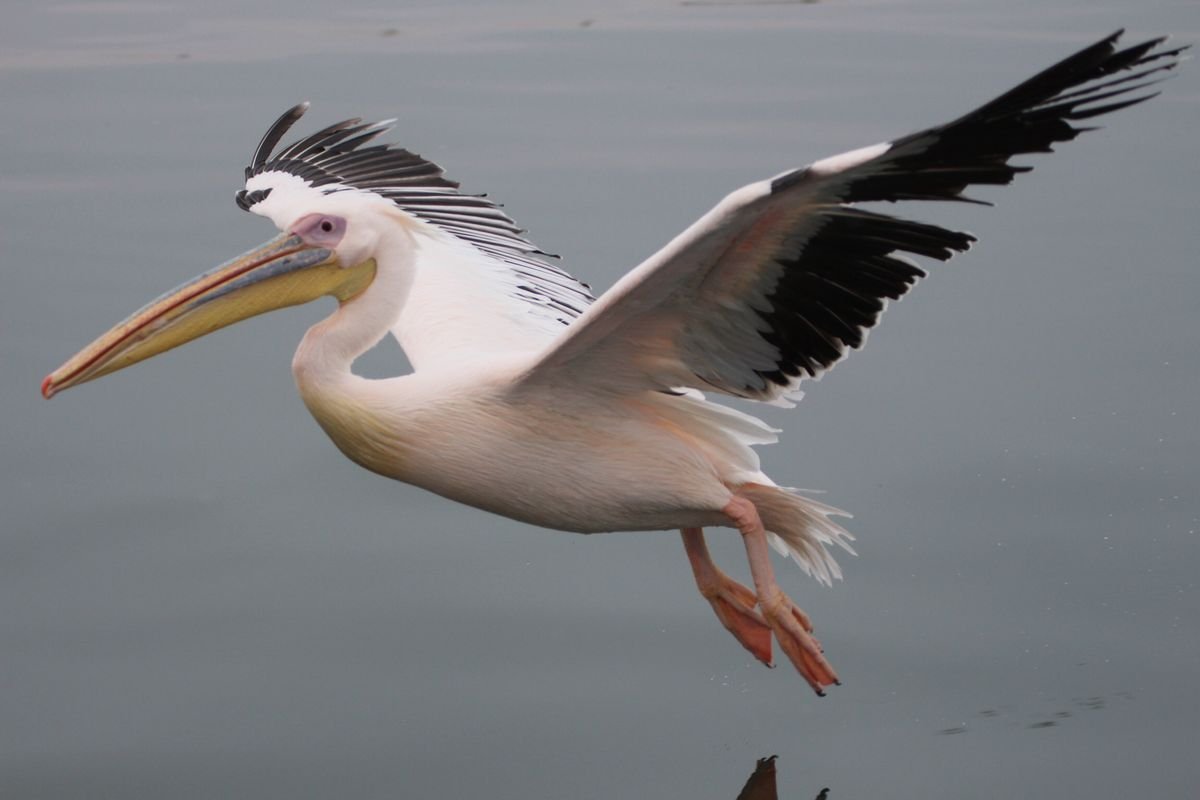
Great White Pelican
Pelecanus onocrotalusA colossal white waterbird that turns fish-rich lakes into theatres of cooperative hunting.
The Great White Pelican (Pelecanus onocrotalus) is one of the largest flying waterbirds associated with African wetlands. It belongs to the family Pelecanidae and is recognized by its enormous pale body, black outer flight feathers, long bill and expandable throat pouch. In Tanzania it gathers on major lakes and wetlands, where groups may work together to drive fish into shallow water before scooping them up.
Great White Pelican Quick Facts
What Is the Great White Pelican?
The Great White Pelican (<em>Pelecanus onocrotalus</em>) is a gigantic waterbird of the family Pelecanidae. Despite its enormous size, it is an accomplished flier, using broad wings and rising air currents to travel efficiently between feeding and breeding areas.
Adults are predominantly white, with contrasting black outer flight feathers. The enormous bill and elastic throat pouch form the species' most obvious feeding adaptation: the pouch is used as a scoop rather than as a simple storage bag.
In Tanzania, Great White Pelicans are especially associated with major inland lakes and wetland systems. Tanzania Birds documents birds from Lake Manyara, Lake Eyasi, Katavi, Lake Natron, Silale Swamp and the Ngorongoro Crater, including breeding birds at Lake Manyara.
How to Identify a Great White Pelican
Few African waterbirds are as immediately recognizable as a Great White Pelican. Its sheer size, enormous bill pouch and white body make it difficult to confuse with smaller pelicans.
- Body: enormous, mostly white, with a broad deep chest and heavy appearance when standing.
- Wings: mostly white but with sharply contrasting black outer flight feathers.
- Bill: extremely long, broad and pale yellowish to grey-blue, with a large expandable throat pouch.
- Head: large and powerful; breeding birds can develop stronger facial and forehead features and a rosy wash to the plumage.
- Legs and feet: pale to pinkish legs with broad webbed feet built for swimming.
- Juveniles: duller and browner than adults, becoming progressively whiter as they mature.
Distinguishing from the Pink-backed Pelican
Great White Pelican is larger, whiter and more powerfully built than Pink-backed Pelican. In flight, the bold black outer primaries and huge white body are especially characteristic. The Pink-backed Pelican has a noticeably smaller, more compact appearance.
Behavior & Social Life
Great White Pelicans are highly social. On productive lakes they may feed in large groups, rest together along shorelines and roost communally on islands, exposed banks or wetland margins.
Daily Activity
- Fishing: groups may cooperate by swimming in lines or semicircles and driving fish toward shallow water.
- Soaring: broad wings and strong thermals allow long-distance movement with relatively low energy cost.
- Roosting: frequently gathers at secure shoreline sites, sandbars, islands and other open places.
Social Feeding
Cooperative fishing is one of the species' most spectacular behaviors. Several birds can move together, compressing a school of fish toward a narrower section of water where individual pelicans can scoop prey efficiently. This behavior means the flock functions as a feeding unit even though each bird eventually captures its own food.
Habitat & Distribution
Great White Pelicans are strongly associated with large bodies of water, especially shallow productive lakes, lagoons, estuaries and marshes where fish are abundant and safe resting sites are available.
- Large freshwater lakes with shallow fish-rich edges and open resting sites.
- Seasonal wetlands and marshes connected to productive water systems.
- Lagoons and estuaries where fish concentrate in sheltered shallow water.
- Large dams and reservoirs where suitable feeding and roosting habitat exists.
The species has a broad Old World distribution, occurring across Africa and parts of southeastern Europe and Asia. African populations occupy major inland and coastal wetlands and can move widely between suitable water bodies.
Tanzania Distribution
Tanzania is an important country for Great White Pelicans. Documented records include Lake Manyara, Lake Eyasi, Katavi, Lake Natron, Silale Swamp and Ngorongoro Crater. Historical ornithological literature also records breeding in Tanzania at Lake Rukwa and reports breeding or observations at Lake Natron.
Great White Pelican in Tanzania
Great White Pelican is one of the most spectacular large waterbirds to look for in Tanzania. Where fish-rich water and suitable roosts occur, flocks can be obvious from a great distance.
Safari Methods
Tanzania Birds documents numerous Great White Pelicans here, including breeding birds. The lake and surrounding wetlands can produce impressive concentrations.
Lake Manyara safariBest Time to See Them
Great White Pelicans can occur year-round at suitable Tanzanian water bodies. Local numbers vary with fish availability, water conditions and movement, so the most productive site can change seasonally.
Ngorongoro safariLake Natron & Silale Swamp
Tanzania records from both locations show how the species uses major northern Tanzania water systems and wetland habitats.
Explore northern TanzaniaLake Eyasi & Katavi
Modern Tanzanian records from Lake Eyasi and Katavi demonstrate the species' use of large inland waters beyond the classic northern circuit.
Plan a broader birding safariSafari Methods
- Lake and shoreline scans: use binoculars to check open water, sandbars, islands and shallow fishing areas.
- Watch flocks: a large group moving in formation can reveal a fish-rich feeding area before individual birds are visible.
- Photography: wider environmental frames show the extraordinary scale of these birds against Tanzanian lakes.
Best Time to See Them
Great White Pelicans are present year-round in suitable habitat. They are most active during the cooler morning and evening hours .
Diet & Feeding
Fish dominate the diet of Great White Pelicans. Their enormous bill and expandable throat pouch allow them to capture aquatic prey efficiently, especially when birds work cooperatively.
Food Sources
- Fish: the principal prey and the foundation of most feeding activity.
- Other aquatic animals: amphibians and small aquatic animals may be taken opportunistically.
- Occasional birds: small seabirds or other birds can sometimes be consumed, but fish remain dominant.
- Opportunistic prey: additional small aquatic animals can supplement the mainly fish-based diet.
Cooperative Fishing Technique
Groups can swim in a coordinated line or semicircle, gradually pushing fish into shallower water. Birds then dip or thrust their bills into the concentrated school, using the expandable gular pouch to scoop fish before swallowing them. The behavior is particularly striking from the shoreline, where the entire group appears to move as one organism.
Breeding & Life Cycle
Great White Pelicans are colonial breeders and depend on secure nesting sites that are protected from predators and severe disturbance. Colonies can become extremely large when food and suitable nesting habitat coincide.
Nesting
- Nest: a simple nest of sticks, reeds and other vegetation on islands, platforms or protected ground near water.
- Eggs: commonly 2 eggs, although clutch size can vary.
- Incubation: roughly 30-36 days, with both parents participating.
Chicks
Both parents care for the young. Chicks begin life dependent on adults and are fed regurgitated food. Young birds become progressively more independent as they grow, eventually joining the wider colony and developing the powerful flight needed for long movements.
Conservation Status
Great White Pelican is currently assessed globally as <strong>Least Concern (LC)</strong>. BirdLife's current global framework gives the species a broad distribution and a global population estimated in the hundreds of thousands, while regional populations may face much stronger local pressure.
The species is highly dependent on large productive wetlands. Problems at breeding or feeding sites can therefore have major local effects even when the worldwide category remains Least Concern.
Important conservation considerations include:
- Water-level change and hydrological disruption: altered water regimes can affect breeding sites and fish availability.
- Overfishing: removal of fish can directly reduce the food base at important wetlands.
Comparisons
Great White Pelican can be compared with Tanzania's Pink-backed Pelican and other large waterbirds. Size, plumage and bill structure are the fastest field clues.
| Feature | Great White Pelican | Pink-backed Pelican | Marabou Stork |
|---|---|---|---|
| Size | Huge; among Africa's largest flying waterbirds | Smaller, more compact | Huge but much narrower-bodied |
| Body color | Predominantly white with black outer flight feathers | Grey-pink/white with darker flight feathers | Mostly dark grey/black with white underside |
| Bill/pouch | Very large pale bill with huge expandable pouch | Large bill and pouch, usually less massive | Long heavy bill without a pelican pouch |
| Feeding | Mainly fish; cooperative fishing | Fish and other aquatic prey | Broad opportunistic diet; often carrion |
| Water association | Strongly tied to large productive waters | Strongly tied to wetlands and lakes | Uses wetlands but also extensive dry/open landscapes |
| Best clue | Enormous white body + black flight feathers | Smaller pinkish/grey pelican | Bare head/neck and stork shape |
Did You Know?
An Enormous Bird
Great White Pelican is among the largest flying birds routinely seen on African lakes, with a wingspan that can extend several metres.
A Living Fishing Net
The throat pouch is highly expandable and acts as a scoop for capturing fish rather than as a simple food-storage bag.
Cooperative Fisher
Flocks can coordinate their movements, driving fish toward shallow water where individual birds can feed more efficiently.
Thermal Traveler
Despite its weight, the pelican is an accomplished soarer and can use thermals to travel long distances.
Lake Manyara Breeder
Tanzania Birds documents breeding birds at Lake Manyara, one of the country's most important pelican locations.
Tanzania-Wide Records
Modern Tanzanian records include Lake Manyara, Lake Eyasi, Katavi, Lake Natron, Silale Swamp and Ngorongoro.
When a group of Great White Pelicans begins to fish, the lake seems to come alive. Birds move shoulder to shoulder, bills sweeping through the water, then break formation and rise into the air. On a Tanzanian lake, this is more than a spectacular wildlife scene: it is a lesson in cooperation, energy and the hidden abundance of freshwater.
Gallery
Frequently Asked Questions
The scientific name is Pelecanus onocrotalus, a member of the pelican family Pelecanidae.
Tanzania Birds documents Great White Pelicans from Lake Manyara, Lake Eyasi, Katavi, Lake Natron, Silale Swamp and Ngorongoro Crater.
Yes. Published ornithological literature records breeding in Tanzania, and Tanzania Birds documents breeding birds at Lake Manyara.
It feeds mainly on fish, although other aquatic animals and occasional birds can be taken opportunistically.
They can fish cooperatively by moving in groups and driving fish toward shallower water before scooping prey with their bill pouches.
Common field references place adults at roughly 140-175 cm in length, with wingspans reaching several metres depending on sex and source.
It is currently assessed globally as Least Concern, although some regional populations face significant threats and declines.
It is a huge predominantly white pelican with black outer flight feathers, a very large pale bill and a conspicuous expandable throat pouch.
References & Further Reading
- Tanzania Birds – Great White Pelican: current Tanzania photographs and records from Lake Manyara, Lake Eyasi, Katavi, Koga River, Lake Natron, Silale Swamp and Ngorongoro Crater; includes breeding birds at Lake Manyara.
- BirdLife South Africa – Great White Pelican: current regional assessment, taxonomy, identification, distribution, ecology, population and conservation pressures.
- Brown (1969), Ibis: breeding biology of Great White Pelican, including African breeding records and Lake Rukwa/Lake Natron context.
- Recent Lake Tana breeding research: modern information on clutch size, hatching, fledging and threats at an African breeding colony.
- eBird and major birding references: field identification, behavior, distribution and occurrence context for Pelecanus onocrotalus.
- Oiseaux.net – Great White Pelican: Confirmed photo records from Tanzania .
- iNaturalist – Great White Pelican observation records from Tanzania .