

.png)
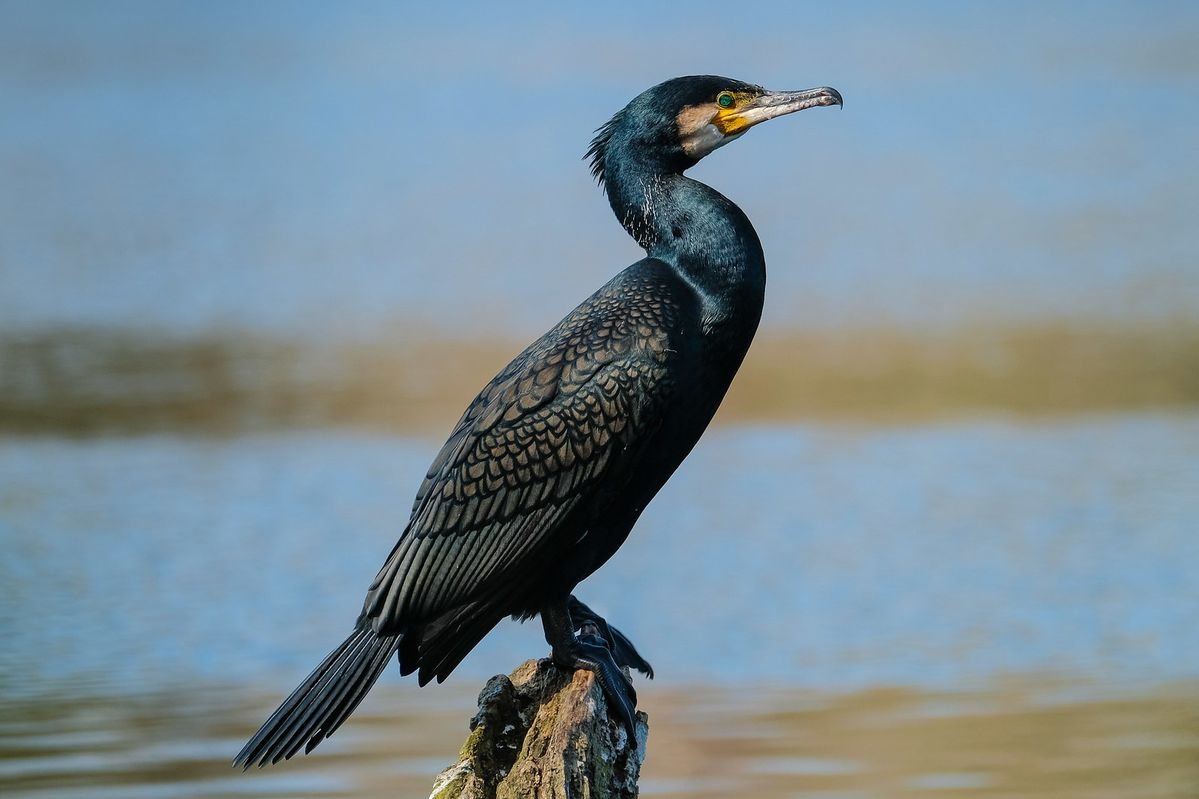
Great Cormorant
Phalacrocorax carboA powerful waterbird of African lakes, rivers and wetlands – a skilled diver built for catching fish.
The Great Cormorant (Phalacrocorax carbo) is a large member of the cormorant family, Phalacrocoracidae. Its long neck, heavy bill, dark glossy plumage and strong diving ability make it one of the most distinctive fish-eating waterbirds on Tanzanian lakes and wetlands. It forages underwater, then often rests with its wings spread to dry.
Great Cormorant Quick Facts
What Is the Great Cormorant?
The Great Cormorant (Phalacrocorax carbo) is a large fish-eating waterbird in the family Phalacrocoracidae and order Suliformes. It is widespread across parts of Africa, Europe and Asia and occurs in both freshwater and marine environments. In Tanzania, it is especially associated with productive lakes, rivers and other wetlands where fish are available.
Adults are powerful, long-bodied birds with a long thick neck, heavy greyish bill, dark legs and glossy black plumage with blue-green reflections. Breeding adults may show a white patch on the thigh and scattered white feathers on the head and neck. Juveniles are browner and often have much paler underparts.
The species is an adaptable cormorant that can use lakes, reservoirs, rivers, estuaries, lagoons and sheltered coastal waters. Its success comes from a combination of excellent underwater vision, powerful feet and a streamlined body that lets it pursue fish below the surface.
How to Identify a Great Cormorant
The Great Cormorant is easiest to recognize as a large, dark waterbird with a long neck, heavy bill, long tail and a habit of sitting upright with its body low in the water. After feeding, it commonly rests with its wings spread to dry its plumage.
- Size: A large cormorant, commonly around 80–100 cm long.
- Plumage: Adults are glossy black with blue-green or bronze reflections; juveniles are browner and paler below.
- Head and bill: The bill is long, strong and greyish, with pale facial and throat areas around the base.
- Breeding features: Adults may show a white thigh patch and scattered white feathers on the head and neck during breeding.
- Legs: Dark legs and feet provide the thrust used during underwater pursuit.
- Posture: Often sits upright on rocks, branches, posts or shorelines and may hold the wings open while drying.
Distinguishing from Other Cormorants
In Tanzania, the Great Cormorant can be separated from smaller cormorants by its larger size, heavier bill and bulkier head and neck. The Reed Cormorant is usually smaller and slimmer, while the African Darter has a much thinner snake-like neck and a pointed bill. Size and body shape are especially useful when the birds are seen at a distance.
Behavior & Social Life
Great Cormorants are strong swimmers and divers that may feed alone or in groups, depending on local fish abundance. They often gather at communal roosts and can be conspicuous when many birds return to the same shoreline, island or tree after feeding.
Daily Activity
- Diving and pursuit: It dives beneath the surface to chase and capture fish, often working close to the bottom in shallow to moderate water.
- Wing-spreading: Because cormorant plumage is less completely waterproof than that of many other waterbirds, birds frequently rest with wings outstretched to dry.
- Roosting: Individuals commonly return to regular resting and roosting places, sometimes gathering in sizeable groups.
Movement
The species is capable of migration in parts of its global range, especially where northern waters freeze. In warmer African regions, movements are often local or seasonal and are closely tied to water levels and food availability.
Habitat & Distribution
The Great Cormorant uses a remarkably broad range of aquatic habitats:
- Freshwater lakes: Large lakes, reservoirs and productive inland waters can provide excellent feeding and roosting sites.
- Rivers and wetlands: Slow-flowing rivers, marshes, deltas and floodplain wetlands may support feeding birds.
- Estuaries and lagoons: Where available, sheltered brackish and coastal waters offer rich fish resources.
- Sheltered coasts: The species also occurs in inshore marine waters and other coastal habitats across parts of its range.
Global distribution is extensive, spanning large parts of Europe, Asia, Africa and Australasia. In Tanzania, the species is documented from important waterbird areas including the Serengeti ecosystem, Ngorongoro Crater and Lake Manyara. A peer-reviewed Tanzanian study also records Phalacrocorax carbo from the Mwanza Gulf of Lake Victoria.
Tanzania Distribution
In Tanzania, Great Cormorants are most likely to be encountered where permanent or seasonal waters concentrate fish. Reliable records include Serengeti National Park, Ngorongoro Crater and Lake Manyara, with additional records around Lake Victoria. The bird can occur well beyond these sites whenever suitable aquatic habitat is available.
Great Cormorant in Tanzania
Tanzania offers excellent opportunities to encounter the Great Cormorant because its major lakes, crater waters and wetland systems provide the fish-rich habitat this species needs. These are useful safari and birding locations:
Serengeti National Park
Great Cormorants are listed on the Serengeti bird checklist and may be seen around suitable water bodies and wetlands within the ecosystem.
Serengeti safariNgorongoro Crater
The Ngorongoro Crater bird checklist records Great Cormorant, making the crater lakes and associated wetland habitat worthwhile for birders.
Ngorongoro safariLake Manyara National Park
Lake Manyara is a particularly important waterbird landscape, and its bird checklist includes Great Cormorant.
Lake Manyara safariLake Victoria – Mwanza Gulf
A Tanzanian scientific study documents Great Cormorant from the Mwanza Gulf of Lake Victoria, confirming its occurrence in northern Tanzania’s vast lake system.
Lake Victoria birdingSafari Methods
- Game drives – Check lakeshores, river margins and wetland viewpoints during wildlife drives where aquatic habitat is visible.
- Birdwatching – Scan exposed rocks, trees, islands and open water for upright cormorants, fishing dives and drying birds.
- Wildlife photography – Look for wing-spreading silhouettes, fishing dives and groups flying low over water.
Best Time to See Them
Great Cormorants can occur year-round where suitable water and fish remain available. Early morning and late afternoon are productive for observation because birds are often active around feeding areas while softer light can make their glossy plumage easier to appreciate.
Diet & Feeding
The Great Cormorant is primarily piscivorous: fish form the core of its diet, and the bird is equipped for underwater pursuit. It may also take amphibians, crustaceans and other aquatic prey when opportunities arise.
Food Sources
- Fish: The principal food, captured during underwater dives and usually swallowed at or near the surface.
- Amphibians: Frogs and other aquatic amphibians can supplement the diet in suitable wetland habitats.
- Crustaceans: Crabs, prawns and other crustaceans may be taken opportunistically.
- Other prey: Small aquatic animals, including nestling birds in some circumstances, may also be consumed.
Hunting Behavior
A Great Cormorant typically dives from the surface, propelling itself underwater with powerful webbed feet while steering with its body and tail. It often searches below the surface for fish, then returns to the surface to swallow its catch. In productive waters, several birds may feed in the same area and occasionally form fishing groups.
Breeding & Life Cycle
Great Cormorants commonly breed in colonies, sometimes alongside other waterbirds, and breeding timing varies with geography and local water conditions. Pairs may return to suitable nesting areas repeatedly when sites remain secure.
Nesting
- Nest: A platform of sticks is built in trees, on cliff ledges or on other suitable elevated or ground sites, depending on local habitat.
- Eggs: Usually 3–5 eggs are laid, with pale blue or greenish tones that may be covered by a chalky white layer.
- Incubation: Incubation lasts about one month, with both adults involved in the breeding cycle.
Chicks
Young hatch in the nest and are cared for by both parents. Fledging occurs at roughly 48–52 days in sources covering the species, but recently fledged birds can remain dependent on adults for additional weeks while developing feeding and flight skills.
Conservation Status
The Great Cormorant is currently assessed as Least Concern globally on the IUCN Red List.
Its very broad distribution and large global population support the current secure global assessment. Nevertheless, the species depends on healthy aquatic ecosystems, so local declines can occur where wetlands are degraded or fish resources are heavily altered.
Important local pressures can include:
- Wetland degradation Drainage, shoreline development, altered river flows and loss of roosting or nesting habitat can reduce suitable habitat.
- Pollution and disturbance Pollution, persistent fishing pressure and disturbance around nesting or roosting colonies can affect feeding and breeding success.
Comparisons
The Great Cormorant can be confused with other dark waterbirds, especially smaller cormorants and the African Darter. These features help separate them in the field:
| Feature | Great Cormorant | Reed Cormorant | African Darter |
|---|---|---|---|
| Size | Large; 80–100 cm | Smaller and slimmer | Smaller, slender-bodied |
| Wingspan | 121–160 cm | Typically shorter | Long-winged, different proportions |
| Bill | Heavy, powerful bill | More slender | Long, narrow pointed bill |
| Plumage | Glossy dark adult plumage; juveniles browner | Darker/slimmer overall | Dark upperparts with contrasting pale body pattern |
| Habitat | Freshwater, estuaries and coasts | Mostly freshwater wetlands | Freshwater lakes, rivers and wetlands |
| Feeding | Deep underwater dives for fish | Fish and aquatic prey | Often perches low and dives with body submerged |
Did You Know?
Wing-Spreading Dryer
Its plumage is not completely waterproof, so it often rests with wings spread wide after fishing.
Powerful Diver
Its webbed feet provide much of the underwater propulsion used to pursue fish.
Huge Range
The species occupies an enormous range across several continents and includes both freshwater and marine populations.
Communal Roosts
Large groups may gather at traditional roosts, creating dramatic lines of birds returning from feeding areas.
Fish Specialist
Fish make up the core of its diet, although amphibians, crustaceans and other aquatic prey may also be taken.
Tanzanian Record
Great Cormorants are documented in several Tanzanian bird checklists, including Serengeti, Ngorongoro and Lake Manyara.
There is something unmistakably prehistoric about a Great Cormorant rising from dark water with its long neck extended, then hauling itself onto a branch and opening both wings to the sun. On a Tanzanian lake, this is more than a striking birding moment: it is a glimpse into a highly specialized fishing lifestyle. Watch patiently and the pattern becomes clear—dive, surface, swallow, regroup, then return to the water.
Gallery
Frequently Asked Questions
The Great Cormorant (Phalacrocorax carbo) is a large fish-eating waterbird of the cormorant family, Phalacrocoracidae. It occurs in freshwater and marine wetlands and is a powerful underwater diver.
Tanzania records include Serengeti National Park, Ngorongoro Crater and Lake Manyara, with documented occurrence in the Mwanza Gulf of Lake Victoria as well.
It feeds mainly on fish and may also take amphibians, crustaceans and other aquatic prey opportunistically.
No. The Great Cormorant is currently assessed as Least Concern globally, although local wetland degradation, pollution and disturbance can still affect populations.
Look for a large dark cormorant with a long thick neck, heavy bill, long tail and glossy black plumage; breeding birds can show pale or white patches around the throat, head and thigh.
It commonly nests colonially. A clutch is usually about 3–5 eggs, with incubation lasting roughly a month; young fledge at around 48–52 days in sources covering the species.
Movement varies geographically. Northern populations can migrate, while birds in warmer regions often make local or seasonal movements linked to water and food availability.
Cormorant plumage is less completely waterproof than that of many other waterbirds, so the bird often spreads its wings to dry after diving and feeding.
References & Further Reading
- BirdLife International – Great Cormorant (Phalacrocorax carbo): global IUCN Least Concern assessment, identification, ecology and major threats.
- Cornell Lab of Ornithology – Great Cormorant: identification, habitat, food and life history.
- BTO BirdFacts – Cormorant (Phalacrocorax carbo): distribution, breeding ecology and population information.
- CIESM Seabird Guide – Great Cormorant: measurements, identification, diet, breeding and movement.
- Tanzania bird checklists – Serengeti National Park, Ngorongoro Crater and Lake Manyara: documented Tanzanian occurrence of Phalacrocorax carbo.
- Tanzania Journal of Science (2023) – documented occurrence of the Great Cormorant in Mwanza Gulf, Lake Victoria, Tanzania.
- IUCN SSC Cormorant Specialist Group – ecology and conservation context for cormorants and aquatic ecosystems.