

.png)
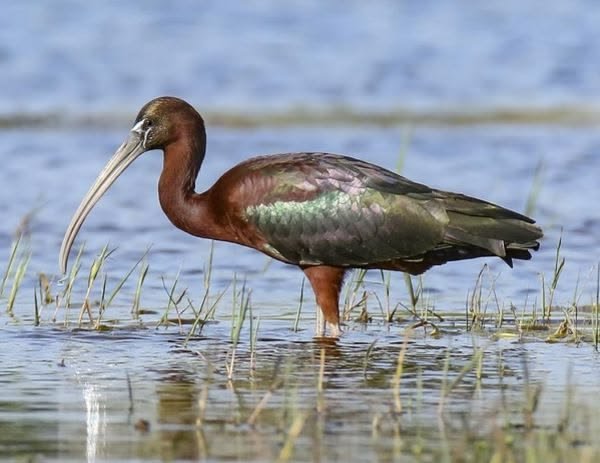
Glossy Ibis
Plegadis falcinellusA dark wetland ibis that flashes bronze, green and violet when sunlight reaches its feathers.
The Glossy Ibis (Plegadis falcinellus) is a medium-sized ibis in the family Threskiornithidae. Its long, slender, down-curved bill is built for probing soft mud and shallow water, while its dark plumage can shine with metallic green, bronze, purple and violet tones. It is found in marshes, floodplains, shallow lakes and wet agricultural landscapes, and populations can move widely in response to water and food.
Glossy Ibis Quick Facts
What Is the Glossy Ibis?
The Glossy Ibis (<em>Plegadis falcinellus</em>) is a medium-sized, long-legged wading bird in the ibis and spoonbill family Threskiornithidae. It is instantly recognizable by its long, slender bill that curves gently downward and its dark plumage, which can look almost black at a distance.
In good light, however, the apparently dark bird changes color. Breeding adults can show rich chestnut and maroon on the head and body, while the folded wings and back shimmer with green, bronze, purple and violet reflections. This iridescence is structural rather than a simple surface pigment effect, so the apparent color changes with viewing angle and light.
Glossy Ibis uses a wide range of wetlands across its huge distribution. It can feed in marshes, flooded grassland, rice fields and shallow lakes, probing soft ground for aquatic invertebrates and taking small fish, frogs and other prey when available. Tanzania lies within the species' African range and supports documented birds at major wetland and safari landscapes.
How to Identify a Glossy Ibis
The Glossy Ibis often looks nearly black until sunlight exposes its iridescent plumage. Its long curved bill, slim body and long legs are the key shape features.
- Plumage: dark reddish-brown to nearly black at a distance, with metallic green, bronze, purple and violet highlights in good light.
- Bill: long, slender and distinctly down-curved, usually dark brown to grey-black.
- Head and neck: relatively narrow, with fine pale streaking especially noticeable in non-breeding birds and juveniles.
- Legs: long and dark reddish-brown to grey-brown, suited to wading through shallow water and mud.
- Breeding adults: richer chestnut tones and stronger iridescence, with a narrow pale facial border around the bill.
- Juveniles: duller brown and less glossy, with finer streaking and a less vivid adult appearance.
Distinguishing from Other Ibises
Glossy Ibis is most easily separated from African Sacred Ibis and Hadada Ibis by its smaller, slimmer build, strongly curved bill and dark metallic plumage. The pale-faced appearance of some ibis species can be misleading, so the bill curve and overall body shape are particularly useful. It is also important not to confuse it with the very similar White-faced Ibis where the ranges or local identification context overlap; species-level identification should rely on the full suite of field marks.
Behavior & Social Life
Glossy Ibises are often social and may form flocks while feeding, roosting or moving between wetlands. Numbers can rise sharply at productive sites where shallow water exposes abundant invertebrates.
Daily Activity
- Foraging: probes mud and shallow water repeatedly with its curved bill, walking steadily as it searches.
- Flock feeding: may feed in loose lines or groups, especially when prey is concentrated.
- Roosting: gathers at communal roosts in reeds, trees or other secure wetland vegetation.
Movement & Migration
Glossy Ibis is a partial migrant with several movement strategies. Some populations are resident, while others move seasonally or disperse widely after breeding. Movements can be especially strong when rainfall changes the distribution of shallow wetlands and food. African populations therefore should not all be described as following one fixed migration route.
Habitat & Distribution
The Glossy Ibis favors shallow, productive wetlands where its long bill can reach prey in mud, soft sediment or low vegetation. It is flexible enough to use natural and agricultural wetlands.
- Freshwater marshes with shallow pools, sedges and muddy edges.
- Floodplains and seasonally flooded grassland where receding water concentrates prey.
- Shallow lakes and lagoons with soft margins and exposed feeding areas.
- Wet agricultural fields, including rice-growing areas, where suitable prey and water remain available.
The species occurs across a vast Old World and New World range, with breeding populations in parts of Europe, Africa, Asia and the Americas. It is one of the world's most widely distributed ibises and can disperse far beyond breeding areas.
Tanzania Distribution
Tanzania records include Lake Manyara, Ngorongoro Conservation Area, Ndutu and other northern Tanzania wetland habitats, while regional bird lists also include Glossy Ibis for Ruaha, Tarangire, Serengeti and Rubondo.
Glossy Ibis in Tanzania
Tanzania is an excellent setting for Glossy Ibis because its safari circuit contains shallow lakes, seasonal wetlands, floodplains and crater wetlands. Documented sightings include Lake Manyara, Ngorongoro and Ndutu, while broader Tanzania bird lists record the species at Ruaha, Tarangire, Serengeti and Rubondo.
Safari Methods
A long-standing Tanzania birding location for Glossy Ibis, with documented sightings on the lake and wetland margins.
Lake Manyara safariBest Time to See Them
The species can occur throughout the year in Tanzania's suitable wetlands, but sightings are strongly affected by water level and rainfall. During wet periods and when shallow feeding habitat expands, local numbers can increase. Early morning and late afternoon often provide the best light for seeing iridescence.
Ngorongoro safariNdutu & Serengeti
Seasonal plains and wetland pockets attract Glossy Ibis, and birding tour reports document birds at Ndutu and in Serengeti.
Serengeti safariRuaha, Tarangire & Rubondo
Regional East Africa bird lists record Glossy Ibis at Ruaha, Tarangire and Rubondo, showing the species' wider Tanzanian reach.
Plan Tanzania birdingSafari Methods
- Game drives: pause at lakes and shallow wetland edges, especially where receding water exposes muddy feeding ground.
- Birdwatching: scan both shoreline and open water because flocks can move between feeding patches quickly.
- Photography: side light is ideal for revealing the metallic green, bronze and purple colors that disappear in flat light.
Best Time to See Them
Glossy Ibiss are present year-round in suitable habitat. They are most active during the cooler morning and evening hours .
Diet & Feeding
Glossy Ibis feeds mainly by probing shallow water, mud and soft wet ground. It is an opportunist whose prey list changes with wetland conditions.
Food Sources
- Aquatic invertebrates: insects, larvae, worms, crustaceans and other small invertebrates.
- Small fish: taken in shallow pools and flooded margins.
- Amphibians: frogs and tadpoles can become important where wetlands are productive.
- Other small prey: molluscs, small reptiles and seeds may be taken opportunistically.
Foraging Technique
The bill is used like a sensitive probe. The bird pushes it into mud or shallow water, feeling for hidden prey rather than relying entirely on sight. Repeated probing lets the bird work a feeding patch systematically. When a flock is feeding, individuals may move steadily through the same shallow area, continually searching newly disturbed sediment.
Breeding & Life Cycle
Glossy Ibises generally breed colonially in wetland landscapes. They often nest with other ibises, herons and wetland birds where suitable vegetation and food are available.
Nesting
- Nest: a platform of reeds, sticks and wetland vegetation, usually placed over or close to water.
- Eggs: commonly several blue-green eggs, often around 3-5 per clutch.
- Incubation: roughly three weeks, with both parents involved in incubation and nest defense.
Chicks
Young hatch dependent on the adults and are fed at the nest until they can move confidently through vegetation and later fly. Breeding success is closely tied to food availability and the persistence of suitable wetland nesting sites.
Conservation Status
Glossy Ibis is currently assessed globally as <strong>Least Concern (LC)</strong>. The species has a very large global distribution and remains widespread, including across Africa and Eurasia.
Despite the secure global category, wetland birds remain sensitive to local habitat change. Loss or degradation of marshes, water pollution, altered hydrology and disturbance at colonies can reduce habitat quality in particular areas.
Important conservation considerations include:
- Wetland conversion: drainage and development can remove shallow feeding habitat.
- Pollution and pesticide pressure: can affect aquatic prey communities and wetland health.
Comparisons
Glossy Ibis shares Tanzania's wetlands with several dark or long-billed ibis species. Bill shape and body profile are the quickest field clues.
| Feature | Glossy Ibis | African Sacred Ibis | Hadada Ibis |
|---|---|---|---|
| Size | Medium, slim | Larger, heavier | Large, robust |
| Bill | Long, slender, strongly down-curved | Long, broader and less strongly curved | Long, strongly curved but thicker |
| Plumage | Dark chestnut with metallic green/bronze/purple sheen | Mostly white body with black flight feathers | Grey-brown |
| Habitat | Marshes, shallow wetlands, floodplains | Wetlands, grassland and open country | Woodland, grassland, gardens and wet areas |
| Feeding style | Probing soft mud and shallow water | Probing soil and wet ground; broad diet | Probing and foraging in moist ground |
| Best clue | Iridescent dark body + slender curved bill | White-and-black body pattern | Larger brown-grey body and loud calls |
Did You Know?
Metallic Feathers
The dark plumage can flash green, bronze, purple and violet depending on the angle of sunlight.
Sickle-shaped Bill
The scientific name refers to the sickle-like curve of the bill, a useful tool for probing soft wetland sediment.
Looks Almost Black
At a distance or in flat light, a Glossy Ibis can appear nearly black; iridescence is easiest to see in side light.
Worldwide Ibis
It has one of the broadest distributions of any ibis, occurring across multiple continents.
Wetland Nomad
Some populations are resident while others migrate or disperse widely after breeding in response to food and water.
Tanzania Record
Birding reports and regional checklists document Glossy Ibis at Lake Manyara, Ngorongoro, Ndutu, Serengeti, Ruaha, Tarangire and Rubondo.
In dull light, a Glossy Ibis can pass as a dark shape at the edge of a marsh. Then the sun breaks through and the bird seems to change species—bronze across the shoulder, green across the wing, violet along the back. It bends its long bill into the mud and continues feeding as if nothing unusual has happened. That quiet contrast is part of what makes the bird special: an expert wetland forager whose colors are revealed only when the landscape gives them back.
Gallery
Frequently Asked Questions
The scientific name is Plegadis falcinellus, a member of the family Threskiornithidae.
Look for a medium-sized dark ibis with a long slender down-curved bill and, in good light, metallic green, bronze, purple and violet plumage.
It mainly eats aquatic invertebrates but also takes small fish, frogs, insects, molluscs and other small prey, with seeds occasionally included.
Documented Tanzania sightings include Lake Manyara, Ngorongoro and Ndutu, while regional bird lists also include Ruaha, Tarangire, Serengeti and Rubondo.
Movement varies by population. Some populations are resident while others migrate seasonally or disperse widely after breeding.
It favors marshes, floodplains, shallow lakes, swamps, wet grassland and other shallow wetlands, and can use wet agricultural fields.
The species breeds colonially in suitable wetlands across its range. Tanzania is also an important area for non-breeding and seasonal occurrence, and exact local breeding status varies by site.
Its dark feathers have strong structural iridescence, so different wavelengths of light are reflected at different viewing angles.
References & Further Reading
- Cornell Lab of Ornithology – Glossy Ibis: identification, habitat, diet, behavior and distribution.
- British Trust for Ornithology – Glossy Ibis: taxonomy, current global status and European occurrence information.
- BirdLife International / IUCN-linked resources: global conservation assessment and species framework.
- BirdLife Africa regional resources: African occurrence, wetland ecology and conservation context.
- Tanzania birding trip reports: documented Glossy Ibis records from Lake Manyara, Ngorongoro and Ndutu.
- East Africa bird lists: regional records for Ruaha, Tarangire, Serengeti and Rubondo.
- Modern Tanzania field records: support the species' presence in major northern and western wetland landscapes.