

.png)
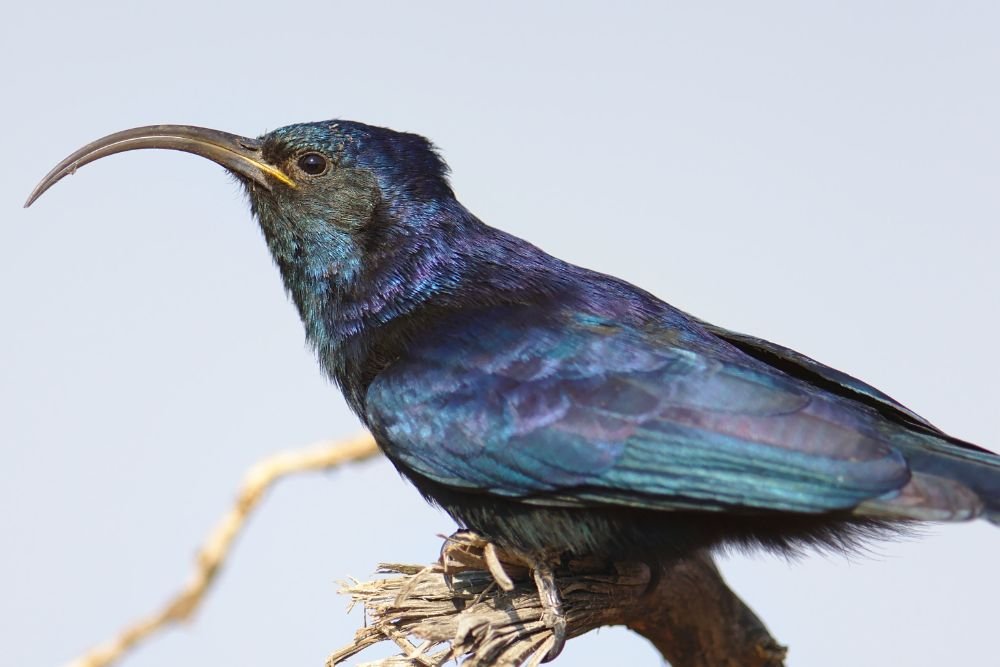
Common Scimitarbill
Rhinopomastus cyanomelasA sleek woodland bird with a scimitar-shaped bill, probing bark and branches for hidden insects.
The Common Scimitarbill (Rhinopomastus cyanomelas) is a small African woodland bird in the family Phoeniculidae. Its deeply curved black bill, graduated tail and dark blue-green plumage are adapted to a life of climbing, probing and picking in trees. It is a resident of dry woodland and thornveld and is regularly encountered in suitable habitats across Tanzania.
Common Scimitarbill Quick Facts
What Is the Common Scimitarbill?
The Common Scimitarbill (Rhinopomastus cyanomelas) is a small, distinctive woodland bird of the family Phoeniculidae. It is recognized by its long, graduated tail, dark blue-green plumage and unusually deep, down-curved black bill.
Its bill is a specialized tool for working along branches, bark and crevices where insects and other small invertebrates shelter. Unlike the more familiar hoopoes, scimitarbills spend much of their time climbing through trees and probing rather than feeding on open ground.
This eagle is a common and widespread resident of wooded habitats across much of sub-Saharan Africa, from Senegal to Ethiopia and south to South Africa .
How to Identify a Common Scimitarbill
The Common Scimitarbill is easier to identify once its silhouette is familiar: a slim dark bird, long stepped tail and a conspicuously curved black bill.
- Bill: Long, strongly decurved black bill used to probe bark and crevices for insects.
- Plumage: Glossy dark blue-green to blackish upperparts with softer brown tones in females and immature birds.
- Tail: Long, graduated tail that gives the bird a distinctive narrow silhouette when moving between branches.
- Eyes: Dark eye set against the deep, glossy facial plumage.
- Legs: Short, dark legs suited to clambering along branches and tree trunks.
- Shape: Slim woodland profile, often seen moving actively through outer branches.
Distinguishing from Other Scimitarbills
In Tanzania it can be separated from the Abyssinian Scimitarbill by its generally larger size, shorter black bill, black legs and prominent white wing patch. It may also be separated from woodhoopoes by its much more strongly curved bill and shorter, slimmer profile.
Behavior & Social Life
Common Scimitarbills are active, agile woodland birds. They often occur alone or in pairs, clambering through branches and outer foliage while methodically inspecting bark and twigs.
Daily Activity
- Foraging: Moves deliberately along branches and trunks, probing cracks and bark surfaces for insects and larvae.
- Movement: Clambers and hops through the canopy and mid-storey rather than spending long periods on the ground.
- Vocalization: Gives a repeated, rhythmic call that can reveal a bird hidden among foliage.
Migration
It is a non-migratory resident across its African range, with local movements reflecting food availability and habitat conditions rather than long-distance seasonal migration.
Habitat & Distribution
The Common Scimitarbill is associated with semi-open woodland habitats where mature trees provide bark, crevices and branching structure for feeding.
- Woodland Dry broad-leaved woodland and thornveld.
- Open woodland Mosaics of trees and grassy or shrubby ground.
- Riverine edges Wooded edges where insect prey and mature trees are available.
- Bushveld Dry scrub and savanna with enough tree cover for nesting and foraging.
The species occupies a broad Afrotropical range across eastern and southern Africa. It is generally associated with lowland and submontane woodland, with altitude varying across its range.
Tanzania Distribution
In Tanzania, documented records include Simanjiro, Suledo Forest, Emayani and Pemba Abwe, with additional records from Selous and the Coast Region. These observations fit its preference for mature dry woodland and thornveld habitats.
Common Scimitarbill in Tanzania
For Tanzania birding, the best strategy is to focus on dry woodland and thornveld landscapes where mature trees support the Common Scimitarbill’s bark-probing feeding style.
Birding Methods
Documented Common Scimitarbills have been photographed in Simanjiro, making the area a useful northern Tanzania woodland locality.
Tarangire safariBest Time to See Them
Common Scimitarbills are resident, so they may be encountered year-round in suitable Tanzanian woodland. Early morning is especially productive because birds are active and calling before the heat builds.
Mkomazi safariEmayani
Tanzanian records include Emayani, where the species can be sought in suitable wooded habitat.
Wildlife guidePemba Abwe
Pemba Abwe is another documented Tanzanian locality for this distinctive scimitarbill.
Birding guideSafari Methods
- Game drives Scan dry woodland edges and mature trees, especially where birds are active in the morning.
- Birdwatching Listen first, then search trunks and outer branches for a moving slim silhouette.
- Wildlife photography A long lens helps reveal the curved bill and glossy plumage when the bird stays high in a tree.
Best Time to See Them
Common Scimitarbills are present year-round in suitable habitat. They are most active during the cooler morning and evening hours .
Diet & Feeding
The Common Scimitarbill is primarily an insect-eating bird, using its long curved bill to extract small prey from bark, cracks and foliage.
Food Sources
- Insects: Beetles, caterpillars, ants and other small insects.
- Larvae: Soft-bodied larvae and other arthropods concealed in bark and plant material.
- Spiders: Occasionally taken while searching dense vegetation.
- Other invertebrates: Small invertebrates encountered during systematic probing of trees.
Foraging Behavior
Rather than hammering into wood, it probes with the curved tip of the bill, working along trunks, branches and leaf clusters. This specialized feeding style lets it exploit insects that are difficult for many other woodland birds to reach.
Breeding & Life Cycle
Common Scimitarbills nest in tree cavities, usually using naturally occurring holes or old cavities rather than excavating a new nest chamber themselves.
Nesting
- Nest: Tree cavity lined with plant material or other debris, depending on the site.
- Eggs: Typically about 3 eggs.
- Incubation: Roughly 16–18 days, with incubation concentrated around the nest cavity.
Chicks
Young remain in the cavity through the early nestling period and are fed by adults until they are ready to leave and follow the parents through the woodland.
Conservation Status
The Common Scimitarbill (Rhinopomastus cyanomelas) is currently assessed as Least Concern.
Its broad distribution and ability to use a range of woodland and thornveld habitats help keep the global species outside the threatened categories. Local habitat changes can still affect individual populations where mature woodland is removed.
The main conservation considerations are habitat loss and degradation, especially where dry woodland is cleared or simplified.
- Habitat loss Clearing of dry woodland, thornveld and mature trees reduces feeding and nesting opportunities.
- Habitat degradation Removal of mature trees and simplification of woodland structure can reduce suitable foraging sites.
Comparisons
The Common Scimitarbill can be confused with other bark-foraging woodland birds. Its strongly curved black bill and long graduated tail are the most useful clues.
| Feature | Common Scimitarbill | Abyssinian Scimitarbill | Common Scimitarbill vs Woodhoopoe |
|---|---|---|---|
| Size | 24–28 cm | Smaller, usually 20–22 cm | Similar overall length in some species |
| Bill | Shorter, strongly curved black bill | Longer, more tapered bill | Scimitarbill bill is much more strongly decurved |
| Wing patch | White wing patch visible in flight | Less prominent | Varies by species |
| Plumage | Dark blue-green to blackish | Darker, brownish tones may show | Woodhoopoes often show different tail/wing patterns |
| Habitat | Dry woodland and thornveld | Woodland and bush | Both use trees, but species preferences differ |
| Diet | Mostly insects and other invertebrates | Mostly arthropods | Both probe bark and branches |
Did You Know?
Scimitar Bill
Its deeply curved black bill is a precision tool for probing bark and narrow crevices.
Tree Specialist
It spends much of its time climbing among branches rather than feeding on open ground.
Glossy Plumage
The dark blue-green sheen can flash as the bird moves between leaves and branches.
Resident Bird
It is a resident rather than a long-distance migrant across its African range.
Insect Hunter
Beetles, larvae, caterpillars and other arthropods make up much of its diet.
Woodland Sentinel
Its repeated calls can reveal its presence even when dense foliage hides the bird.
There is a quiet precision to the Common Scimitarbill. It moves through woodland like a small climbing specialist, using a remarkable curved bill to inspect bark and branches for hidden life. In a Tanzanian woodland, a sudden call followed by a glimpse of its dark glossy body and long tail can turn an ordinary game drive into a memorable birding moment.
Gallery
Frequently Asked Questions
The Common Scimitarbill (Rhinopomastus cyanomelas) is a small woodland bird in the family Phoeniculidae, recognized by its strongly curved black bill and long graduated tail.
Documented Tanzanian localities include Simanjiro, Suledo Forest, Emayani and Pemba Abwe, with additional records from Selous and the Coast Region.
It feeds mainly on insects and other invertebrates, which it probes from bark, branches and foliage.
No. The species is currently assessed as Least Concern, although local habitat loss can reduce suitable woodland.
Look for the strongly curved black bill, dark blue-green plumage, long graduated tail and active climbing movements through woodland.
It nests in tree cavities, typically laying about three eggs; incubation is roughly 16–18 days.
Yes. The Common Scimitarbill is generally a resident species, with local movements rather than long-distance migration.
It is generally larger, with a shorter black bill, black legs and a noticeable white wing patch compared with the Abyssinian Scimitarbill.
References & Further Reading
- Tanzanian Birds & Butterflies – Common Scimitarbill records from Simanjiro, Suledo Forest, Emayani and Pemba Abwe.
- ITIS – Taxonomic record for Rhinopomastus cyanomelas and accepted English common name.
- Oiseaux.net – Common Scimitarbill: classification, ecology, diet, breeding and conservation summary.
- World Bird Names – Common Scimitarbill taxonomy and Least Concern status.
- BirdLife International – Bird taxonomy framework and current checklist methodology.
- eBird / Macaulay Library – Observation and media records for Common Scimitarbill in East Africa.
- African Majestic Adventure – Tanzania birding guide context for observing Common Scimitarbill.