

.png)
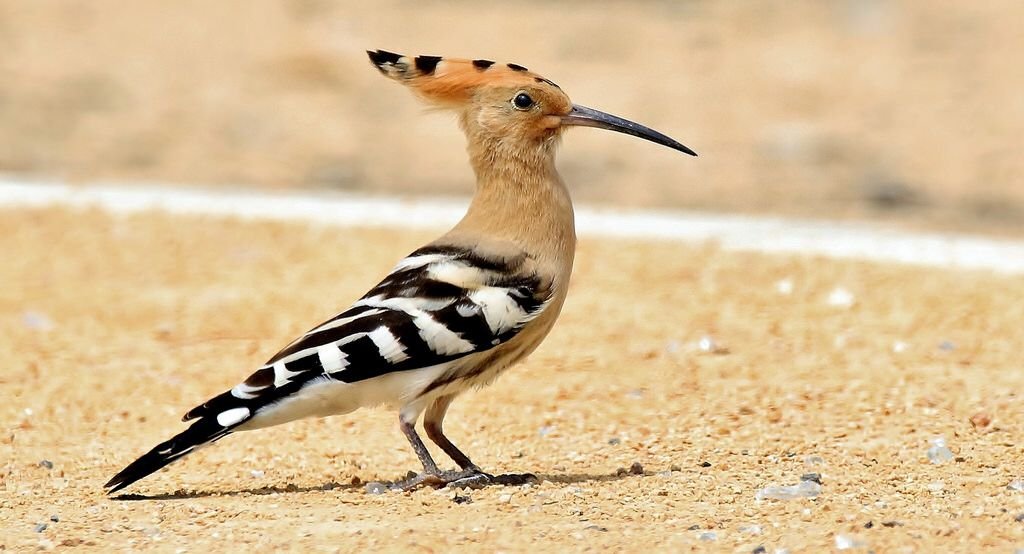
African Hoopoe
Upupa africanaA striking crested ground-forager whose long bill probes soil and leaf litter for hidden prey.
The African Hoopoe (Upupa africana) is a medium-sized member of the hoopoe family Upupidae. It is recognized by its orange-brown body, dramatic black-and-white wings and tail, erectile crest, and long down-curved bill used to probe soil and leaf litter. In Tanzania it is a familiar bird of open woodland, savanna, grassland edges, gardens and other habitats with suitable feeding ground.
African HoopoeQuick Facts
What Is the African Hoopoe?
The African Hoopoe (Upupa africana) is a distinctive African hoopoe in the family Upupidae. Its raised crest, warm orange-brown body, barred black-and-white wings and long curved bill make it one of the easiest open-country birds to recognize.
The African form is commonly treated as a species separate from the Eurasian Hoopoe by modern African bird references, although some global taxonomies have historically grouped African and Eurasian hoopoes together. Taxonomic lists are periodically revised, so the page follows the African treatment used by Tanzanian birding references.
Unlike a bird that depends on dense forest, it thrives where bare or lightly vegetated ground is available for probing. It is often encountered alone or in pairs, walking deliberately while listening and searching for prey beneath the surface.
How to Identify a African Hoopoe
The African Hoopoe is unmistakable once the crest, bill and wing pattern are seen together.
- Crest: A long fan of orange-brown feathers with black tips, raised when the bird is alert or displaying.
- Plumage: Warm cinnamon to orange-brown body plumage with bold black-and-white barring across the folded wings and tail.
- Bill: Long, narrow and strongly down-curved, ideal for probing soil and leaf litter.
- Head: Pale orange-brown face with a conspicuous crest and dark eye.
- Flight: Deep, irregular wingbeats create a characteristic undulating flight pattern.
- Legs: Strong legs suited to walking and probing on the ground.
Distinguishing from Other Hoopoes
The African Hoopoe is more strongly associated with sub-Saharan Africa than the Eurasian Hoopoe and is best separated by geography, habitat and the African taxonomic treatment used by local checklists.
Behavior & Social Life
African Hoopoes are mainly solitary or seen in pairs. They walk confidently over open ground, pause to listen, and repeatedly probe the soil with the bill before moving to another feeding patch.
Daily Activity
- Foraging: Walks slowly across open ground and probes soil, dung-rich ground and leaf litter for hidden prey.
- Display: Raises the crest when excited, alarmed or interacting with another bird.
- Vocalization: The familiar call is a soft, repeated “hoo-poo-poo” style phrase, especially associated with breeding and territorial contexts.
Movement
In Tanzania the species is generally resident, although local movements can occur as birds track food, rainfall and suitable ground conditions.
Habitat & Distribution
African Hoopoes occupy a broad range of open and semi-open habitats where they can hunt on the ground:
- Open savanna and lightly wooded grassland.
- Dry woodland edges, bushland and scrub.
- Cultivated landscapes, gardens and settled areas with open soil.
- Parkland, river valleys and other mosaics with feeding sites and scattered trees.
Distribution: The African form is widespread across sub-equatorial Africa, with a large range extending through much of eastern and southern Africa.
Tanzania Distribution
In Tanzania, documented records include Oldonyo Sambu, Yaida Valley, Engikaret, Ngorongoro Crater, Tarangire and Mikumi, reflecting its ability to use both protected landscapes and human-modified open habitats.
African Hoopoe in Tanzania
The African Hoopoe is a familiar Tanzanian bird in open woodland, savanna and settled landscapes. These documented areas are strong places to watch for it.
Ngorongoro Crater
Open crater grasslands, woodland edges and roadside ground can produce close views.
Ngorongoro Crater safariTarangire National Park
Dry savanna, scattered trees and open clearings provide excellent feeding habitat.
Tarangire National Park safariMikumi National Park
Open grasslands and woodland mosaics suit its ground-foraging lifestyle.
Mikumi National Park safariArusha National Park
Open forest and grassland edges can support hoopoes alongside other woodland birds.
Arusha National Park safariSafari Methods
- Game drives: scan open ground, road verges and short grass for walking hoopoes.
- Birdwatching: listen for the soft repeated call and watch for the raised crest.
- Wildlife photography: early light is especially good for the contrasting crest and barred wings.
Best Time to See Them
Best viewing is often during the cooler morning and late-afternoon periods when birds are active on the ground; the species may be encountered year-round in suitable Tanzanian habitat.
Diet & Feeding
The African Hoopoe is primarily an insectivore and ground forager, using its long bill to uncover prey that would be difficult for a short-billed bird to reach.
Food Sources
- Insects: beetles, grasshoppers, crickets and other adult insects.
- Larvae: caterpillars and other soft-bodied larvae found in soil and litter.
- Other invertebrates: worms, grubs and similar prey.
- Occasional small prey: small reptiles and other tiny animals may be taken opportunistically.
Foraging Behavior
It probes and pries at the ground, then uses the bill to manipulate prey before swallowing. This feeding strategy makes open patches of soft soil and short vegetation particularly valuable.
Breeding & Life Cycle
African Hoopoes nest in cavities and crevices, including holes in trees, walls and other suitable structures. The pair typically uses a concealed cavity that provides protection for the eggs and young.
Nesting
- Nest: A natural tree cavity or other enclosed hole, often with little or no nest material.
- Eggs: Usually 4–7 eggs laid at intervals.
- Incubation: About 15–16 days, with the female spending much of the incubation period in the cavity while the male supplies food.
Chicks
Young remain in the cavity for roughly 26–32 days before fledging. The adults continue feeding and guiding the young after they leave the nest, allowing them to gain feeding and predator-avoidance skills.
Conservation Status
The African Hoopoe is currently treated as Least Concern in the African bird references used for this page.
Its broad distribution and ability to use a wide range of open habitats help buffer it against regional declines, although habitat quality still matters because it depends on accessible ground for feeding and suitable cavities for nesting.
Local pressures can include:
- Intensive removal of old trees and loss of natural nesting cavities.
- Pesticide use that can reduce the abundance of large terrestrial insects.
Comparisons
African Hoopoes can be confused with other hoopoes or with unrelated brown-and-white ground birds at a distance. The combination of crest, long curved bill and barred wings is distinctive.
| Feature | African Hoopoe | Eurasian Hoopoe | Green Woodhoopoe |
|---|---|---|---|
| Size | 26–32 cm | 25–29 cm | 33–40 cm |
| Crest | Large erectile crest | Large erectile crest | No similar fan crest |
| Bill | Long, strongly down-curved | Long, down-curved | Long, slender and straighter |
| Plumage | Orange-brown with bold black-white wings | Orange-brown with bold black-white wings | Dark glossy green/purple |
| Habitat | Open woodland, savanna, gardens | Open woodland, farmland, woodland edges | Woodland and forest |
| Diet | Mostly insects and other invertebrates | Mostly insects and other invertebrates | Insects and fruit |
Did You Know?
Famous Crest
Its tall fan-shaped crest can be folded down and raised dramatically when the bird is excited or alert.
Living Pleistocene Relic
Hoopoes belong to an ancient bird lineage, and their distinctive body plan is unlike most African passerines.
Ground Forager
The long bill is used like a probe, helping the bird find insects and larvae hidden below the surface.
Powerful Nest Strategy
A sealed tree cavity can help protect eggs and nestlings from many ground predators.
Not a Hornbill
Despite sharing the word “hoopoe” with no other group, hoopoes are in their own family, Upupidae.
Tanzania Wide-ranging
Tanzanian records span dry savanna, crater landscapes, woodland edges and cultivated areas.
There is something unmistakable about seeing an African Hoopoe walking across open ground, crest folded, then suddenly fanning that crown of feathers as it becomes alert. Its long bill turns ordinary soil into a hidden pantry, linking the bird directly to the health of the small invertebrate world beneath our feet.
Gallery
Frequently Asked Questions
The African Hoopoe (Upupa africana) is a distinctive African hoopoe of the family Upupidae, recognized by its erectile crest, long curved bill and black-and-white barred wings.
Documented Tanzanian records include Oldonyo Sambu, Yaida Valley, Engikaret, Ngorongoro Crater, Tarangire and Mikumi.
It mainly eats insects and other invertebrates such as beetles, grasshoppers, larvae, worms and grubs, found by probing soil and leaf litter.
It is treated as Least Concern in the African references used for this page; its wide distribution and flexible habitat use support that status.
The crest is made of long feathers tipped with black and white. It can be raised into a fan when the bird is excited, alert or displaying.
It nests in enclosed cavities and typically lays about 4–7 eggs. Incubation lasts roughly 15–16 days, with young remaining in the nest around 26–32 days.
Look for the orange-brown body, erectile crest, long down-curved bill, black-and-white barred wings and distinctive undulating flight.
Yes. The African form is generally resident in suitable sub-Saharan habitats, although local movements occur as food and rainfall conditions change.
References & Further Reading
- BirdLife International – Taxonomy and Red List framework for African Hoopoes and treatment of African bird taxa.
- Tanzanian Birds & Butterflies – African Hoopoe: Tanzania photographs and records from Oldonyo Sambu, Yaida Valley, Engikaret, Ngorongoro, Tarangire and Mikumi.
- Wildlife Vagabond – African Hoopoe: feeding, cavity nesting, incubation and fledging notes.
- BirdLife / IUCN Red List resources – global conservation-status framework for birds.
- Current African birding references – identification, habitat, diet, calls and behaviour of Upupa africana.
- Tanzania national and regional bird checklists – distribution and occurrence in Tanzanian landscapes.
- Field ornithology references – breeding ecology, cavity nesting and seasonal activity of hoopoes.