

.png)
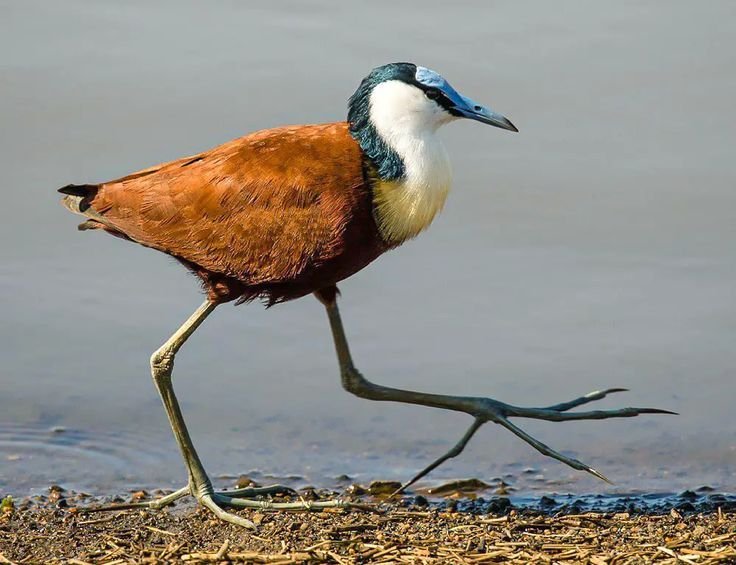
African Jacana
Actophilornis africanusA remarkable wetland wader that walks across floating leaves with extraordinary long toes.
The African Jacana (Actophilornis africanus) is a striking African waterbird in the family Jacanidae. Its oversized toes and claws distribute its weight across floating vegetation, allowing it to forage over lily pads and other aquatic plants.
African Jacana Quick Facts
What Is the African Jacana?
The African Jacana is one of Africa's most distinctive freshwater waders, recognized by its chestnut-and-black plumage, blue facial shield and extraordinarily long toes.
Rather than relying on firm ground, it forages over floating plants in shallow wetlands. The bird's widely spread toes act like natural snowshoes, distributing its weight across leaves and stems and helping it reach insects and other small prey.
Across Tanzania, African Jacana is closely associated with freshwater lakes, ponds, marshes and vegetated wetland margins. Its presence is therefore a useful reminder that healthy shallow wetlands support specialized wildlife as well as large, visible safari animals.
How to Identify an African Jacana
The adult African Jacana is unmistakable once its proportions and colour pattern are noticed. The combination of a blue facial shield, long toes and warm chestnut body makes it one of the easiest jacanas to recognize in Tanzania.
- Facial shield: Bright sky-blue shield and bill form a striking mask around the face.
- Head and neck: Crown, sides of the face and hindneck are predominantly black.
- Breast and body: White throat transitions into golden-yellow and rich chestnut tones across the breast and upperparts.
- Wings: In flight, darker maroon and black flight feathers contrast with the body.
- Legs and toes: Extremely long toes and claws are the signature adaptation for walking on floating plants.
- Juveniles: Young birds are browner and duller, with a less vivid facial shield and a paler underpart pattern.
Distinguishing from Other Wetland Birds
It can be confused at a distance with other wetland birds such as the Purple Swamphen or smaller jacanas. The African Jacana's very long toes, larger body and characteristic black, white and chestnut pattern provide the strongest identification clues.
Behavior & Social Life
The African Jacana is a highly specialized wetland forager. It spends much of its time walking carefully across floating leaves, stems and mats of aquatic vegetation while probing for prey. It is mostly active during daylight, with deliberate high-stepping movements across floating plants and short flights between feeding patches.
Daily Activity
- Foraging: Walks across floating vegetation and picks prey from leaves, stems and shallow water.
- Water crossing: Uses broad, splayed toes to spread its weight and remain supported on floating plants.
- Vocalization: Uses calls and display behaviour around mates, breeding territories and potential threats.
Movement
The species is generally resident within suitable wetland landscapes rather than a long-distance migrant. Local movements can occur when water levels, vegetation and food availability change, allowing birds to track productive wetlands.
Habitat & Distribution
The African Jacana is strongly tied to shallow freshwater wetlands with abundant floating or emergent vegetation. It occurs around lakes, ponds, marshes, floodplain wetlands and other calm waters where floating plants provide both food and a platform for movement.
- Freshwater lakes: Shallow margins with floating plants are particularly productive.
- Marshes and ponds: Dense emergent and floating vegetation provides feeding and nesting opportunities.
- Floodplains: Seasonal wetlands can become important feeding areas when water spreads across low-lying ground.
- Artificial wetlands: The species can use suitable human-created ponds and dams where vegetation and water quality remain adequate.
Its range spans much of sub-Saharan Africa. The species is widespread but is naturally less likely in extensive forest belts and truly arid landscapes where suitable freshwater vegetation is scarce.
Tanzania Distribution
In Tanzania, documented records include Lake Manyara, Tarangire, TPC-Moshi, Selous, Burigi-Chato and other wetland locations. These records highlight the species' association with freshwater habitats from northern safari country to larger southern and western wetland systems.
African Jacana in Tanzania
Tanzania offers excellent opportunities to encounter African Jacanas wherever shallow freshwater wetlands support floating vegetation. Documented records and photographs confirm the species from several important birding and safari landscapes.
Lake Manyara National Park
A strong wetland location where African Jacanas have been photographed around the lake and its vegetated margins.
Lake Manyara safariTarangire National Park
African Jacanas have been photographed here, including breeding birds, showing that suitable wetland habitats can occur within an otherwise savanna-dominated park.
Tarangire safariBurigi-Chato National Park
Documented photographs from this western Tanzanian park add another confirmed location for this wetland specialist.
Burigi-Chato safariSelous Game Reserve
Records and photographs from the Selous landscape show the species using productive freshwater habitats in southern Tanzania.
Selous safariSafari Methods
- Game drives through woodland and savanna habitats. and water-edge searches through park habitats where suitable wetlands occur.
- Birdwatching – watch for perched birds and soaring during the day . – look for birds standing on lily pads and floating mats, especially near open shallows.
- Wildlife photography – the long crest makes it a striking subject. – the long toes, blue facial shield and chestnut plumage create strong identification details.
Best Time to See Them
The species is resident where habitat remains suitable, but wetland conditions influence local visibility. Early morning is especially rewarding for birders because activity is often high and surface conditions are calmer.
Diet & Feeding
The African Jacana is an opportunistic wetland feeder, taking mostly small aquatic and terrestrial invertebrates but also seeds and occasional small vertebrate prey.
Food Sources
- Insect larvae: A major food source gathered from floating and emergent vegetation.
- Crustaceans: Small aquatic crustaceans are picked from shallow wetland habitats.
- Mollusks: Small snails and other soft-bodied aquatic invertebrates may be eaten.
- Other prey and seeds: Occasional small fish and other tiny prey are supplemented by seeds and plant material.
Foraging Behavior
Its diet commonly includes insect larvae and adults, small crustaceans, mollusks and other invertebrates found on floating vegetation and in shallow water. Small fish and other tiny aquatic prey may also be taken, along with plant material and seeds. The bird searches methodically as it walks over vegetation, picking prey from leaves and stems or probing around shallow water.
Breeding & Life Cycle
The African Jacana has one of the most unusual breeding systems among African waterbirds. Females are larger than males and may mate with multiple males, creating a polyandrous system in which males provide most direct care for eggs and young.
Nesting
- Breeding system: Polyandrous; females may mate with multiple males during a breeding season.
- Eggs: Usually about 4 eggs per clutch.
- Incubation: Approximately 23 days, primarily by the male.
Chicks
Nests are shallow structures associated with floating vegetation in shallow wetlands. A typical clutch contains about four eggs. The male is primarily responsible for incubation and later brood care, while the young hatch relatively developed and can leave the nest soon after hatching.
Conservation Status
The African Jacana is currently assessed as Least Concern globally. BirdLife's current assessment reports a broad range and a globally stable overall population trend.
The main conservation consideration is habitat quality rather than a specialist threat to the bird itself. The species depends on shallow freshwater wetlands with floating vegetation, ecosystems that can be altered by drainage, water diversion, pollution, invasive plants and changes in hydrology.
Tanzania's protected lakes, marshes, floodplains and wetland edges therefore play an important role in maintaining suitable habitat. Protecting water quality, seasonal flooding patterns and native wetland vegetation benefits the African Jacana alongside many other waterbirds.
- Wetland loss Drainage, conversion and degradation of shallow freshwater habitats can remove feeding and nesting areas.
- Hydrological change Water abstraction and altered seasonal flows can reduce the floating vegetation on which the species depends.
Comparisons
The African Jacana is best separated from other Tanzanian wetland birds by its unusually long toes, larger size and distinctive blue facial shield.
| Feature | African Jacana | Lesser Jacana | African Swamphen |
|---|---|---|---|
| Size | 23-31 cm | 15-16 cm | 38-50 cm |
| Wingspan | about 50-58 cm | smaller | about 80-100 cm |
| Facial shield | Sky-blue | Less prominent | Red |
| Toes | Extremely long | Long, but much smaller bird | Large toes, not jacana-like |
| Habitat | Shallow freshwater wetlands with floating vegetation | Vegetated wetland edges | Marshes, lakes and swamps |
| Diet | Invertebrates, seeds and small aquatic prey | Small wetland invertebrates | Plant matter, invertebrates and other food |
Did You Know?
Walking on Water
Its extraordinary toes spread the bird's weight across floating plants, creating the famous impression that it is walking on water.
Female Dominance
Females are larger than males and may mate with multiple partners during a breeding season.
Male Care
The male is primarily responsible for incubation and care of the chicks.
Wetland Specialist
The species is strongly associated with shallow freshwater habitats rich in floating or emergent vegetation.
Tanzanian Records
Photographs and records document African Jacanas at Lake Manyara, Tarangire, TPC-Moshi, Selous and Burigi-Chato.
Four-Egg Clutches
A typical clutch contains about four eggs, usually placed in a floating or wetland nest.
There is something almost magical about watching an African Jacana cross a mat of lily pads. The bird seems too substantial for the fragile surface beneath it, yet its long toes distribute its weight with remarkable efficiency. Around Tanzania's wetlands, that simple movement tells a larger ecological story: shallow freshwater, floating vegetation and a healthy food web can support a bird that has evolved one of Africa's most specialized ways of walking.
Gallery
Frequently Asked Questions
The African Jacana (Actophilornis africanus) is a distinctive wetland wader of sub-Saharan Africa, famous for its extremely long toes and its ability to walk across floating vegetation.
Documented Tanzanian locations include Lake Manyara, Tarangire, TPC-Moshi, Selous and Burigi-Chato, with suitable wetlands offering the best opportunities.
It feeds mainly on insects and other small invertebrates, including insect larvae, crustaceans and mollusks, with seeds and occasional small aquatic prey also taken.
No. The African Jacana is currently assessed as Least Concern globally, with BirdLife reporting a stable overall global population trend.
Its long toes spread weight over floating leaves and vegetation, allowing the bird to forage across surfaces that would not support a typical heavier-footed wader.
The species has a polyandrous breeding system. Females are larger, may mate with multiple males, and males perform most incubation and brood care.
Look for the sky-blue facial shield, black head and neck, rich chestnut body colours and especially the very long toes.
It is generally resident where suitable wetlands persist, although local movements can occur as water levels, vegetation and food availability change.
References & Further Reading
- BirdLife South Africa – African Jacana assessment: current 2025 regional Least Concern category, global 2024 category, ecology and population information.
- BirdLife International – IUCN Red List authority and taxonomy resources for current species assessments and nomenclature.
- Tanzania Birds – African Jacana species page with photographs and documented records from Lake Manyara, TPC-Moshi, Tarangire, Selous and Burigi-Chato.
- Birds of the World – African Jacana account covering identification, habitat, feeding ecology and breeding behaviour.
- Recent wetland research – Current research on African Jacana nesting ecology, incubation and sex-role reversal in freshwater wetlands.
- African Bird Club – Species and photographic records for Actophilornis africanus across Africa.
- World Bird Names – Current common and scientific name reference for African Jacana, Actophilornis africanus.