

.png)
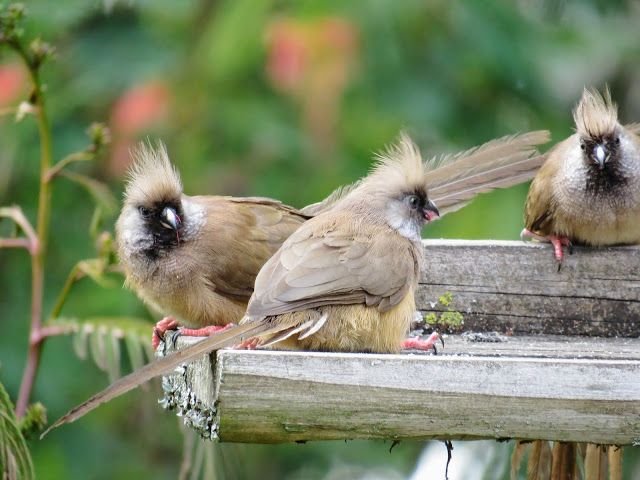
Speckled Mousebird
Colius striatusA familiar, long-tailed woodland bird that moves through branches with mouse-like agility.
The Speckled Mousebird (Colius striatus) is a medium-sized mousebird of the family Coliidae. Its soft grey-brown body, barred breast, red facial skin and long tail are adapted to life in trees, thickets, farms and gardens across much of eastern and southern Africa.
Speckled Mousebird Quick Facts
What Is the Speckled Mousebird?
The Speckled Mousebird (Colius striatus) is one of Africa’s most widespread mousebirds, a mostly terrestrial-foraging but highly arboreal species in the family Coliidae. It is especially at home in leafy habitats where its long tail, grasping feet and agile climbing style help it move through vegetation.
The species is variable across its broad range, and birds can show differences in body tone, bare-part colour and the degree of barring around the neck and chest. In Tanzania it is a familiar bird of moister habitats, including gardens, woodland edges, farms and leafy park landscapes.
Unlike true mice, mousebirds have specialised feet with reversible outer toes that help them cling to branches, hang beneath vegetation and manoeuvre through dense foliage. This unusual foot arrangement contributes to the mousebird group’s distinctive, almost mammal-like movement.
How to Identify a Speckled Mousebird
The Speckled Mousebird is a compact, long-tailed bird with a soft grey-brown appearance and fine streaking or barring. In good light, its red facial skin and two-toned bill can be useful field marks.
- Body plumage Mostly grey-brown, with darker streaking and fine barring around the underparts and neck.
- Head and face The face shows bare reddish skin around the eye, contrasting with the feathered head.
- Bill Short, curved and two-toned, with a paler lower part in many birds.
- Tail Very long and graduated, making the body seem much smaller than the full bird length suggests.
- Feet Strong, grasping feet adapted for climbing and clinging to branches.
- Flight Often flies with rapid wingbeats, then perches and resumes its characteristic climbing movements.
Distinguishing the Speckled Mousebird from Other Mousebirds
In Tanzania it may be compared with other mousebirds such as White-backed and Red-faced Mousebirds. The Speckled Mousebird is especially useful to identify by its combination of a broadly streaked body, relatively uniform brown-grey tones and the extensive, very long tail. Habitat and flocking behaviour can also help when plumage details are difficult to see.
Speckled Mousebird: Behavior & Social Life
Speckled Mousebirds are highly social, often moving in small groups or larger loose flocks. They climb rather than simply hop through foliage, feeding together in fruiting trees and resting close to one another in sheltered vegetation.
Daily Activity
- Foraging Moves methodically through trees and shrubs while gleaning fruit, leaves, buds and nectar.
- Resting Often perches closely together and may bask or sit quietly in leafy cover.
- Vocalization Gives soft chattering and contact notes that help keep flock members together.
Movements
The species is generally resident but can make local movements when food or suitable vegetation changes. It is not a classic long-distance migrant; instead, its distribution can shift seasonally at a local scale.
Habitat & Distribution
The Speckled Mousebird favours relatively moist, leafy environments and adapts well to human-modified landscapes. It can occur in:
- Woodland Open and semi-open woodland with fruiting trees and shrubs.
- Forest edge Leafy margins, secondary growth and thickets.
- Farms and gardens Cultivated landscapes, orchards and gardens where food plants are available.
- Moist savanna Grassy woodland mosaics and riverine or well-vegetated areas.
Distribution: Speckled Mousebird is widely distributed in eastern and southern Africa, extending from the Great Lakes region southward through much of the subcontinent. Its broad ecological tolerance helps it persist in both natural and cultivated landscapes.
Tanzania Distribution
In Tanzania the species is recorded in many moister parts of the country. Documented records include Arusha and Moshi-area sites, Tarangire National Park, Lake Manyara landscapes, Mkungunero and the Lake Victoria region.
Speckled Mousebird in Tanzania
Speckled Mousebird is a practical species for Tanzania birding because it can occur in leafy parklands as well as gardens and farms. Reliable documented localities include:
Lake Manyara
Recorded in the Lake Manyara area and associated moist woodland habitats.
Lake Manyara birdingArusha National Park
Documented from the Arusha area, where moist woodland and montane vegetation provide suitable cover.
Arusha birdingTarangire National Park
Recorded in Tarangire’s wooded landscapes and in habitat with fruiting and leafy vegetation.
Tarangire birdingMoshi & Kilimanjaro foothills
Records from Olasiti, Marangu and Simba Farm-West Kilimanjaro show its association with gardens, farms and moist woodland.
Kilimanjaro birdingSafari Methods
- Birdwatching Scan fruiting trees, shrubs and woodland edges for active flocks.
- Garden and lodge walks Because it tolerates gardens and farms, quiet walks can produce excellent views.
- Wildlife photography The long tail, facial skin and social flocking make it a rewarding photographic subject.
Best Time to See Them
Speckled Mousebirds can be encountered year-round in suitable Tanzanian habitat. Cooler morning periods are often productive because birds are active in vegetation before the heat of the day builds.
Diet & Feeding
The Speckled Mousebird is primarily herbivorous, with a flexible plant-based diet that allows it to exploit fruiting trees, shrubs and cultivated food plants.
Food Sources
- Fruit Soft fruits and berries are important food items.
- Leaves and shoots Young leaves, shoots and other tender plant material supplement the diet.
- Nectar and flowers Nectar and floral resources are taken when available.
- Buds and cultivated foods Buds and fruit from farms, orchards and gardens can be used opportunistically.
Foraging Behavior
It gleans food while climbing and hanging among branches, sometimes feeding in groups. Its reversible toes provide a secure grip while it reaches for fruit and foliage in awkward positions.
Breeding & Life Cycle
Speckled Mousebirds are social breeders, and breeding pairs may nest while remaining associated with other birds. The nest is a compact structure placed in vegetation where it is sheltered from direct disturbance.
Nesting
- Nest A small, neatly built nest positioned in dense vegetation, often in a fork or thick foliage.
- Eggs Usually about 2–4 eggs.
- Incubation Approximately 12–13 days, among the shortest incubation periods of African landbirds.
Chicks
Young develop quickly and may leave the nest after roughly 17–18 days. Adults continue to feed and protect the young after fledging while family groups remain together.
Conservation Status
The Speckled Mousebird is currently assessed as <strong>Least Concern</strong> globally, reflecting its broad distribution and ability to occupy a range of wooded and human-modified habitats.
Its adaptability can help buffer it against some habitat changes, but populations can still be affected locally when mature vegetation, food trees and nesting cover are removed.
Important local pressures may include:
- Habitat conversion Loss of wooded vegetation and mature food-producing trees can reduce suitable habitat.
- Pesticide exposure Intensive land management can reduce plant and invertebrate resources and increase chemical exposure.
Comparisons
The Speckled Mousebird can be compared with other mousebirds by body colour, habitat and tail pattern. These distinctions are especially useful when several species occur together.
| Feature | Speckled Mousebird | Red-faced Mousebird | White-backed Mousebird |
|---|---|---|---|
| Length | 36 cm | 34–35 cm | 32–35 cm |
| Tail | Very long | Very long | Very long |
| Main colour | Grey-brown, finely barred | Grey with red face | Grey-brown with white back |
| Habitat | Woodland, moist savanna, gardens | Dryer woodland and savanna | Open dry country and scrub |
| Diet | Fruit, leaves, nectar | Fruit, leaves, nectar | Fruit, leaves and seeds |
| Social behaviour | Often in flocks | Often social | Often social |
Did You Know?
Mouse-like Feet
Its unusual reversible toes let it grip branches in several directions.
Long Tail
The tail makes up a major share of its apparent body length.
Plant Specialist
Fruit, leaves, buds and nectar form the core of its flexible herbivorous diet.
Social Bird
Speckled Mousebirds often move and rest in groups.
Fast Nestling
Incubation is only about 12–13 days, and young can leave the nest in roughly 18 days.
Tanzania Wide-ranging
Documented records span northern, eastern and western Tanzanian localities, from Moshi and Arusha to Lake Victoria and Dar es Salaam.
There is something wonderfully nimble about the Speckled Mousebird: a bird that can look unremarkable at a distance, then become fascinating once it begins climbing through foliage with its mouse-like feet and extraordinary tail. In Tanzania, it rewards patient birders in gardens, woodland edges and moist park habitats where its social calls and restless movements give it away.
Gallery
Frequently Asked Questions
The Speckled Mousebird (Colius striatus) is a medium-sized mousebird of the family Coliidae, recognised by its grey-brown plumage, fine barring, long tail and social behaviour.
Documented Tanzanian records include Olasiti, Arusha National Park, Tarangire, Marangu, Simba Farm-West Kilimanjaro and the Lake Victoria region.
It feeds mainly on fruit, leaves, shoots, buds, flowers and nectar, with its exact diet varying with seasonal food availability.
No. The Speckled Mousebird is currently assessed as Least Concern globally, although local habitat loss can still reduce suitable cover and food trees.
The very long tail is characteristic of mousebirds and contributes to balance and manoeuvrability as the bird climbs through branches.
Pairs build small nests in vegetation, usually lay about 2–4 eggs, and incubation lasts roughly 12–13 days; young can leave after around 17–18 days.
Look for the grey-brown, finely barred body, red facial skin, two-toned bill, grasping feet and very long tail, often in a small flock.
Yes. It is generally a resident species in Tanzania, although local movements occur in response to food and habitat conditions.
References & Further Reading
- Tanzanian Birds & Butterflies – Speckled Mousebird: Tanzania photographs and locality records.
- Oiseaux.net – Speckled Mousebird: identification, measurements, diet and breeding data.
- BirdLife / IUCN Red List – Speckled Mousebird: global conservation assessment and taxonomy.
- Birds of the World – Speckled Mousebird: social behaviour, ecology and breeding biology.
- African Bird Club – Speckled Mousebird: regional distribution and field records.
- iNaturalist – Speckled Mousebird: recent observation records from Tanzania and East Africa.
- eBird – Speckled Mousebird: identification, range and observation records.