

.png)
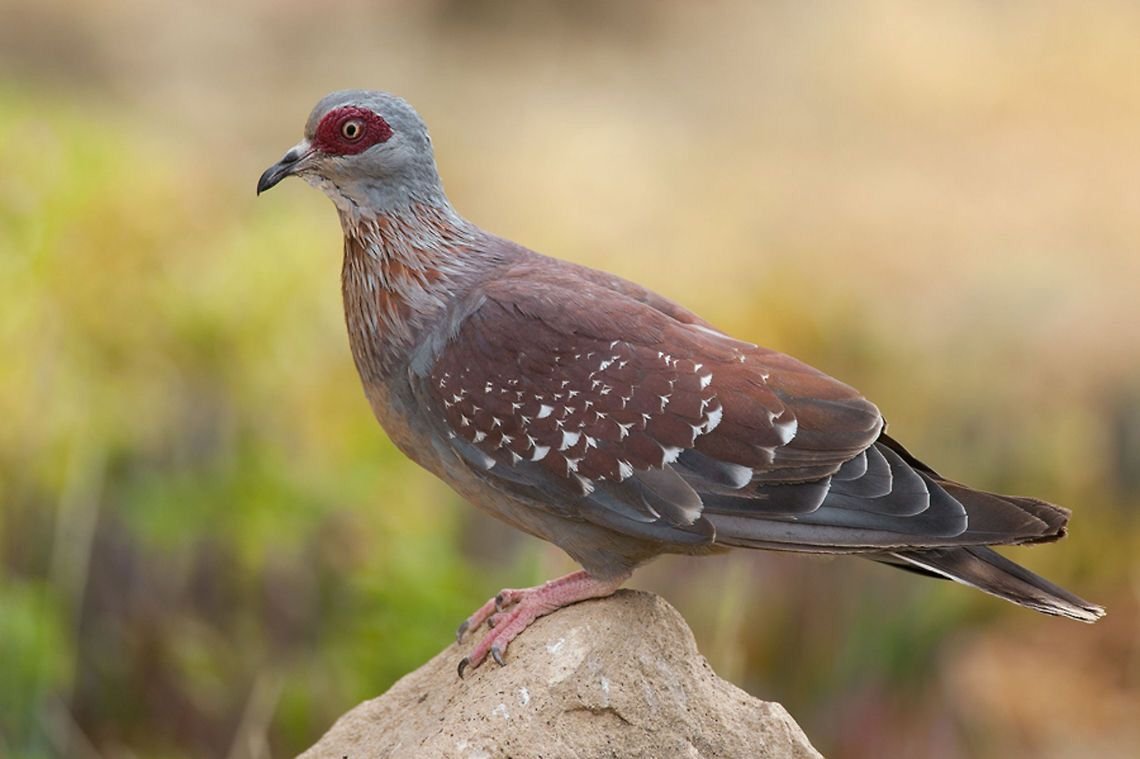
Speckled Pigeon
Columba guineaA familiar African pigeon of rocky country, savanna, farmland and towns – marked by bold wing spotting.
The Speckled Pigeon (Columba guinea) is a medium-sized pigeon of the family Columbidae. Its grey body, reddish eye area and pale spots scattered across dark wings make it one of Africa's most recognisable large pigeons.
Speckled Pigeon Quick Facts
What Is the Speckled Pigeon?
The Speckled Pigeon (Columba guinea) is a medium-sized African pigeon of the family Columbidae. It is recognised by its grey head and breast, reddish eye area, dark back and wings marked with contrasting pale spotting.
Unlike many forest pigeons, it is strongly associated with open country, rocky landscapes, cultivated land and human settlements. It often roosts or nests on cliffs, rocky ledges and buildings where suitable nesting sites are available.
The species is one of the familiar pigeons of eastern and southern Africa, and its adaptation to farmland and towns allows it to remain common across much of its range, including Tanzania.
How to Identify a Speckled Pigeon
The Speckled Pigeon is usually easy to recognise at close range, especially by the combination of a grey head, reddish facial skin and strongly patterned wings.
- Head and breast: Mainly grey, with a subtle purple or green sheen on parts of the neck in good light.
- Eye area: Noticeable reddish or pinkish bare skin surrounds the eye.
- Wing pattern: Dark wings are liberally marked with white or pale spots, producing its characteristic “speckled” appearance.
- Back: Generally grey-brown to darker grey than the head and underparts.
- Tail: Dark with paler contrasting areas visible in flight.
- Legs: Pinkish to red feet and legs.
- Flight: Strong, direct wingbeats followed by short glides, with the pale wing markings becoming conspicuous.
Distinguishing from Other Pigeons
The Speckled Pigeon can be confused with other large pigeons, but its spotted wing coverts, grey body, reddish eye patch and preference for open rocky or settled habitats provide a useful combination of field marks.
Behavior & Social Life
Speckled Pigeons are adaptable, social birds that may occur singly, in pairs or in loose groups around feeding and drinking sites. They often become particularly conspicuous where food is available around farms, villages and town edges.
Daily Activity
- Foraging: Most feeding takes place on the ground, where pigeons walk and peck among short grass, bare soil, crop fields and roadsides.
- Roosting: Rocky ledges, cliffs, large trees and buildings can provide secure resting places.
- Drinking: Like many pigeons, it may drink by placing the bill in water and drawing water continuously rather than taking repeated sips.
Movement
Speckled Pigeons are generally resident or locally mobile rather than long-distance migrants. Local movements can follow food, water and changes in land use.
Habitat & Distribution
The Speckled Pigeon occupies a broad range of open and semi-open landscapes, especially where rocky roosts, feeding grounds and reliable water occur together.
- Rocky terrain including cliffs, kopjes, gorges and escarpments.
- Open savanna and grassland with scattered trees and exposed ground.
- Farmland where grain, seeds and other food sources are available.
- Urban and peri-urban areas where buildings can substitute for cliffs and ledges.
Distribution: The species has a wide distribution in sub-Saharan Africa, with substantial populations across eastern and southern Africa.
Tanzania Distribution
In Tanzania, Speckled Pigeons are widespread in suitable open habitats and are especially familiar around rocky landscapes, agricultural areas and settlements. They are represented in regional bird checklists from northern Tanzania and across the wider country.
Speckled Pigeon in Tanzania
Speckled Pigeons are not usually a headline safari species, but they are widespread and often easy to find around rocky scenery, lodges, agricultural edges and towns. Useful Tanzanian birding locations include:
Serengeti National Park
Open plains, rocky outcrops and settlement edges can provide feeding and roosting habitat.
Serengeti safariNgorongoro Conservation Area
Rocky escarpments, cultivated margins and the crater landscape offer suitable open-country habitat.
Ngorongoro safariTarangire National Park
Open savanna and rocky habitats can support Speckled Pigeons, particularly around water and developed areas.
Tarangire safariMoshi & Arusha Area
Town edges, farmland and rocky slopes around northern Tanzania provide regular birding opportunities.
Northern Tanzania birdingSafari Methods
- Game drives – scan rocky outcrops, roadside edges and open ground around water.
- Birdwatching – listen for the characteristic pigeon calls and check ledges, roofs and exposed perches.
- Wildlife photography – early morning light can reveal the subtle neck sheen and contrasting wing spots.
Best Time to See Them
Speckled Pigeons can be encountered throughout the year in Tanzania. They are often easiest to watch during cooler morning hours when they feed actively on the ground.
Diet & Feeding
The Speckled Pigeon is primarily a seed-eating pigeon, but it is opportunistic and can use a wide variety of plant foods in natural and human-modified landscapes.
Food Sources
- Seeds and grains: Grass seeds, cereal grains and other small seeds form an important part of the diet.
- Fruits: Fallen or accessible fruits and berries may be taken when available.
- Green plant matter: Young shoots and other soft vegetation can supplement the diet.
- Human-associated food: Around settlements and farms it may exploit spilled grain and other easily available food.
Foraging Behavior
Feeding is commonly terrestrial. Birds walk through short grass, bare ground or cultivated areas, searching visually and pecking rapidly at edible items.
Breeding & Life Cycle
Speckled Pigeons can breed opportunistically when food and nesting sites are suitable. Pairs may use cliffs, rocky ledges, buildings and other elevated structures that offer shelter from predators.
Nesting
- Nest: A relatively simple platform of twigs and plant material placed on a ledge, beam, building or other secure support.
- Eggs: Usually 1-2 pale eggs per clutch.
- Incubation: Around 16-18 days, shared by the pair.
Chicks
Young pigeons are fed the nutritious crop secretion known as crop milk by their parents. They grow quickly and leave the nest after roughly three to four weeks, depending on conditions.
Conservation Status
The Speckled Pigeon is assessed as Least Concern globally.
Its broad geographic range and ability to use open landscapes, farmland and urban environments help explain its secure overall status. In many areas it remains common and readily observed.
Local pressures can still affect individual populations:
- Habitat change where important rocky roosting or feeding areas are heavily altered.
- Persecution or control where pigeons are regarded as agricultural pests.
- Food and water changes caused by intensive land-use practices or drought.
Comparisons
The Speckled Pigeon is one of several medium to large African pigeons. Field identification becomes easier when size, wing pattern and habitat are considered together.
| Feature | Speckled Pigeon | Laughing Dove | Tambourine Dove |
|---|---|---|---|
| Size | 31-36 cm | 25-26 cm | 23-26 cm |
| Body shape | Large, robust pigeon | Slender, long-tailed dove | Small, compact dove |
| Wing pattern | Strong pale spotting on dark wings | Rufous and black patterned wings | Dark wings with rich chestnut tones |
| Habitat | Open country, rocky areas, farms and towns | Open woodland, scrub, farmland and settlements | Woodland, thickets and forest edges |
| Common impression | Large grey pigeon with spotted wings | Small warm-brown dove | Small woodland dove with soft coloration |
Did You Know?
Speckled Wings
The pale spots across the dark wing coverts give this pigeon the pattern behind its common name.
Rock-Loving
Cliffs, rocky ledges and kopjes can provide valuable roosting and nesting sites.
Urban Adapter
Buildings can substitute for natural cliffs, allowing the species to live close to people.
Ground Feeder
Much of the diet is collected by walking and pecking across open ground for seeds and grain.
Crop Milk
Parents nourish chicks with crop milk, a specialised secretion produced during the breeding period.
Adaptable Pigeon
Its ability to use savanna, farmland, rocky country and towns has helped it remain widespread.
The Speckled Pigeon is easy to overlook because it often lives alongside us. Yet close observation reveals a beautifully patterned African pigeon: the red around the eye, the quiet sheen of the neck and the pale spots scattered across dark wings. Around Tanzania's rocky landscapes, farms and towns, it is a familiar reminder that remarkable wildlife is not always far from the safari road.
Gallery
Frequently Asked Questions
The Speckled Pigeon (Columba guinea) is a medium-sized African pigeon recognised by its grey body, reddish eye area and strongly spotted dark wings.
It is widespread in Tanzania and can be encountered in open country, rocky areas, farmland and urban settings, including northern Tanzania birding areas.
It mainly eats seeds and grains, with fruits and green plant material supplementing the diet when available.
No. The Speckled Pigeon is currently assessed as Least Concern globally.
The name refers to the conspicuous pale spotting scattered across its darker wings and upperparts.
It typically lays one or two eggs in a simple twig nest placed on a cliff ledge, building or other elevated support.
Look for the grey head and breast, reddish eye area, robust build, pinkish legs and contrasting pale spots on the dark wings.
Yes. It is generally resident or locally mobile in suitable Tanzanian habitats rather than a long-distance migrant.
References & Further Reading
- BirdLife International / BirdLife South Africa – Current taxonomic and conservation information for African bird species, including global Red List context.
- Tanzanian Birds & Butterflies – Tanzania-focused species pages, birding records, photographs and distribution resources.
- eBird – Species identification, sightings and distribution information for Speckled Pigeon.
- Birds of the World – Detailed species account covering behaviour, diet, breeding and distribution.
- IOC World Bird List – Current scientific naming and higher classification for Columbidae.
- GBIF – Occurrence data and taxonomic reference material for Columba guinea.
- Regional bird atlases and checklists – Supporting records for the species across eastern and southern Africa.