

.png)
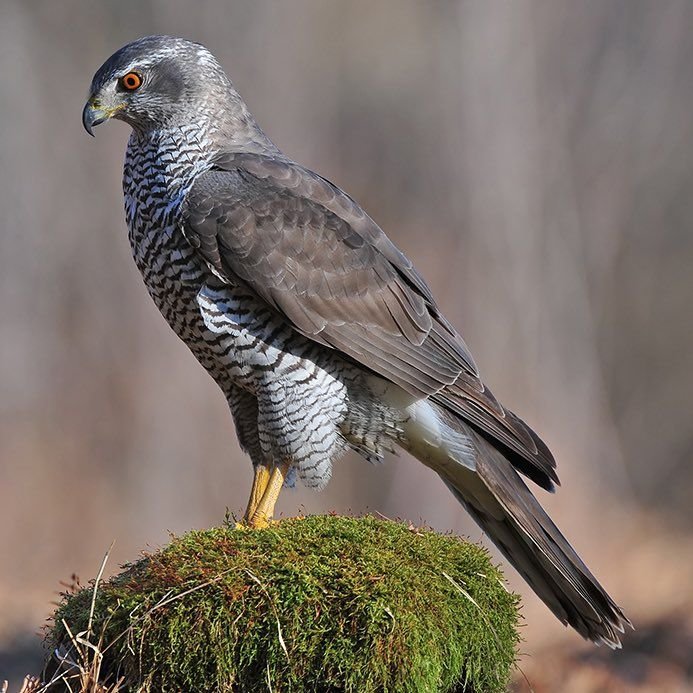
Gabar Goshawk
Micronisus gabarA small but fierce predator – the polymorphic hawk that terrorises small birds at waterholes.
The Gabar Goshawk (Micronisus gabar) is a small species of African and Arabian bird of prey in the family Accipitridae.[reference:0] It is a distinctive raptor with a slender grey body, a distinct dark hood, and a conspicuous white rump. A scarce dark melanistic form also occurs, adding to its intrigue. This agile hunter is a master of ambush, often found in pairs patrolling moist and arid savanna where it terrorises small birds and other small vertebrates at waterholes.[reference:1]
Gabar Goshawk Quick Facts
What Is the Gabar Goshawk?
The Gabar Goshawk (Micronisus gabar) is a small species of African and Arabian bird of prey belonging to the family Accipitridae, which also includes eagles, kites, buzzards and hawks.[reference:2] It was first described by the French naturalist François-Marie Daudin in 1800 under the protonym Falco gabar. The species is the only member of the genus Micronisus.[reference:3][reference:4]
The name "gabar" is derived from the local name for the bird in parts of its African range. It is also known by several alternative names including the Gabar Hawk, and in Afrikaans as the Witkruissperwer (White-rumped Sparrowhawk).
This species is notable for being polymorphic – it occurs in two distinct colour forms that fluctuate in relative abundance across its geographic range.[reference:5][reference:6] The more frequent pale grey form is widespread, while a rare dark melanistic form accounts for approximately 25 percent of the overall population.[reference:7]
How to Identify a Gabar Goshawk
The Gabar Goshawk is a distinctive and easily recognisable raptor. Here are its key identifying features:
- Size: A small, slender raptor measuring 28-36 cm (11-14 in) in length with a wingspan of about 63 cm (25 in).[reference:8][reference:9]
- Head: Small head with a distinct dark hood – a key identification feature.[reference:10][reference:11]
- Rump: Conspicuous white rump, highly visible in flight.[reference:12][reference:13]
- Plumage (Pale Form): Mostly grey upperparts with white and grey barring on the chest, thighs and underwings.[reference:14][reference:15]
- Plumage (Dark Form): Almost completely black, accounting for approximately 25% of the population.[reference:16][reference:17]
- Tail: Dark grey, barred tail.[reference:18]
- Eyes: Dark eyes.[reference:19]
- Cere and Legs: Red in adults; yellow in immatures.[reference:20][reference:21]
Juvenile vs Adult
Immature birds have yellow cere and yellow legs, and the plumage is generally browner than adults. The pale birds have untidier barring on the chest than the adult.[reference:22][reference:23]
Distinguishing from Other Hawks
The Gabar Goshawk can be distinguished from similar species as follows: the Ovambo Sparrowhawk has a barred throat; the Shikra has a white throat and red eye; the Lizard Buzzard has a throat streak and distinctive tail banding; and chanting-goshawks are much larger.[reference:24] Its small size, slender build, distinct hood, and white rump make it unique.
Behavior & Social Life
The Gabar Goshawk is a versatile and agile raptor, typically seen alone or in pairs.[reference:25] It is most frequently observed alone, but pairs are common, particularly during the breeding season.[reference:26]
Foraging & Hunting
- Ambush Hunter: It is a stealthy predator that hunts from a concealed perch, often in the canopy of trees.[reference:27]
- Diving Pursuit: It actively pursues prey, diving after flighted animals.[reference:28]
- Waterhole Strategy: Pairs inhabit moist and arid savanna, where they terrorise small birds and other small vertebrates at waterholes.[reference:29][reference:30]
- Versatile Feeder: It consumes various types of prey, but seems to prefer hunting birds of all sizes.[reference:31]
Vocalization
The Gabar Goshawk gives a distinctive piping repeated call described as peeii-peeii-peeii and teeui-teeui-teeui, which is reminiscent of the Water Thick-knee and different from other small hawks.[reference:32]
Habitat & Distribution
The Gabar Goshawk occurs in a wide variety of open and wooded habitats across sub-Saharan Africa and the Arabian Peninsula.
Key habitat types include:
- Open woodland – especially dry Acacia savanna and broad-leaved woodland.[reference:33]
- Acacia thornscrub and semi-arid steppe along watercourses.[reference:34][reference:35]
- Miombo (Brachystegia), cluster-leaf Terminalia, and mopane woodland.[reference:36]
- Lowland to submontane open woodland.[reference:37]
- Urban areas – may move into cities and towns in southern Africa.[reference:38]
Distribution: The species has an extremely large range, with an Extent of Occurrence of approximately 26,100,000 km².[reference:39] It is found throughout sub-Saharan Africa, from Senegambia in the west to Eritrea, Ethiopia and Somalia in the east, and southward to South Africa.[reference:40][reference:41] It also extends to the southwestern Arabian Peninsula.[reference:42]
Subspecies: Three subspecies are currently recognised: M. g. niger (Senegambia to Sudan and southwestern Arabia), M. g. aequatorius (highlands of Ethiopia to DRC and northern Mozambique), and M. g. gabar (southern Angola to South Africa).[reference:43][reference:44]
Tanzania Distribution
In Tanzania, the Gabar Goshawk is found in most national parks and game reserves. It has been recorded in Serengeti National Park (including Seronera), Ngorongoro Conservation Area, Tarangire National Park, and Ruaha National Park.[reference:45][reference:46]
Gabar Goshawk in Tanzania
The Gabar Goshawk is a fascinating and agile raptor of Tanzania's woodlands and savannas. Here are the best locations to see it:
Serengeti National Park
Recorded in the Serengeti, including a documented observation of hunting in open acacia bush around Seronera.[reference:47] Also observed in the Ndutu area.[reference:48]
Serengeti safariNgorongoro Crater
Recorded in the Ngorongoro Conservation Area, often seen perched in acacia trees or soaring over the crater rim.[reference:49]
Ngorongoro safariTarangire National Park
Found in the park's acacia woodlands and open savanna habitats. Recorded on the Engikaret Lark Plains.[reference:50]
Tarangire safariRuaha National Park
A resident species in Ruaha's miombo woodland and dry savanna habitats.
Ruaha safariSafari Methods
- Game drives through acacia woodland and savanna habitats.
- Birdwatching – watch for the distinctive hood, white rump, and slender silhouette.
- Wildlife photography – the Gabar Goshawk's striking appearance and hunting behaviour make it a rewarding subject.
- Waterhole watching – as pairs often terrorise small birds at waterholes.[reference:51]
Best Time to See Them
Gabar Goshawks are present year-round in suitable habitat. They are most active during the cooler morning and evening hours. The dry season (June to October) is generally best for wildlife viewing.
Diet & Feeding
The Gabar Goshawk is a carnivore with a diverse diet, but it shows a clear preference for hunting birds.[reference:52][reference:53]
Food Sources
- Small birds: The primary prey. It feeds on a variety of small birds including guineafowl, coucals, and francolins.[reference:54]
- Eggs and nestlings: It will feed on eggs and nestlings of other bird species, particularly those of weavers.[reference:55]
- Small mammals: Including rodents and bats.[reference:56][reference:57]
- Reptiles: Lizards and small snakes.[reference:58]
- Insects: Various insects.[reference:59]
Hunting Behavior
The Gabar Goshawk is a solitary diurnal hunter, flying low over the ground or watching from a tree for its prey.[reference:60] It is an ambush predator, often hunting from a concealed perch and diving after flighted animals.[reference:61] It spends a decent amount of time actively pursuing prey.[reference:62]
Breeding & Life Cycle
The Gabar Goshawk is monogamous and territorial.
Nesting
- Nest: A small platform nest constructed using thin twigs, positioned in a vertical fork in the crown of a thorny tree, such as an acacia.[reference:63]
- Clutch: One to three eggs, with a mean clutch size of 2.5.[reference:64] Studies in the Transvaal recorded six clutches of two eggs and six clutches of three eggs.[reference:65]
- Incubation: About 33-38 days, primarily by the female.[reference:66]
Chicks
Chicks fledge around 35-36 days old.[reference:67] The young remain dependent on the parents for some time after fledging.
Conservation Status
The Gabar Goshawk is assessed as Least Concern on the IUCN Red List.[reference:68][reference:69]
It has an extremely large range (Extent of Occurrence of approximately 26,100,000 km²) and does not approach the thresholds for Vulnerable under the range size criterion.[reference:70] The population trend appears to be stable, and the population size is very large, so it does not approach the thresholds for Vulnerable under the population trend criterion.[reference:71]
The species is listed on CITES Appendix II, meaning that international trade in this species should be carefully monitored and controlled.[reference:72]
Comparisons
The Gabar Goshawk is sometimes confused with other small raptors. Here are the key differences:
| Feature | Gabar Goshawk | Ovambo Sparrowhawk | Shikra |
|---|---|---|---|
| Size | 28-36 cm | 30-36 cm | 28-36 cm |
| Throat | Dark hood (no barring) | Barred throat | White throat |
| Eye | Dark | Dark | Red |
| Rump | Conspicuous white rump | No white rump | No white rump |
| Distinctive Feature | Polymorphic forms | Barred underparts | Red eye & white throat |
Did You Know?
Two Colour Forms
The Gabar Goshawk is polymorphic – it occurs in a pale grey form and a rare dark melanistic form that accounts for about 25% of the population.[reference:73]
Tiny but Mighty
Despite its small size (weighing as little as 90g), it is a fierce predator that terrorises small birds at waterholes.[reference:74]
White Rump Signal
The conspicuous white rump is highly visible in flight and serves as a key identification feature.[reference:75]
Egg Thief
It feeds on eggs and nestlings of other bird species, particularly targeting weaver colonies.[reference:76]
Bat Hunter
It has been documented successfully preying on bats in Kenya.[reference:77]
Secretive Nesters
It builds its nest in the fork of a thorny tree, such as an acacia, providing protection from predators.[reference:78]
There is something captivating about the Gabar Goshawk – a tiny predator with the heart of a giant. Its sleek grey form, dark hood, and flash of white rump make it a striking sight against the African sky. But it is its behaviour that truly sets it apart. To watch a pair of these hawks working together at a waterhole, systematically flushing and picking off small birds, is to witness the raw efficiency of nature's design. In a world of giants, the Gabar Goshawk reminds us that sometimes the most effective predators come in the smallest packages.
Gallery
Frequently Asked Questions
The Gabar Goshawk (Micronisus gabar) is a small species of African and Arabian bird of prey in the family Accipitridae. It is notable for its polymorphic coloration, with a pale grey form and a rare dark melanistic form.[reference:79]
The Gabar Goshawk is found in open woodland, acacia savanna, and wooded habitats across Tanzania. Key locations include Serengeti National Park, Ngorongoro Conservation Area, Tarangire National Park, and Ruaha National Park.[reference:80][reference:81]
The Gabar Goshawk is a carnivore that feeds mainly on small birds, but also takes small mammals (including bats), reptiles, insects, and eggs and nestlings of other birds.[reference:82]
No. The Gabar Goshawk is listed as Least Concern on the IUCN Red List, with a stable population and an extremely large range of 26,100,000 km².[reference:83][reference:84]
The Gabar Goshawk is a small, slender greyish hawk with a distinct hood and a white rump. It occurs in two forms: a pale grey form and a rare dark melanistic form. It has a red cere, long red legs, and dark eyes.[reference:85][reference:86]
The Gabar Goshawk is a small raptor, measuring 28-36 cm (11-14 in) in length with a wingspan of about 63 cm (25 in). Females are significantly larger than males, weighing 167-240 g compared to 90-173 g for males.[reference:87][reference:88]
The Gabar Goshawk builds a small platform nest of thin twigs in the fork of a thorny tree, such as an acacia. Clutch size is typically 2-3 eggs, with a mean clutch size of 2.5.[reference:89][reference:90]
In Swahili, the Gabar Goshawk is known locally as Kipanga, though local names can vary across regions.
References & Further Reading
- Encyclopedia of Life – Gabar goshawk: Description, polymorphism, distribution, subspecies, habitat, biology.[reference:91]
- eBird – Gabar Goshawk: Identification, vocalisation, differentiation from similar species.[reference:92]
- Wikipedia – Gabar goshawk: Scientific name, description, taxonomy, distribution, subspecies.[reference:93]
- Avibase – Gabar Goshawk: Taxonomic details, subspecies, distribution.[reference:94]
- BirdLife DataZone – Gabar Goshawk: IUCN Red List assessment, range, population trend.[reference:95]
- IUCN Red List – Micronisus gabar: Conservation status, habitat and ecology, geographic range.[reference:96]
- Citizen.co.za – Get to know the gabar goshawk: Diet, habitat, behaviour.[reference:97]