

.png)
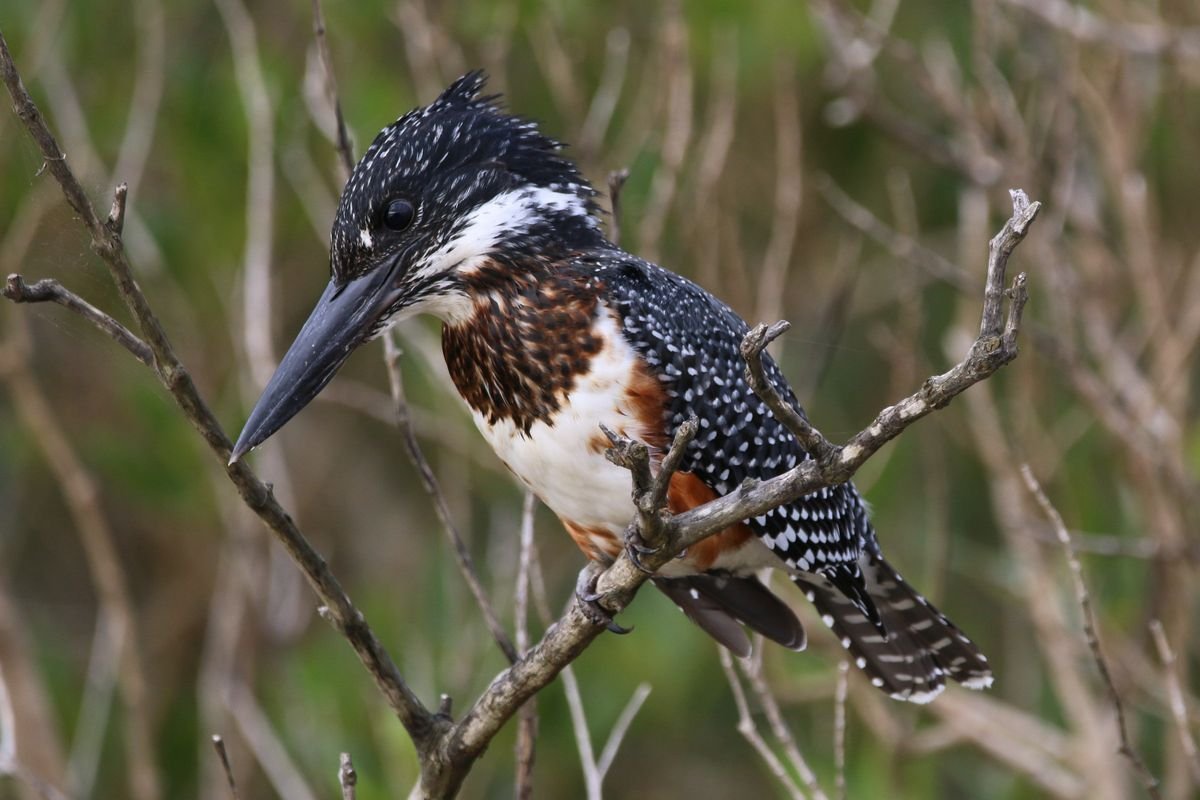
Giant Kingfisher
Megaceryle maximaA powerful black-and-white kingfisher built for Africa’s rivers, lakes and wooded waterways.
The Giant Kingfisher (Megaceryle maxima) is the largest kingfisher in Africa, a striking waterside hunter with a heavy black bill, bold plumage and a dramatic crest. In Tanzania it is associated with permanent rivers, lakes, forested waterways and other productive freshwater habitats where it waits on a perch before plunging for fish and aquatic prey.
Giant Kingfisher Quick Facts
What Is the Giant Kingfisher?
The Giant Kingfisher (Megaceryle maxima) is Africa’s largest kingfisher, a robust freshwater bird in the family Alcedinidae. It combines a large head, heavy bill, broad wings and bold black-and-white plumage, giving it a more powerful appearance than the smaller stream and woodland kingfishers.
Its life is closely tied to water. It uses quiet reaches of rivers, lake margins, channels and wooded shorelines where clear water and exposed perches provide good hunting conditions. Rather than chasing prey continuously, it often watches from a branch and dives decisively when a fish or other aquatic animal comes within range.
Across Tanzania the species occurs in suitable freshwater habitat from northern lakes to larger southern waterways. Tanzania Birds documents birds at Lake Duluti, Lake Manyara, the Rufiji–Selous system, Ruaha and Pembe Abwe, illustrating the species’ broad ecological reach.
How to Identify a Giant Kingfisher
The Giant Kingfisher is unmistakable when seen well: it is very large for a kingfisher, has a long heavy bill, a prominent shaggy crest and sharply contrasting black-and-white plumage. The male and female differ in the pattern of the chest and belly, while young birds are generally duller and more heavily marked.
- Size: Very large; about 43 cm long.
- Bill: Long, broad and powerful, suited to striking aquatic prey.
- Crest: Prominent shaggy crest, especially noticeable when alert.
- Plumage: Bold black-and-white patterning with chestnut tones on the breast and belly depending on sex.
- Eyes: Dark eyes with a strong facial contrast.
- Legs: Dark to greyish legs and feet adapted for perching.
Distinguishing from Other Kingfishers
Its size helps separate it from Pied, Malachite and other smaller Tanzanian kingfishers. The Giant Kingfisher also has a more substantial head and bill, and it typically hunts from larger waterside perches along broad rivers and lakes.
Behavior & Social Life
Giant Kingfishers are usually encountered singly or in pairs, especially along productive stretches of water. They spend long periods quietly perched before making a rapid, direct plunge. Territorial behaviour is most obvious around favoured fishing stretches and nesting banks.
Daily Activity
- Hunting: Perches above water, then dives powerfully to seize fish and other aquatic prey.
- Perching: Uses prominent branches, snags and riverside trees as hunting stations.
- Vocalization: Gives sharp, ringing calls that carry across open water and river corridors.
Migration
It is not a long-distance migrant. Movements are mainly local or seasonal responses to water conditions, prey availability and breeding needs, although individuals can range widely along connected river systems.
Habitat & Distribution
The Giant Kingfisher is associated with freshwater systems that provide both prey and suitable perches.
- Rivers and streams Permanent and seasonal waterways with fish-rich pools and exposed banks.
- Lakes and wetlands Lake margins, channels and wetland edges where prey is accessible.
- Wooded shorelines Riparian forest and riverine woodland with sturdy hunting perches.
- Mosaics Open water beside woodland, marsh and floodplain habitats can be especially productive.
In Tanzania, the species is widely distributed where suitable freshwater habitat occurs. Documented localities include Lake Manyara, Lake Duluti, Ruaha, the Rufiji–Selous system and Pembe Abwe.
Tanzania Distribution
In Tanzania, the Giant Kingfisher is found in most national parks and game reserves, including Serengeti, Ngorongoro, Tarangire, and Ruaha .
Giant Kingfisher in Tanzania
The Giant Kingfisher is a rewarding Tanzania birding target wherever permanent water meets mature riverside vegetation. Documented sites include several major lakes and river systems.
Lake Manyara
Documented Giant Kingfishers occur around the lake and its freshwater edges, where wooded shorelines provide perches.
Lake Manyara birdingLake Duluti
A documented northern Tanzania locality with photographic records of the species.
Lake Duluti birdingRufiji–Selous
The Rufiji River–Selous system provides large rivers and productive backwaters suited to a giant fish-eating kingfisher.
Selous safariRuaha National Park
Riverine habitats around Ruaha support Giant Kingfishers where permanent water remains available.
Ruaha safariSafari Methods
- Game drives – Watch river crossings, lakeshores and woodland waterways from vehicles.
- Birdwatching – Scan exposed branches above quiet water for a large, upright kingfisher.
- Wildlife photography – Early and late light can emphasize the bird’s dramatic black-and-white pattern.
Best Time to See Them
Because the species is closely tied to local water conditions rather than a single narrow migration window, it can be encountered year-round in suitable Tanzanian habitat. Cooler morning hours can be especially comfortable for prolonged birding watches.
Diet & Feeding
The Giant Kingfisher is a carnivore whose diet is dominated by aquatic prey. Fish are central, but it also takes frogs, crabs and other water-associated animals when opportunities arise.
Food Sources
- Fish: Main prey, especially small to medium-sized fish.
- Frogs: Taken around shallow water and vegetated margins.
- Crabs: Aquatic and semi-aquatic crustaceans are also captured.
- Other prey: Small aquatic animals may be taken opportunistically.
Hunting Behavior
The classic strategy is a patient perch-and-dive technique. A bird may sit motionless above the water, adjust its head to judge distance, then launch into a fast plunge before carrying the prey back to a perch to swallow it.
Breeding & Life Cycle
Pairs establish breeding territories around suitable water and excavate long tunnels in vertical riverbanks or sandbanks, usually close to the waterline. Breeding timing varies by region and rainfall.
Nesting
- Nest: A long horizontal tunnel excavated by both adults in a steep riverbank or sandbank near water.
- Eggs: Usually 3–5 white eggs are laid in a chamber at the end of the tunnel.
- Incubation: About 25–27 days, with both parents involved in incubation and care.
Chicks
Young remain in the nest for about 37 days and continue to receive parental care after leaving. Both adults contribute to feeding the brood, bringing fish and other aquatic prey back to the nest.
Conservation Status
The Giant Kingfisher (Megaceryle maxima) is currently assessed as <strong>Least Concern</strong> globally.
Its broad sub-Saharan range and adaptability to many freshwater habitats help buffer the species at global scale. However, local populations can be affected when rivers and wetlands are degraded, fishing pressure changes prey availability, or mature riverside vegetation is removed.
Practical conservation priorities include protecting freshwater catchments, retaining riparian trees and banks, and maintaining healthy fish and aquatic-prey communities.
- Wetland degradation Drainage, pollution and altered water flow can reduce feeding habitat.
- Riparian clearing Loss of riverbank trees removes hunting perches and nesting habitat.
Comparisons
The Giant Kingfisher is much larger than most kingfishers seen on Tanzanian safari. The comparison below highlights useful field differences.
| Feature | Giant Kingfisher | Pied Kingfisher | Grey-headed Kingfisher |
|---|---|---|---|
| Size | About 43 cm | About 25–28 cm | About 20–24 cm |
| Bill | Large and powerful | Long, straight | Medium, strong |
| Plumage | Bold black-and-white with chestnut areas | Black-and-white | Grey head, chestnut belly |
| Habitat | Rivers, lakes, large wetlands | Open water of many types | Woodland and bush, often near water |
| Diet | Fish, frogs, crabs and aquatic prey | Mainly fish | Fish, frogs and insects |
| Hunting style | Perch-and-dive from large riverside perches | Hover/dive and perch hunting | Perch hunting in varied habitats |
Did You Know?
Largest African Kingfisher
At around 43 cm, it is the largest kingfisher species found in Africa.
Heavy Bill
Its powerful bill is adapted for striking and carrying relatively large aquatic prey.
Water Specialist
It is strongly associated with rivers, lakes and productive freshwater margins.
Tanzania Wide
Documented Tanzanian sites range from Lake Manyara and Lake Duluti to Rufiji–Selous and Ruaha.
Patient Hunter
It may sit motionless on a branch for long periods before making a rapid plunge.
Riverbank Nesting
Breeding can involve cavities or tunnels in earth banks close to water.
A Giant Kingfisher beside a Tanzanian river has a presence that matches its name. The bird sits heavily on a branch, watches the water with remarkable patience, then turns a quiet stretch of river into a moment of explosive action. Its size, bold plumage and powerful plunge make it one of Africa’s most memorable freshwater birds.
Gallery
Frequently Asked Questions
The Giant Kingfisher (Megaceryle maxima) is the largest kingfisher in Africa. It is a powerful freshwater hunter with bold black-and-white plumage, a heavy bill and a prominent crest.
Documented Tanzanian localities include Lake Manyara, Lake Duluti, the Rufiji–Selous system, Ruaha and Pembe Abwe.
It feeds mainly on fish and also takes frogs, crabs and other aquatic animals.
No. The Giant Kingfisher is currently assessed as Least Concern globally.
Look for its large size, heavy bill, shaggy crest and strongly contrasting black-and-white plumage.
It commonly waits on a waterside perch, then dives or plunges to seize prey before returning to a perch to swallow it.
It nests in cavities or tunnels in earth banks near water. Clutches are commonly around two or three eggs.
Yes. It is a resident species in Tanzania where suitable rivers, lakes and other freshwater habitats persist, although local movements can follow water and prey conditions.
References & Further Reading
- Tanzanian Birds & Butterflies – Giant Kingfisher species page: photographs and documented records from Lake Duluti, Lake Manyara, Rufiji–Selous, Ruaha and Pembe Abwe.
- Tanzanian national bird checklist – lists Giant Kingfisher (*Megaceryle maxima*) among Tanzanian kingfishers.
- BirdLife DataZone – current global taxonomy and conservation framework for Giant Kingfisher.
- Birds of the World – detailed account of Giant Kingfisher identification, ecology, feeding and breeding behaviour.
- eBird – field identification and occurrence information for Giant Kingfisher.
- Oiseaux.net – morphology, habitat and natural-history information for *Megaceryle maxima*.
- IUCN Red List / BirdLife – global conservation assessment and species status context.