

.png)
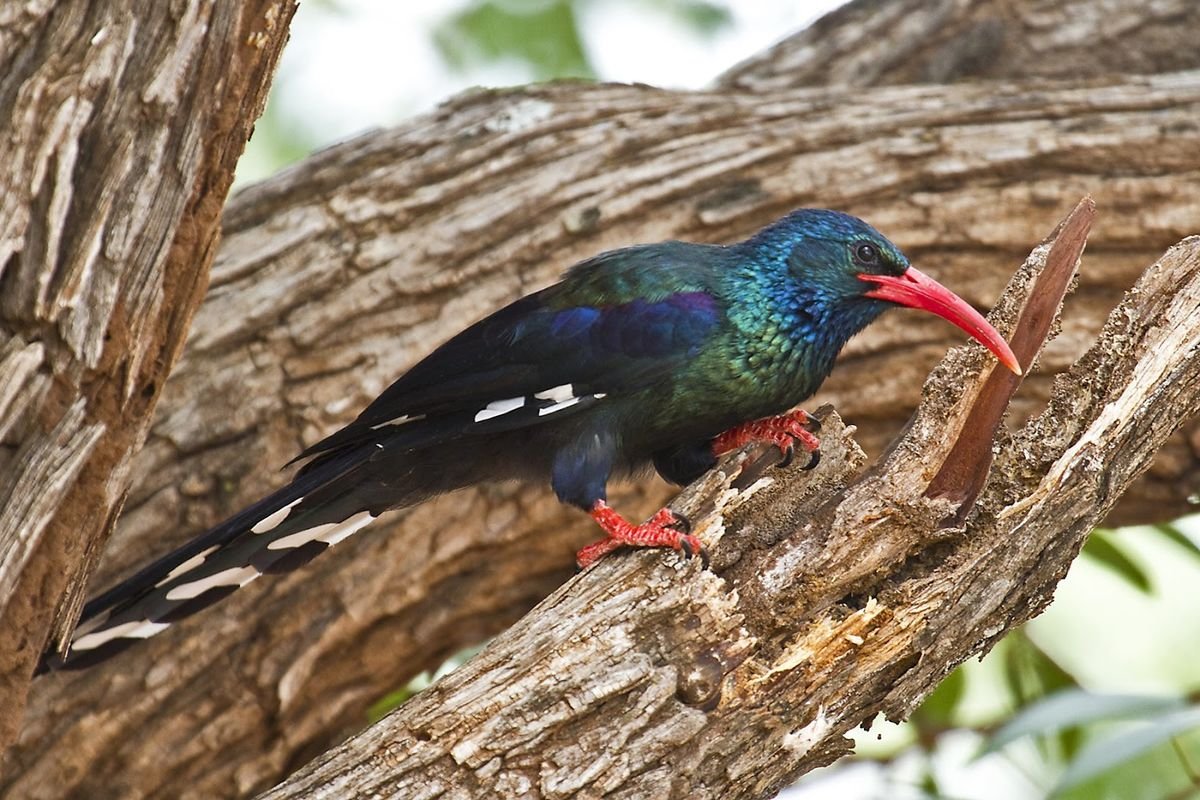
Green Wood Hoopoe
Phoeniculus purpureusA striking metallic green bird with a long red curved bill, a raucous cackling call, and a remarkable cooperative social structure.
The Green Wood Hoopoe (Phoeniculus purpureus) is a large tropical bird native to Africa, a member of the family Phoeniculidae. Formerly known as the Red-billed Wood Hoopoe, this abundant species is easily recognised by its metallic dark green plumage, purple back, very long diamond-shaped purple tail, and distinctive long, thin, curved red bill. It is a cooperative breeder and common resident in forests, woodlands and suburban gardens across most of sub-Saharan Africa.
Green Wood Hoopoe Quick Facts
What Is the Green Wood Hoopoe?
The Green Wood Hoopoe (Phoeniculus purpureus) is a large, striking tropical bird native to Africa. It is a member of the family Phoeniculidae, the wood hoopoes, and was formerly known as the Red-billed Wood Hoopoe.[reference:0] At up to 44 centimetres in length, it is a sizeable bird with a slender appearance due to its fairly lengthy tail.[reference:1] Its metallic dark green plumage, purple back, and very long diamond-shaped purple tail make it unmistakable, as do its distinctive white wing markings and white chevrons on the tail edges.[reference:2] The long, thin, curved red bill is another key identifying feature.[reference:3]
In 1784, the English illustrator John Frederick Miller included a hand-coloured plate of the Green Wood Hoopoe in his Icones animalium et plantarum and coined the binomial name Promerops purpureus, mistakenly specifying the type locality as eastern India.[reference:4] The species is now placed in the genus Phoeniculus, which was introduced in 1821 by the Polish zoologist Feliks Paweł Jarocki.[reference:5] Six subspecies are recognised across its range.[reference:6]
The Green Wood Hoopoe is sometimes considered conspecific with the Black-billed Wood Hoopoe (Phoeniculus somaliensis) and the Violet Wood Hoopoe (Phoeniculus damarensis).[reference:7] The species is widespread and common throughout its large range and is assessed as Least Concern on the IUCN Red List.[reference:8]
How to Identify a Green Wood Hoopoe
The Green Wood Hoopoe is a striking bird that is difficult to mistake once seen well. Its metallic sheen, long tail, and curved red bill make it instantly recognisable.
- Size: A large bird, 32–44 cm long, with a slender appearance and a long tail.[reference:9][reference:10]
- Plumage: Metallic dark green overall, with a purple back and a very long diamond-shaped purple tail.[reference:11]
- Wings: Distinctive white markings on the wings and white chevrons on the tail edges.[reference:12]
- Bill: Long, thin, and curved, coloured bright red in adults.[reference:13]
- Legs and feet: Red legs with powerful claws that enable it to cling easily to the underside of branches.[reference:14][reference:15]
- Sexes: Similar in appearance, though males have slightly longer beaks than females.[reference:16]
- Immatures: Have a black bill that gradually turns red as they mature.[reference:17]
- Call: A loud, raucous, cackling call. It has been described as "bubbling and maniacal" and sounds like the rattling of a stick against a hard surface.[reference:18][reference:19] It advertises its presence with its loud kuk-uk-uk-uk-uk call and other vocalisations.[reference:20]
Distinguishing from Similar Species
The Green Wood Hoopoe can be confused with other wood hoopoe species, but key differences exist. The Violet Wood Hoopoe (Phoeniculus damarensis) is distinguished by variable plumage traits and is sometimes considered conspecific.[reference:21] The Green Wood Hoopoe has a lighter body mass than the Violet Wood Hoopoe, which is manifested in flight.[reference:22] The Black-billed Wood Hoopoe (Phoeniculus somaliensis) has a black bill, while the Green Wood Hoopoe has a red bill. The Abyssinian Scimitarbill (Rhinopomastus minor) is a smaller, more slender bird with a different bill shape and lacking the metallic green plumage.[reference:23]
Behavior & Social Life
The Green Wood Hoopoe is a highly social bird that lives in family groups and is known for its cooperative breeding system. It is territorial and often seen in small, noisy clusters.[reference:24][reference:25]
Daily Activity
- Foraging: Green Wood Hoopoes usually hang upside down on tree branches and poke into crevices in search of arthropods.[reference:26] Their specialised claws enable them to cling easily to the underside of branches while closely inspecting the bark for insects.[reference:27] They also feed on the ground and at termite mounds.[reference:28]
- Social Structure: They live in family groups of 2 to 16 birds, containing a single breeding pair.[reference:29][reference:30] They defend their territory with wing-fanning and tail-swaying displays.[reference:31]
- Communication: The wood-hoopoe's cackling call has been described as "bubbling and maniacal."[reference:32] They are raucous and loud, cackling a lot.[reference:33]
- Cooperative behaviour: Green Wood Hoopoes are naturally generous, often helping in the feeding of chicks—and not just their own. In one remarkable instance at California's San Diego Zoo, when no chicks were available, a hoopoe delivered some of its food directly to the open mouth of an obviously startled neighbour, a kingfisher.[reference:34]
- Roosting: Individuals roost in groups in cavities at night.[reference:35]
Cooperative Breeding
The Green Wood Hoopoe is a cooperative breeder and common resident in the forests, woodlands and suburban gardens of most of sub-Saharan Africa.[reference:36] It is found in groups of up to a dozen or so birds with only one breeding pair.[reference:37] The breeding male and helpers of both sexes bring food to the incubating female.[reference:38][reference:39] Helpers also assist in feeding the chicks.[reference:40] There is no evidence that helpers' feeding contributions to young per se influence the indirect fitness of helpers.[reference:41]
Habitat & Distribution
The Green Wood Hoopoe is widespread across sub-Saharan Africa, from Senegal and Gambia east to Ethiopia and northwestern Somalia, and south to most of Botswana and South Africa.[reference:42][reference:43] It is numerous in wooded habitat from sea level to 9,000 feet (2,743 m).[reference:44]
- Woodland: Open woodland and riverine forest provide ideal foraging habitat.
- Forest: Forest edges and clearings.[reference:45]
- Savanna: Wooded savanna with trees.[reference:46]
- Suburban gardens: Common in suburban gardens and parks.[reference:47]
- Altitude: Found from sea level up to 2,743 m.[reference:48]
Tanzania Distribution
The Green Wood Hoopoe is a resident species in Tanzania.[reference:49] It has been recorded in the Arusha region, including at Kilimanjaro Golf and Wildlife.[reference:50][reference:51] Other records include the Udzungwa Mountains National Park, where it has been photographed at Luala Camp.[reference:52] The species is widespread across the country in suitable woodland and forest habitats. It is present in Tanzania as a resident, non-migratory species.[reference:53]
Green Wood Hoopoe in Tanzania
The best opportunities to see the Green Wood Hoopoe in Tanzania are in woodland, forest and savanna habitats where it can be found foraging in family groups. Its raucous calls often give away its presence before it is seen.
Arusha National Park
Woodland and forest habitats in the Arusha region provide excellent opportunities to see this species.
Arusha safariSerengeti National Park
Search woodland edges and riverine forest in the Serengeti ecosystem for noisy family groups.
Serengeti birding safariUdzungwa Mountains National Park
Forest and woodland habitats in the Udzungwa Mountains offer good sightings of this species.
Udzungwa safariRuaha National Park
Dry woodland and riverine forest in Ruaha provide feeding habitat for the Green Wood Hoopoe.
Ruaha safariSafari Methods
- Game drives: Search slowly through woodland and forest edges, listening for the distinctive raucous calls.
- Birdwatching: Look for the bird's characteristic upside-down foraging posture on tree branches.
- Wildlife photography: These birds are often bold and can be approached carefully, offering excellent photo opportunities.
Best Time to See Them
The Green Wood Hoopoe is a resident species in Tanzania and can be seen throughout the year.[reference:54] Early morning and late afternoon are often most productive for birding, as the birds are active and vocal during these times.
Diet & Feeding
The Green Wood Hoopoe is primarily insectivorous, feeding mainly on arthropods, especially insects and their larvae.[reference:55] It also eats small reptiles, seeds, and some fruits.[reference:56]
Food Sources
- Insects: Beetles, caterpillars, grasshoppers, and other arthropods.[reference:57]
- Larvae: Insect larvae found in crevices and under bark.[reference:58]
- Small reptiles: Occasionally eats small reptiles.[reference:59]
- Seeds and fruit: Also consumes seeds and some fruits.[reference:60]
Foraging Behavior
Green Wood Hoopoes usually hang upside down on tree branches and poke into crevices in search of arthropods.[reference:61] Their specialised claws enable them to cling easily to the underside of branches while closely inspecting the bark for insects.[reference:62] They also feed on the ground and at termite mounds.[reference:63] The species is strictly arboreal in its foraging habits.[reference:64]
Breeding & Life Cycle
The Green Wood Hoopoe is a cooperative breeder. Groups of up to a dozen or so birds contain a single breeding pair.[reference:65]
Nesting
- Nest site: Eggs are laid in natural tree holes or old barbet nests.[reference:66]
- Clutch: 2–4 blue eggs.[reference:67]
- Incubation: Approximately 18 days, shared by the breeding female.[reference:68][reference:69]
- Helpers: The breeding male and helpers of both sexes bring food to the incubating female.[reference:70][reference:71]
- Chicks: On hatching, she and the nestlings are fed by the rest of the group, even after they have fledged and left the nest hole.[reference:72]
- Defence: The group is fearless in defence of the nestlings against intruders.[reference:73]
- Multiple broods: Breeding can take place twice per year in good years.[reference:74]
The species is parasitised by the Greater and Lesser Honeyguide.[reference:75]
Conservation Status
The Green Wood Hoopoe is assessed globally as Least Concern by the IUCN.[reference:76][reference:77][reference:78] The species has an extremely large range (extent of occurrence over 22.7 million km²) and does not approach the thresholds for Vulnerable under any criterion.[reference:79]
The population size has not been quantified, but it is not believed to approach the thresholds for Vulnerable under the population size criterion.[reference:80] Despite the fact that the population trend appears to be decreasing, the decline is not believed to be sufficiently rapid to approach the thresholds for Vulnerable under the population trend criterion.[reference:81]
Key local pressures can include habitat loss from deforestation and land conversion, as well as the use of pesticides that reduce insect prey populations. However, the species is widespread and adaptable, occurring in suburban gardens and modified habitats, which helps buffer it against severe declines.
Comparisons
The Green Wood Hoopoe is easiest to separate from similar African wood hoopoe species by its red bill, metallic green plumage, and long diamond-shaped purple tail.
| Feature | Green Wood Hoopoe | Violet Wood Hoopoe | Black-billed Wood Hoopoe | Abyssinian Scimitarbill |
|---|---|---|---|---|
| Length | 32–44 cm | Similar | Similar | Smaller |
| Plumage | Metallic dark green, purple back | Variable, often more violet | Similar metallic plumage | Duller, less metallic |
| Bill | Long, curved, red | Long, curved, red | Long, curved, black | Long, curved, black |
| Tail | Very long, diamond-shaped, purple | Similar | Similar | Shorter, less distinctive |
| Weight | 54–99 g (avg 70–80 g) | Heavier (avg 81 g) | Similar | Lighter |
| Distribution | Widespread sub-Saharan Africa | Namibia, Angola, Kenya, Tanzania | Horn of Africa | Eastern and southern Africa |
| Breeding | Cooperative breeder | Cooperative breeder | Cooperative breeder | Not cooperative |
Did You Know?
Red-billed Formerly
The Green Wood Hoopoe was formerly known as the Red-billed Wood Hoopoe, a name that reflects its most distinctive feature — the long, curved red bill.[reference:82]
Cooperative Breeder
It is a cooperative breeder, with groups of up to 12 birds containing a single breeding pair. Helpers of both sexes assist in feeding the incubating female and the chicks.[reference:83]
Upside-Down Forager
Green Wood Hoopoes are acrobatic foragers that often hang upside down on tree branches, using their specialised claws to cling to the underside while inspecting bark for insects.[reference:84][reference:85]
Generous Nature
These birds are naturally generous, often helping in the feeding of chicks — and not just their own. One was observed feeding a startled neighbour, a kingfisher.[reference:86]
Maniacal Call
The wood-hoopoe's cackling call has been described as "bubbling and maniacal." It sounds like the rattling of a stick against a hard surface.[reference:87][reference:88]
Widespread Resident
The Green Wood Hoopoe is a resident species across most of sub-Saharan Africa, from Senegal to South Africa, and is not migratory.[reference:89][reference:90]
The Green Wood Hoopoe is a bird that refuses to go unnoticed. Its raucous, cackling call announces its presence long before the metallic flash of green and purple appears in the treetops. Watch closely and you'll see it cling upside down to a branch, its long red bill probing crevices for insects with surgical precision. But the real story is in the family — a cooperative network of helpers that feed the incubating female, guard the nest, and raise the young together. In the woodlands of Tanzania, the Green Wood Hoopoe is a reminder that survival is not just about individual strength, but about the bonds we build.
Gallery
Frequently Asked Questions
The Green Wood Hoopoe (Phoeniculus purpureus) is a large, striking tropical bird native to Africa, a member of the family Phoeniculidae. It was formerly known as the Red-billed Wood Hoopoe.[reference:91]
The Green Wood Hoopoe is widespread in Tanzania, with records from the Arusha region, Serengeti National Park, Ruaha National Park, Selous Game Reserve, and Udzungwa Mountains National Park. It is a resident species in Tanzania.[reference:92][reference:93]
It is an insect-eating species that feeds mainly on arthropods, especially insects and their larvae. It also eats small reptiles, seeds, and some fruits. It forages on tree trunks, termite mounds, and the ground.[reference:94][reference:95]
No. It is assessed globally as Least Concern by the IUCN. It has an extremely large range of over 22.7 million km² and, while the population trend is decreasing, the decline is not rapid enough to approach Vulnerable thresholds.[reference:96][reference:97][reference:98]
It is a cooperative breeder. Groups of up to a dozen birds contain a single breeding pair. The female lays 2-4 blue eggs in a natural tree hole or old barbet nest, and incubation lasts about 18 days. The breeding male and helpers feed the incubating female, and the entire group feeds the nestlings.[reference:99]
Look for a large bird up to 44 cm long with metallic dark green plumage, a purple back, a very long diamond-shaped purple tail, distinctive white markings on the wings, white chevrons on the tail edges, and a long, thin, curved red bill. Sexes are similar, but immatures have a black bill.[reference:100]
The Green Wood Hoopoe has a loud, raucous, cackling call. It has been described as 'bubbling and maniacal' and sounds like the rattling of a stick against a hard surface. It advertises its presence with its loud kuk-uk-uk-uk-uk call and other vocalisations.[reference:101][reference:102]
No. The Green Wood Hoopoe is not a migrant. It is a resident species throughout its range in sub-Saharan Africa.[reference:103]
References & Further Reading
- BirdLife DataZone – Green Woodhoopoe species factsheet with IUCN Red List assessment, distribution map and population information.[reference:104]
- Wikipedia – Green wood hoopoe species page with taxonomy, description, behaviour, and conservation status.[reference:105]
- Mpala Live! Field Guide – Green Wood-Hoopoe species account covering diet, breeding, social structure and range.[reference:106]
- Oiseaux.net – Green Wood Hoopoe species photos and distribution information.[reference:107]
- Africa Wild Bird Book – Green Wood-Hoopoe identification, description and measurements.[reference:108]
- eBird – Green Wood Hoopoe sightings, photos and observations.
- IUCN Red List – Phoeniculus purpureus global assessment framework and Least Concern category.[reference:109]
- Biodiversity Explorer – Green Woodhoopoe ecology, social behaviour and cooperative breeding.