

.png)
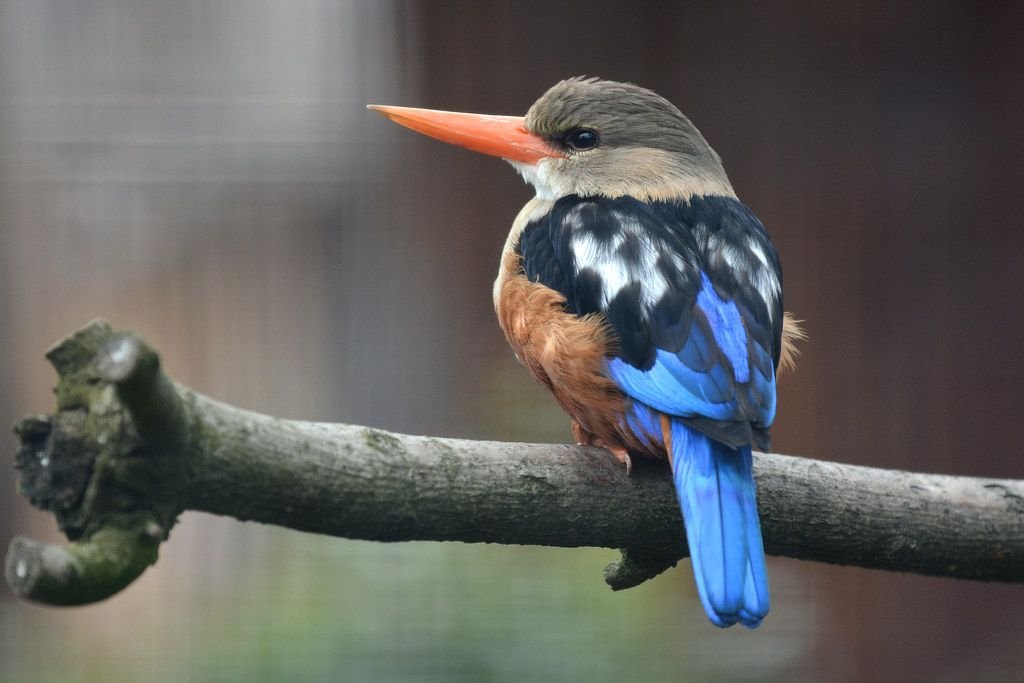
Grey-headed Kingfisher
Halcyon leucocephalaA striking dry-country kingfisher with a grey head, chestnut belly, blue wings and a vivid red bill.
The Grey-headed Kingfisher (Halcyon leucocephala) is a medium-sized member of the kingfisher family Alcedinidae. Unlike many kingfishers, it is not strongly tied to open water and commonly hunts from perches in woodland, bush and cultivated landscapes, often near streams or other water sources.
Grey-headed Kingfisher Quick Facts
What Is the Grey-headed Kingfisher?
The Grey-headed Kingfisher is also known as the Chestnut-bellied Kingfisher. It is a distinctive African kingfisher with a pale grey head, dark upperparts, bright blue wings and tail, chestnut underparts and a large red bill.
It is unusual among kingfishers because it often hunts away from open water. From a perch, it drops or dives to the ground to seize insects and small reptiles, then returns to cover or a lookout branch.
Across Tanzania it occurs in woodland and bush country, especially around Lake Manyara, Tarangire and other suitable dry-country habitats.
How to Identify a Grey-headed Kingfisher
Look for a compact kingfisher about 20–21 cm long with a grey head, blackish back, brilliant blue wings and tail, warm chestnut underparts and a conspicuous red bill. Sexes are broadly similar.
- Grey head and upper throat are pale grey to grey-brown.
- Mantle and back are dark, contrasting strongly with the blue wings and tail.
- Underparts are rich chestnut, giving the species its alternate name.
- Bill is long, strong and bright red.
- Eyes are dark with a purposeful, alert expression.
- In flight, the blue wing and tail feathers become especially obvious.
Distinguishing from Other Kingfishers
Its combination of grey head, chestnut belly and blue wings separates it from Tanzania’s other common kingfishers; its largely terrestrial hunting style is another useful clue.
Behavior & Social Life
Grey-headed Kingfishers are usually solitary or seen in pairs and defend feeding and breeding areas. They perch quietly, scanning open ground from branches, wires or other elevated lookouts.
Daily Activity
- Perching: watches the ground from exposed branches.
- Foraging: makes short, rapid sorties to seize prey on the ground.
- Movement: populations vary seasonally, and some birds move with rainfall and food availability.
Movement
Their calls are repeated sharp notes, while the song can form rising and falling waves of increasingly strident notes. During breeding they become more vocal and strongly territorial.
Habitat & Distribution
Typical habitat includes dry woodland, open bush, scrub, parkland and cultivated landscapes, often with nearby rivers, streams, gullies or other water sources.
- Woodland and dry savanna.
- Bush, scrub and open cultivated areas.
- Riparian edges, gullies and riverine woodland.
- Open country with scattered trees or perches.
It avoids the most arid landscapes but occupies a very broad belt of sub-Saharan Africa and parts of the Arabian Peninsula, using both natural and modified habitats.
Tanzania Distribution
In Tanzania, documented records include Lake Manyara, Tarangire and Silale Swamp, with the species described as widespread in woodland and bush and often encountered near water.
Grey-headed Kingfisher in Tanzania
Tanzania offers excellent opportunities to encounter this dry-country kingfisher, particularly in northern safari landscapes and woodland around productive wetlands.
Lake Manyara National Park
Documented adults and immatures; woodland and bush around the lake provide strong habitat.
Kingfisher safariTarangire National Park
Recorded regularly in woodland and bush, where birds use exposed perches to scan for prey.
Kingfisher safariSilale Swamp
Documented from the swamp and surrounding woodland, showing the species can occur close to seasonal water.
Kingfisher safariSerengeti & northern Tanzania
Suitable woodland and bush country provides additional opportunities, especially around wooded river systems and greener seasonal areas.
Kingfisher safariSafari Methods
- Game drives through woodland, bush and open savanna.
- Birdwatching from a quiet vehicle or walking route near suitable woodland.
- Wildlife photography from a respectful distance, especially around perches.
Best Time to See Them
The species may be encountered year-round in Tanzania, although local activity can vary with rainfall and breeding conditions. Morning and late-afternoon birding can be productive when birds are most visible from perches.
Diet & Feeding
The Grey-headed Kingfisher is a carnivorous, mainly insect-eating kingfisher that captures prey with fast sallies from elevated perches.
Food Sources
- Grasshoppers and other large insects.
- Beetles and caterpillars.
- Lizards and other small reptiles.
- Occasionally small fish or other small vertebrates.
Hunting Behavior
A bird usually sits motionless on a branch, then drops or swoops to the ground to catch prey. Its hunting style explains why it can thrive well away from open water.
Breeding & Life Cycle
Pairs excavate or use tunnel-like cavities in banks, gullies, termite mounds or similar suitable substrates. Both sexes contribute to nest excavation and parental care.
Nesting
- Nest: a burrow or tunnel leading to a nest chamber, often in a bank, gully or similar cavity.
- Eggs: usually 3–4 white eggs.
- Incubation: about 18–20 days, with both adults involved in the breeding cycle.
Chicks
Clutches contain about 3–4 eggs. Incubation is around 18–20 days, and chicks remain in the nest for roughly 25 days before fledging.
Conservation Status
The Grey-headed Kingfisher is currently assessed as Least Concern globally.
Its very large geographic range and adaptable use of woodland, bush and cultivated habitats help buffer it against localized habitat changes, although degradation of dry woodland and nesting banks can affect local populations.
Conservation of the species therefore benefits from protecting woodland mosaics, riparian vegetation and natural nesting banks while maintaining healthy insect prey communities.
- Habitat loss and woodland clearance can reduce suitable territories.
- Degradation of riverbanks and nesting banks can reduce breeding opportunities.
Comparisons
The Grey-headed Kingfisher is often identified by a distinctive combination of colours and by its habit of hunting from land-based perches rather than fishing in open water.
| Feature | Grey-headed Kingfisher | Woodland Kingfisher | Brown-hooded Kingfisher |
|---|---|---|---|
| Size | 20–21 cm | 20–23 cm | 23–25 cm |
| Head | Grey | Grey-brown to dark | Brown to chestnut |
| Wings | Bright blue | Dark/blue-green with white markings | Blue-green with chestnut/brown tones |
| Underparts | Chestnut | White to pale buff | White to pale buff |
| Habitat | Dry woodland, scrub, bush | Woodland, savanna, gardens | Woodland and wooded savanna |
| Diet | Insects, lizards, small vertebrates | Mostly insects | Insects and small vertebrates |
Did You Know?
Chestnut-bellied
The species is also known as the Chestnut-bellied Kingfisher because of its rich chestnut underparts.
Dry-country specialist
Although a kingfisher, it often hunts over dry ground rather than catching fish.
Red bill
The large, bright red bill is one of its strongest field marks.
Blue flash
The blue wings and tail can appear suddenly bright when a perched bird takes flight.
Ground hunter
From a perch it drops to the ground to capture insects and small reptiles.
Burrow nester
It excavates tunnel-like nesting cavities in banks, gullies and similar substrates.
The Grey-headed Kingfisher rewards the patient observer. It may sit quietly in a dry woodland, looking almost ordinary until the red bill, chestnut belly and electric blue wings catch the light. Then it drops like a stone to the ground, revealing why this bird is such an unusual and memorable kingfisher.
Gallery
Frequently Asked Questions
The Grey-headed Kingfisher (Halcyon leucocephala) is a medium-sized African kingfisher of woodland and bush, with a grey head, chestnut belly, blue wings and a red bill.
Tanzania records include Lake Manyara, Tarangire and Silale Swamp, with the species widespread in suitable woodland and bush.
It mainly eats insects such as grasshoppers and beetles, plus small reptiles and other small vertebrates.
No. The species is currently assessed as Least Concern globally.
Its rich chestnut underparts give it the alternate common name Chestnut-bellied Kingfisher.
It nests in tunnel-like cavities or burrows, often in banks or gullies, with about 3–4 eggs and incubation of roughly 18–20 days.
Look for the grey head, chestnut belly, bright blue wings and tail, and large red bill.
Tanzania Birds describes it as widespread in Tanzania, and records include resident/breeding-season and local movements; local activity varies with rainfall.
References & Further Reading
- BirdLife International — current taxonomy and global conservation framework; Grey-headed Kingfisher is listed as Least Concern.
- Tanzania Birds & Butterflies — Grey-headed Kingfisher records from Lake Manyara, Tarangire and Silale Swamp, including feeding and nesting observations.
- Mpala Live Field Guide — identification, size, habitat, feeding, social behaviour and breeding notes for Halcyon leucocephala.
- Oiseaux.net — measurements, diet and breeding details including 3–4 eggs, about 18 days incubation and about 25 days to fledging.
- Biodiversity Explorer — habitat, insect-rich diet, African seasonal movements and ground-bank burrow nesting.
- eBird / Macaulay Library — Tanzanian observation and photographic records for the species.
- Tanzania national bird checklist — Halcyon leucocephala listed as Grey-headed Kingfisher.