

.png)
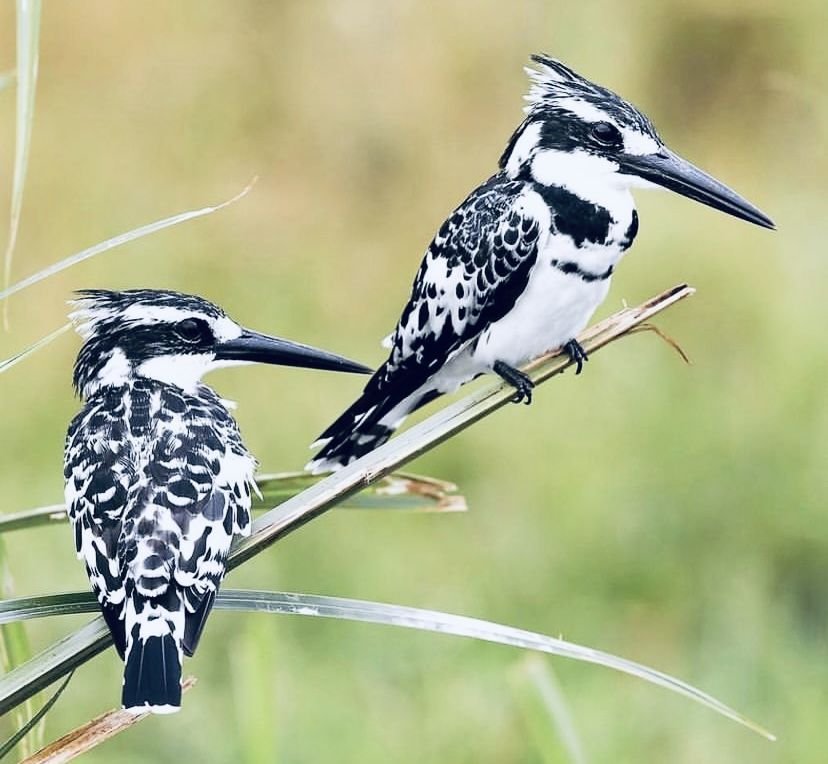
Pied Kingfisher
Ceryle rudisA black-and-white master of the hover, plunge and catch.
The Pied Kingfisher is one of Africa's most distinctive waterbirds. It can hold position above open water while searching for fish, then plunge bill-first into the water and emerge with its prey. In Tanzania it occurs around suitable rivers, lakes, reservoirs, wetlands and coastal waters, and has been recorded at birding sites including Lake Manyara, Seronera, Tarangire and Ruaha.
Pied Kingfisher Quick Facts
What Is the Pied Kingfisher?
The Pied Kingfisher (Ceryle rudis) is a medium-sized water kingfisher recognized instantly by its crisp black-and-white plumage, pointed bill, shaggy crest and remarkable habit of hovering above water before diving for prey. It belongs to the kingfisher group and is widely distributed across Africa, the Middle East and parts of Asia.
Its name reflects its pied, or strongly contrasting, black-and-white appearance. The bird is especially associated with open water where fish are available, but it can also use streams, reservoirs, estuaries, temporary pools and other productive aquatic habitats.
Unlike a kingfisher that must always wait on a branch to hunt, the Pied Kingfisher can search from the air. That aerial hunting style allows it to exploit open water where there may be few convenient perches.
How to Identify a Pied Kingfisher
The Pied Kingfisher is one of the easier African kingfishers to recognize once its combination of pattern, crest and fishing technique becomes familiar.
- Plumage: Bold black-and-white patterning covers the head, upperparts, wings and underparts.
- Crest: A noticeable dark crest gives the head a slightly shaggy outline.
- Bill: The bill is long, strong and pointed, built for striking fish and other aquatic prey.
- Breastbands: Adult males generally show two black breastbands, while females normally show a single breastband that is broken in the centre.
- Flight: The bird has a strong, direct flight between feeding areas and often pauses to hover over water.
- Perched posture: It may bob its head and flick its tail while watching the water.
How to Recognize It in Flight
At a distance, the flashing black-and-white pattern is often the first clue. Over open water, the more decisive clue is behaviour: a Pied Kingfisher may face into the wind, hold its position with rapid wingbeats and then suddenly drop into a steep plunge.
Behavior & Social Life
Pied Kingfishers are active during daylight and can be encountered singly, in pairs, or in family groups. They are more social than many kingfishers and may form groups around productive waters and communal roosting sites.
The Famous Hover
The hovering technique is the species' signature performance. The bird watches the water from above, often holding its body almost vertically with its head angled down. Once a fish is detected, it folds into a plunge and strikes with its bill. It can hunt from perches as well, but hovering gives it unusual freedom over open water.
Communication
The species is vocal, especially around breeding and social activity. Calls can be sharp, high-pitched and repeated, and several birds may call while flying or displaying. In a quiet wetland, the sound can reveal a Pied Kingfisher before the bird becomes visible.
Movement & Residency
Across much of its African range the Pied Kingfisher is a resident rather than a long-distance migrant. Local movements can still occur when water levels, fish availability or seasonal conditions change. This flexibility helps explain its presence across many kinds of aquatic landscapes.
Habitat & Distribution
The Pied Kingfisher follows food-rich water. It is not restricted to one kind of wetland and can occupy natural and human-modified aquatic habitats when clear or productive water supports suitable prey.
- Rivers and streams with fish and exposed banks for nesting.
- Lakes and reservoirs where open water creates hunting space.
- Dams and irrigation waters when fish and aquatic prey are available.
- Estuaries and coastal waters where small fish concentrate.
- Temporary pools and floodlands when seasonal water supports prey.
- Lower river valleys in some mountainous landscapes.
Globally, Ceryle rudis has a broad range across Africa and extends through parts of the Middle East and Asia. In Africa, its ability to use many different water bodies makes it one of the most familiar fish-eating kingfishers in suitable habitats.
Tanzania Distribution
Tanzania offers extensive habitat for the species. Tanzanian bird records include Pied Kingfishers from Emayani, Pembe Abwe, Ruaha, Seronera and Tarangire, while Lake Manyara's bird checklist also records the species. Coastal and inland wetlands provide additional suitable habitat wherever small fish and exposed banks occur.
Pied Kingfisher in Tanzania
For birdwatchers, the key is not simply finding a famous national park; it is finding water. Scan open lakeshores, river margins, dams, floodplain channels and productive wetlands, especially where birds can hover without dense vegetation blocking their view.
Lake Manyara
Lake Manyara supports a rich aquatic bird community, and Pied Kingfisher is included on the park's bird checklist. Scan the lake margins and other open water where small fish are available.
Explore Lake ManyaraTarangire Area
Tanzanian bird records include Pied Kingfishers from Tarangire. During suitable conditions, riverine and water-associated habitats can provide productive feeding areas.
Explore TarangireSeronera & Serengeti
Seronera is among the Tanzanian localities represented in Pied Kingfisher photographic records. Watercourses and pools can be worth checking during birding drives.
Explore SerengetiRuaha
Pied Kingfishers have also been photographed in Ruaha, demonstrating their use of Tanzania's riverine and inland-water environments beyond the northern circuit.
Explore RuahaBirdwatching Methods
- Scan the waterline: Look for exposed perches, hovering birds and sudden plunge dives.
- Listen first: Repeated high-pitched calls can reveal birds moving along a river or lake edge.
- Watch open water: Hovering is easiest to spot where vegetation does not block the water surface.
- Carry binoculars: The black-and-white pattern is distinctive, but distance can hide the breastband details.
Best Time to Watch
Because the species is diurnal, daylight birding is productive. Early morning and late afternoon are often comfortable for observers and can coincide with active feeding. At seasonal wetlands, local water levels may matter more than a single calendar month: where fish concentrate, Pied Kingfishers may follow.
Diet & Feeding
Fish make up the core of the Pied Kingfisher's diet. The bird is a specialized plunge-diver, but it is not restricted to fish and can take other aquatic prey when opportunities arise.
Food Sources
- Fish: The principal prey, especially small fish that can be carried and swallowed.
- Aquatic insects: Larger insects and aquatic larvae can supplement the diet.
- Crustaceans: Small crustaceans are taken where available.
- Amphibians: Frogs and large tadpoles may be taken less frequently.
- Other aquatic prey: Small mollusks and other suitable prey may be taken opportunistically.
From Hover to Swallow
The classic sequence is precise: hover, sight the prey, dive, strike and return from the water. Pied Kingfishers are unusual among kingfishers because they can swallow captured fish while still in flight rather than always carrying the prey back to a perch. This is part of what makes their fishing behaviour so visually dramatic.
Why Water Quality Matters
A fish-eating bird is closely connected to the condition of the water it hunts over. Changes in fish abundance, shoreline structure and aquatic pollution can affect feeding opportunities. Contaminants that accumulate in aquatic food webs can also become a conservation concern even for a species that remains globally common.
Breeding & Life Cycle
The Pied Kingfisher does something remarkable for a bird that spends so much time over water: it excavates its own nest tunnel in a bank. Both sexes participate in digging, loosening soil with the bill and pushing material out with the feet.
Nesting
- Location: A soft earth or sand bank, commonly near water.
- Construction: The pair excavates a tunnel leading to an unlined nest chamber.
- Clutch: One to seven eggs can occur; four to six are commonly reported in southern African studies.
- Eggs: Glossy and white.
- Incubation: About 18 days.
Cooperative Breeding
One of the species' most fascinating traits is cooperative breeding. Non-breeding birds, often males from earlier broods, can help the breeding pair. Helpers may contribute to feeding adults and young, turning the nest into a small family enterprise rather than a two-parent operation.
Young Birds
Young Pied Kingfishers develop rapidly. Flight feathers can develop within roughly two weeks, while parental and helper care continues beyond fledging as young birds learn to become effective hunters. The transition from nestling to independent fisher is therefore a gradual process, not simply a single flight from the burrow.
Conservation Status
The Pied Kingfisher is currently assessed as Least Concern globally. It remains widespread and common across much of its range, including many parts of Africa.
Being common does not mean that every local population is free from pressure. The species depends on functioning aquatic food webs and suitable nesting banks, and pollution can move through fish prey into fish-eating birds.
Local conservation priorities include:
- Protecting clean water: Healthy aquatic systems support the fish and invertebrates the species needs.
- Maintaining natural shorelines: Suitable banks can provide nesting sites.
- Protecting wetlands and rivers: A connected network of aquatic habitats helps birds find food as water levels change.
- Reducing toxic pollution: Contaminants that accumulate in fish can create risks even where birds remain abundant.
Comparisons
The Pied Kingfisher is easiest to separate from other Tanzanian kingfishers by its black-and-white plumage and hovering fishing style.
| Feature | Pied Kingfisher | Malachite Kingfisher | Giant Kingfisher | Woodland Kingfisher |
|---|---|---|---|---|
| Scientific name | Ceryle rudis | Corythornis cristatus | Megaceryle maxima | Halcyon senegalensis |
| Plumage | Bold black and white | Blue, orange and dark markings | Large black, white and brown tones | Blue, black and chestnut |
| Typical hunting style | Hover and plunge; also perch and plunge | Perch and plunge | Perch and plunge | Usually perch and strike prey |
| Main habitat | Open rivers, lakes, dams, estuaries and coasts | Streams, pools and vegetated waters | Rivers, lakes and larger waters | Woodland and savanna, often away from open water |
| Main diet | Fish and aquatic prey | Small fish and aquatic prey | Fish, frogs and other vertebrates | Insects and small vertebrates |
Did You Know?
Hovering Hunter
The Pied Kingfisher can search for fish while hovering above open water, a hunting technique that makes it exceptionally recognizable.
Black-and-White Signature
Its high-contrast plumage is one of the clearest field marks among African water kingfishers.
Water Follows Food
It can use rivers, lakes, reservoirs, estuaries, temporary pools and other waters when suitable prey is present.
Family Helpers
Non-breeding birds can help a breeding pair feed young, making cooperative breeding an important part of its life history.
Bank Builder
The nest is excavated into a bank rather than built as a conventional cup nest in a tree.
Tanzania Records
Tanzanian records include Lake Manyara, Tarangire, Seronera and Ruaha, alongside other suitable aquatic habitats.
A Pied Kingfisher encounter often begins before the dive. Watch the water, notice the bird hanging almost motionless against the wind, and wait for the sudden drop. For a few seconds the bird disappears beneath the surface; then it rises again, carrying the result of a calculation made in the air. Along Tanzania's lakes and rivers, this small drama connects a bird, a fish and an entire aquatic ecosystem in one unforgettable moment.
Gallery
Frequently Asked Questions
The Pied Kingfisher (Ceryle rudis) is a black-and-white water kingfisher famous for hovering over water before plunging to catch fish.
Tanzanian records include Lake Manyara, Tarangire, Seronera and Ruaha, and the species can occur around other suitable rivers, lakes, wetlands and coastal waters.
It feeds mainly on fish, with aquatic insects and crustaceans supplementing the diet. Frogs and other small aquatic prey may be taken less often.
It often hovers above the water, watches for prey and then dives bill-first. It can also hunt from a perch.
Males generally have two black breastbands, while females normally have a single breastband that is broken in the centre.
Both sexes excavate a tunnel in a suitable earth or sand bank near water, and non-breeding helpers may assist the breeding pair.
Clutches can range from one to seven eggs, with four to six commonly reported in southern African studies. The eggs are glossy white.
The species is currently assessed as Least Concern globally and remains widespread across Africa and parts of Asia.
It is generally resident across much of its African range, although local movements can occur as birds respond to water levels and food availability.
References & Further Reading
- Tanzanian Birds & Butterflies – Tanzania records and photographs of Pied Kingfishers from sites including Emayani, Pembe Abwe, Ruaha, Seronera and Tarangire.
- Lake Manyara National Park bird checklist – Pied Kingfisher listed among the park's kingfishers.
- Animal Diversity Web – Species account covering habitat, feeding, reproduction, behaviour and conservation.
- Mpala Live Field Guide – Identification, Tanzanian/East African field information and measurements.
- NCBI Taxonomy – Scientific name and taxonomic lineage for Ceryle rudis.
- Avibase / BirdLife taxonomic resources – Taxonomic and distribution cross-reference for the species.
- IUCN Red List framework – Global conservation status reference; the species is assessed as Least Concern.