

.png)
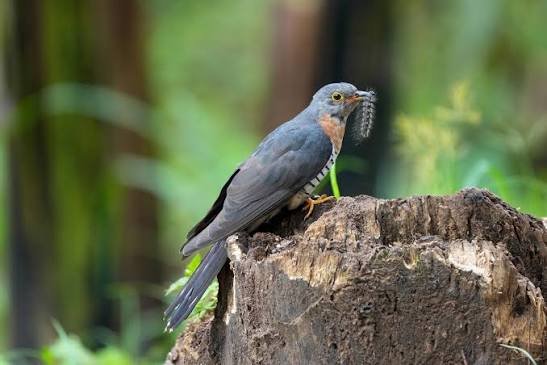
Red-chested Cuckoo
Cuculus solitariusA beautifully marked, highly vocal woodland cuckoo whose repeated three-note song can carry across the African landscape.
The Red-chested Cuckoo (Cuculus solitarius) is a medium-sized cuckoo in the family Cuculidae. It occurs in forests, closed woodland, wooded savanna, plantations and gardens, and is often heard before it is seen. The species feeds mainly on invertebrates and reproduces through brood parasitism, placing eggs in the nests of other birds.
Red-chested Cuckoo Quick Facts
What Is the Red-chested Cuckoo?
The Red-chested Cuckoo (Cuculus solitarius) is an African cuckoo recognized by its warm reddish chest, grey upperparts and loud three-note song.
It favours wooded environments across much of sub-Saharan Africa, including forest, closed woodland, tree-rich savanna, plantations, parks and mature gardens.
It is a brood parasite: females lay their eggs in the nests of other birds, leaving the host to incubate the egg and raise the young cuckoo.
How to Identify a Red-chested Cuckoo
The Red-chested Cuckoo is most safely identified by combining its plumage, shape and unmistakable song.
- Head and upperparts: Grey to dark grey, creating a subdued upper-body appearance.
- Chest: Warm reddish or chestnut wash across the upper breast.
- Underparts: Paler lower breast and belly, with darker barring on the lower breast.
- Tail: Dark and graduated, with pale or whitish tips that can show in flight.
- Shape: Slim, long-winged cuckoo with pointed wings and a relatively long tail.
- Juveniles: Darker young birds are more heavily barred below and can look quite different from adults.
Distinguishing from Other Cuckoos
Its reddish chest and three-note song help separate it from the darker Black Cuckoo and from smaller Chrysococcyx cuckoos. Voice is especially useful because the bird can remain hidden inside foliage.
Behavior & Social Life
The Red-chested Cuckoo is generally solitary and often secretive, but breeding-season calling can make it one of the most conspicuous sounds in wooded country.
Daily Activity
- Calling: A repeated three-note song is the classic field clue and may continue for long periods.
- Foraging: Searches leaves and branches for caterpillars and other invertebrates.
- Social behavior: Usually encountered singly; adults are most conspicuous when advertising during the breeding season.
Migration
Movements vary across Africa. Tanzania's checklist records the species as a breeding and intra-African migrant; local presence can therefore vary with season and breeding conditions.
Habitat & Distribution
The species is associated with habitats that combine mature trees, cover and abundant insect prey:
- Forest and Afromontane woodland: Dense vegetation provides feeding cover and habitat for potential host species.
- Miombo and closed woodland: Tree-rich landscapes can support both the cuckoo and its passerine hosts.
- Wooded savanna and parkland: Scattered mature trees and thickets provide suitable habitat.
- Gardens and plantations: Human-modified areas can remain useful where substantial tree cover persists.
Distribution: The Red-chested Cuckoo occurs widely in sub-Saharan Africa and generally avoids the most arid landscapes.
Tanzania Distribution
Tanzania has documented records from Tarangire National Park, Olasiti and Kisongo near Arusha, and the national checklist includes the species. It is most associated with woodland, forest and gardens.
Red-chested Cuckoo in Tanzania
Good opportunities come where woodland, gardens and mature trees support both the cuckoo and its host birds.
Tarangire National Park
Tanzanian records include adults and immature birds from Tarangire, making this one of the best-documented safari areas for the species.
Tarangire birdingArusha Area
Olasiti and Kisongo records show the species occurs around Arusha in wooded and garden habitats.
Arusha birdingSerengeti National Park
Tree-rich areas and woodland edges provide suitable habitat within the Serengeti ecosystem.
Serengeti birdingNgorongoro Conservation Area
Woodland and tree-rich habitats can support the species and its passerine hosts.
Ngorongoro birdingSafari Methods
- Birdwatching: Listen for the repeated three-note call before scanning leafy tree crowns.
- Game drives: Move slowly through wooded savanna and stop near mature trees for listening opportunities.
- Wildlife photography: Use patience and longer lenses because the cuckoo often stays partly hidden.
Best Time to See Them
The breeding and calling period offers the strongest chance of detection. Early morning is especially rewarding for listening, although birds may call later in the day as well.
Diet & Feeding
The Red-chested Cuckoo is chiefly insectivorous and is especially fond of caterpillars, with additional invertebrates and occasional small vertebrate or plant foods recorded.
Food Sources
- Caterpillars: A major food, including hairy caterpillars.
- Other insects: Beetles, grasshoppers and termite alates are among recorded prey.
- Spiders and other invertebrates: Spiders, centipedes, millipedes, snails and slugs may be taken.
- Occasional foods: Small frogs, lizards, host eggs and berries have also been recorded.
Hunting Behavior
Foraging is mainly among leaves and branches, where the cuckoo picks prey from foliage, especially in the canopy and middle storey.
Breeding & Life Cycle
Breeding is based on brood parasitism. Instead of building and provisioning its own nest, the female places an egg in a suitable host nest.
Nesting
- Nest parasitism: One cuckoo egg is placed in a host nest, often after a host egg has been removed.
- Eggs: Typically one cuckoo egg is laid in each parasitized nest.
- Incubation: The cuckoo egg hatches after roughly 12-14 days, depending on conditions and source.
Chicks
The young cuckoo hatches ahead of many host nestlings and may eject host eggs or young. It remains in the host nest for about 17-21 days and then depends on its foster parents for additional weeks.
Conservation Status
The Red-chested Cuckoo is currently assessed globally as Least Concern.
Its broad sub-Saharan range and tolerance of several wooded habitats support a comparatively secure global status, although local populations can still be affected by habitat change and loss of host species.
Important local pressures include:
- Habitat loss: Clearing woodland and mature trees reduces feeding cover and habitat for host birds.
- Host-bird decline: Because successful reproduction depends on other species, changes in host populations can affect cuckoo breeding opportunities.
Comparisons
The Red-chested Cuckoo is easiest to separate from similar cuckoos by its reddish chest, grey upperparts and characteristic three-note song.
| Feature | Red-chested Cuckoo | Black Cuckoo | African Emerald Cuckoo |
|---|---|---|---|
| Size | 28-31 cm | About 38 cm | About 22-24 cm |
| Upperparts | Grey | Dark brown-black | Metallic green |
| Chest | Reddish/chestnut | Usually dark | Green to coppery sheen |
| Main clue | Three-note call + red chest | Very dark plumage and call | Bright green adult plumage |
| Habitat | Woodland, forest, gardens | Woodland and forest | Forest and dense woodland |
| Breeding | Brood parasite | Brood parasite | Brood parasite |
Did You Know?
Three-note Signature
Its repeated three-note song is often the easiest way to locate the species.
Brood Parasite
It lays eggs in the nests of other birds and leaves them to raise its young.
Caterpillar Specialist
Hairy caterpillars are an important part of its invertebrate-rich diet.
Tanzania Records
Tarangire, Olasiti and Kisongo are among documented Tanzanian localities.
Often Heard First
The bird may remain hidden in foliage even when it is calling repeatedly nearby.
Flexible Woodland Species
It can use natural forest, woodland, plantations, parks and mature gardens.
There is something wonderfully deceptive about the Red-chested Cuckoo: a bird can be calling repeatedly from nearby woodland while remaining almost invisible among leaves. Once the three-note song becomes familiar, the landscape changes—you start hearing the cuckoo before you see it. Its insect-rich diet and remarkable brood-parasitic strategy make it one of Tanzania's most intriguing woodland birds.
Gallery
Frequently Asked Questions
The Red-chested Cuckoo (Cuculus solitarius) is a medium-sized African cuckoo in the family Cuculidae, recognized by its reddish chest and distinctive three-note song.
Documented Tanzanian records include Tarangire National Park, Olasiti and Kisongo near Arusha. Look in woodland, forest edges and mature gardens.
It feeds mainly on invertebrates, especially caterpillars, with beetles, grasshoppers, spiders, snails and other prey also recorded.
No. It is currently assessed globally as Least Concern, although local habitat and host-bird changes can still matter.
Its loud three-note song is highly distinctive, and its brood-parasitic breeding strategy is another defining characteristic.
It lays its eggs in the nests of other birds. The foster parents incubate the egg and raise the cuckoo chick.
Look for grey upperparts, a warm reddish chest and pale lower underparts, but listen especially for the repeated three-note call.
Tanzania's checklist records it as a breeding and intra-African migrant species, so local occurrence can vary seasonally rather than being uniform everywhere.
References & Further Reading
- Tanzania Birds – Red-chested Cuckoo species account with Tanzania records and notes on host-fed juveniles.
- Tanzania Birds Checklist – National checklist listing Cuculus solitarius as Red-chested Cuckoo.
- Biodiversity Explorer – Species account covering habitat, diet, brood parasitism, hosts and chick development.
- BirdLife DataZone – Current global bird taxonomy and IUCN category framework.
- BirdForum Opus – Range, habitat, diet, breeding and vocalization overview.
- Oiseaux.net – Identification, habitat and brood-parasitism notes.
- eBird – Field identification and distribution information for the species.