

.png)
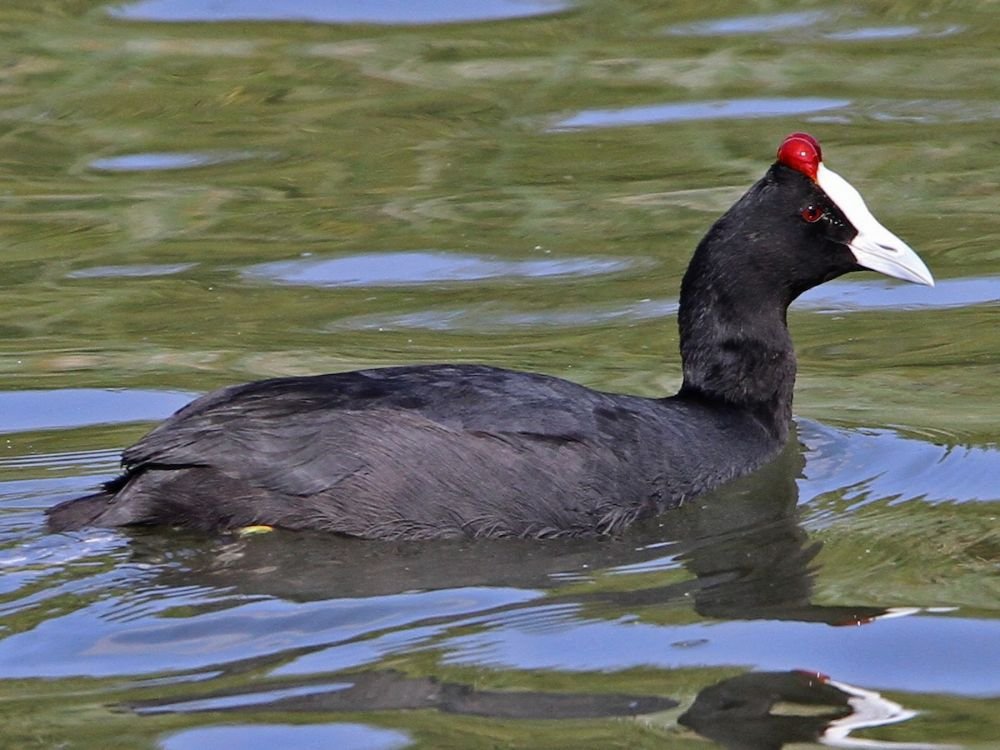
Red-knobbed Coot
Fulica cristataA distinctive waterbird with bright red knobs on its forehead – a fascinating and social inhabitant of Africa's freshwater lakes.
The Red-knobbed Coot (Fulica cristata), also known as the Crested Coot, is a medium-sized waterbird belonging to the rail family Rallidae. Found in Africa, the Iberian Peninsula, and Morocco, it is easily recognised by the two bright red knobs on its forehead, which are particularly prominent during the breeding season. This social and agile bird is a common sight on freshwater lakes, ponds, and marshes across Tanzania.
Red-knobbed Coot Quick Facts
What Is the Red-knobbed Coot?
The Red-knobbed Coot (Fulica cristata) is a medium-sized waterbird belonging to the rail family Rallidae, which includes rails, crakes, gallinules, and coots. It was first described by the German naturalist Johann Friedrich Gmelin in 1789. The species name cristata is from the Latin cristatus, meaning "crested", referring to the distinctive red knobs on the forehead.
The Red-knobbed Coot is the African representative of the coot family, closely related to the Eurasian Coot (Fulica atra) and the American Coot (Fulica americana). It was once considered a subspecies of the Eurasian Coot but is now treated as a separate species.
This bird is found in Africa, the Iberian Peninsula, and Morocco, with the largest populations in sub-Saharan Africa. It is a resident species in most of its range, though some populations may make local movements in response to rainfall and water availability.
How to Identify a Red-knobbed Coot
The Red-knobbed Coot is a distinctive and easily recognisable waterbird, especially by its red forehead knobs. Here are its key identifying features:
- Size: A medium-sized waterbird, measuring 38-45 cm (15-18 in) in length with a wingspan of 75-85 cm (30-33 in).
- Plumage: Dark grey to black overall, with a paler grey breast and belly. The head and neck are black.
- Forehead knobs: Two bright red knobs on the forehead, which are larger and more prominent in breeding adults. These give the bird its common name.
- Bill: White with a reddish base, with a distinctive white frontal shield extending onto the forehead.
- Legs and feet: Greyish-green, with large lobed toes adapted for swimming.
- Eye: Red.
- Breeding plumage: Red knobs become more prominent and brighter, and the plumage may take on a glossier appearance.
- Non-breeding and juvenile: Red knobs are smaller or absent, and the plumage is duller.
Distinguishing from Similar Species
The Red-knobbed Coot can be confused with the Eurasian Coot (Fulica atra). The Red-knobbed Coot is distinguished by the presence of red knobs on the forehead, which the Eurasian Coot lacks. The Eurasian Coot has a white bill with a black tip and lacks the red knobs. The Red-knobbed Coot also has a more rounded head and slightly different bill shape.
Behavior & Social Life
Red-knobbed Coots are highly social birds, often found in large flocks, especially during the non-breeding season. They are excellent swimmers and divers, spending much of their time on the water.
Swimming and Diving
- Swimming: Red-knobbed Coots are agile swimmers, using their lobed toes to propel themselves through the water.
- Diving: They are capable divers, diving to feed on aquatic plants and small animals. They can stay underwater for up to 15-20 seconds.
- Wing flapping: When they take to the air, they require a running start across the water, flapping their wings vigorously.
Social Behaviour
- Flocking: Often found in large flocks, sometimes numbering hundreds of individuals, especially on lakes and reservoirs.
- Aggressive displays: Red-knobbed Coots can be aggressive, particularly during the breeding season. They engage in threat displays, chasing, and fighting.
- Territoriality: During the breeding season, pairs defend territories around their nests.
Vocalization
Red-knobbed Coots are vocal birds, producing a variety of calls including harsh, grating notes, "kek-kek" calls, and a range of other sounds used for communication and alarm.
Habitat & Distribution
The Red-knobbed Coot is found in a variety of freshwater habitats across Africa and parts of Europe.
Key habitat types include:
- Freshwater lakes and ponds – with abundant aquatic vegetation.
- Marshes and swamps – particularly those with reedbeds and papyrus.
- Reservoirs and dams – man-made water bodies.
- Slow-moving rivers – with extensive marginal vegetation.
Distribution: The Red-knobbed Coot has an extremely large range, with an Extent of Occurrence of approximately 24,900,000 km². It is found across much of sub-Saharan Africa, from Senegambia in the west to Ethiopia and Kenya in the east, and southwards to South Africa. It also occurs in Morocco, the Iberian Peninsula (Spain and Portugal), and occasionally in other parts of Europe.
The species is largely resident in Africa, though some local movements may occur in response to rainfall. The European population is small and declining.
Tanzania Distribution
In Tanzania, the Red-knobbed Coot is found in freshwater lakes, ponds, and marshes across the country. It has been recorded in Serengeti National Park (particularly in Lake Ndutu and other wetland areas), Ngorongoro Conservation Area (in Lake Magadi), Tarangire National Park, and Ruaha National Park. It is also common in the Malagarasi wetlands and other major wetland areas.
Red-knobbed Coot in Tanzania
The Red-knobbed Coot is a common and widespread waterbird of Tanzania's lakes, ponds, and wetlands. Here are the best locations to see it:
Serengeti National Park
Found in the Serengeti's lake and wetland areas, particularly around Lake Ndutu, Lake Magadi, and the seasonal floodplains. Often seen in large flocks on open water.
Serengeti safariNgorongoro Crater
Recorded in the Ngorongoro Conservation Area, especially in the Lake Magadi area of the crater floor. Often seen swimming in the shallow alkaline waters.
Ngorongoro safariTarangire National Park
Found in the permanent and seasonal water bodies within the park, particularly during the dry season when water is scarce.
Tarangire safariRuaha National Park
A resident species in Ruaha's wetland areas along the Great Ruaha River and in seasonal pools.
Ruaha safariSafari Methods
- Game drives near lakes, ponds, and wetlands.
- Birdwatching – look for the dark grey plumage, white bill, and distinctive red forehead knobs.
- Wildlife photography – the Red-knobbed Coot's distinctive appearance and social behaviour make it an excellent photographic subject.
- Boat safaris – where available, boat-based viewing offers excellent opportunities to observe coots foraging and resting.
Best Time to See Them
Red-knobbed Coots are resident year-round in suitable habitat. The dry season (June to October) is generally best for wildlife viewing as birds congregate around remaining water sources. The breeding season typically occurs during the rainy season (November to May).
Diet & Feeding
The Red-knobbed Coot is an omnivore with a varied diet that changes seasonally.
Food Sources
- Aquatic plants: The staple diet, including submerged and emergent aquatic vegetation, seeds, and algae.
- Insects: Aquatic insects, larvae, and other invertebrates.
- Small fish and amphibians: Occasionally takes small fish and frogs.
- Molluscs and crustaceans: Snails, mussels, and small crustaceans.
Feeding Behavior
The Red-knobbed Coot feeds by diving from the water's surface, swimming underwater to forage on aquatic plants and small animals. It also feeds by upending (tipping forward with its tail in the air) in shallow water, and by grazing on vegetation at the water's edge. It is an agile and efficient forager, spending much of its day feeding.
Breeding & Life Cycle
The Red-knobbed Coot is monogamous and often mates for life.
Nesting
- Breeding season: Typically occurs during the rainy season, from November to May in East Africa.
- Nest site: A floating platform of aquatic vegetation, anchored to reeds, sedges, or other emergent vegetation.
- Nest construction: Both sexes build the nest, which is a cup-shaped structure lined with soft plant material.
- Clutch: 3 to 7 eggs.
- Incubation: 21 to 24 days, shared by both parents.
Chicks
Chicks are precocial (born covered in down and able to move around soon after hatching). Both parents care for the chicks, feeding them and protecting them. Young fledge at 45 to 55 days old but remain dependent on the parents for some time after fledging.
Conservation Status
The Red-knobbed Coot is assessed as Least Concern on the IUCN Red List.
Population: The global population is estimated at between 25,000 and 100,000 individuals. The population trend is stable.
Justification: This species has an extremely large range (24,900,000 km²) and hence does not approach the thresholds for Vulnerable. The population size is large, and the population trend is stable, so the species does not approach the thresholds for Vulnerable.
Threats: While the species is not currently threatened globally, it faces local threats including:
- Habitat loss: Drainage and degradation of wetlands.
- Pollution: Pesticides and other chemicals in water bodies.
- Human disturbance: Disturbance at breeding sites.
- Declining European population: The European population is small and declining.
The Red-knobbed Coot is listed on CITES Appendix II and is protected by various international agreements, including the African-Eurasian Waterbird Agreement (AEWA).
Comparisons
The Red-knobbed Coot is sometimes confused with other coots. Here are the key differences:
| Feature | Red-knobbed Coot | Eurasian Coot | American Coot |
|---|---|---|---|
| Forehead Knobs | Two bright red knobs | No knobs | No knobs |
| Bill | White with red base | White with black tip | White with dark band |
| Frontal Shield | White, rounded | White, pointed | White, rounded |
| Plumage | Dark grey to black | Black | Dark grey to black |
| Range | Africa, Iberia, Morocco | Europe, Asia, Australia | North & South America |
Did You Know?
Red Forehead Knobs
The Red-knobbed Coot is named for the two bright red knobs on its forehead, which are larger and more prominent during the breeding season.
Lobed Toes
Like all coots, the Red-knobbed Coot has large, lobed toes that are adapted for swimming, making it an agile and efficient swimmer.
Floating Nests
Red-knobbed Coots build floating nests of aquatic vegetation, anchored to reeds or other emergent plants.
Aggressive Displays
Coots can be highly aggressive, engaging in threat displays, chasing, and fighting to defend territories.
Widespread Resident
With a range of over 24 million square kilometres, the Red-knobbed Coot is one of the most widespread coot species in Africa.
European Presence
Unlike most African waterbirds, the Red-knobbed Coot also occurs in the Iberian Peninsula and Morocco.
There is a quiet beauty in the Red-knobbed Coot as it glides across the still waters of an African lake. Its dark plumage contrasts with the bright red knobs on its forehead, a flash of colour against the grey-green of the water. It moves with purpose, diving and resurfacing, always busy, always in motion. And when it takes flight, it skitters across the water with a flurry of wings, a sound that echoes across the lake. To watch a flock of coots is to witness the rhythm of life on the water – a constant, gentle movement that speaks of the abundance of Africa's wetlands.
Gallery
Frequently Asked Questions
The Red-knobbed Coot (Fulica cristata) is a medium-sized waterbird found in Africa, the Iberian Peninsula, and Morocco. It is a member of the rail family Rallidae and is easily recognised by the two bright red knobs on its forehead, which are particularly prominent during the breeding season.
Red-knobbed Coots are found in freshwater lakes, ponds, marshes, and reservoirs across Tanzania. Key locations include Serengeti National Park (particularly in the lake and wetland areas), Ngorongoro Conservation Area, Tarangire National Park, and Ruaha National Park.
The Red-knobbed Coot is an omnivore. Its diet consists mainly of aquatic plants, seeds, and algae, but it also takes aquatic insects, small fish, amphibians, molluscs, and crustaceans. It is an agile swimmer and dives to feed.
No. The Red-knobbed Coot is listed as Least Concern on the IUCN Red List. It has a large range of approximately 24,900,000 km² and a stable population, though it is declining in parts of its European range.
The Red-knobbed Coot is a medium-sized waterbird with dark grey to black plumage, a white bill with red knobs at the base, and a distinctive white frontal shield extending onto the forehead. The red knobs are more prominent in breeding adults.
The Red-knobbed Coot measures 38-45 cm (15-18 in) in length with a wingspan of 75-85 cm (30-33 in). It weighs between 550-900 grams (1.2-2.0 lb).
Red-knobbed Coots are monogamous and often mate for life. They build floating nests of aquatic vegetation anchored to reeds or other plants. The female lays 3-7 eggs which are incubated by both parents for about 21-24 days. Chicks fledge after 45-55 days.
In Swahili, the Red-knobbed Coot is known as Kivuli or Kivuli-maji.
References & Further Reading
- BirdLife International – Red-knobbed Coot: IUCN Red List assessment, Least Concern status, range 24,900,000 km², population estimate.
- Wikipedia – Red-knobbed coot: Description, distribution, habitat, diet, breeding, conservation.
- eBird – Red-knobbed Coot: Identification, distribution, sightings.
- Avibase – Red-knobbed Coot: Taxonomy, subspecies, distribution.
- BirdLife South Africa – Red-knobbed Coot: Biology, ecology, distribution.
- Oiseaux.net – Red-knobbed Coot: Photo records from Tanzania.
- South African National Biodiversity Institute – Red-knobbed Coot: Conservation status, threats, research.