

.png)
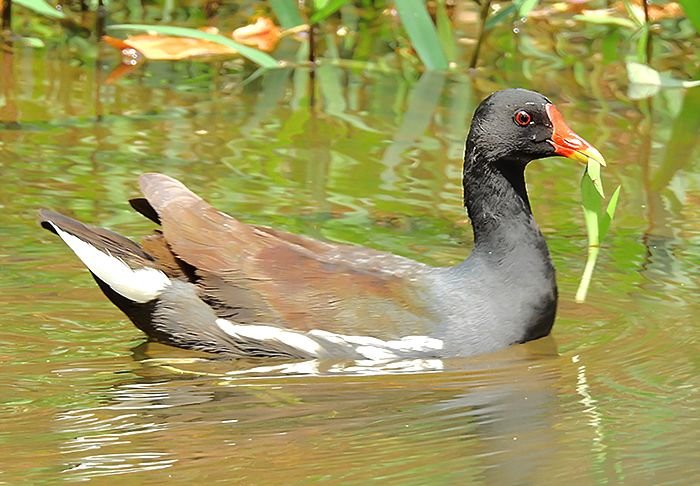
Common Moorhen
Gallinula chloropusA striking wetland rail with a scarlet frontal shield and a busy, ground-hugging feeding style.
The Common Moorhen (Gallinula chloropus) is a medium-sized member of the rail family Rallidae, closely associated with freshwater wetlands, ponds, marshes and shallow lake margins. It combines an olive-black body, white flank and undertail markings, yellow-green legs and a red bill and frontal shield with a yellow tip, making it one of the easiest rails to recognize when it steps into view.
Common Moorhen Quick Facts
What Is the Common Moorhen?
The Common Moorhen (Gallinula chloropus) is a medium-sized rail in the family Rallidae. It is widespread across much of the Old World and is strongly associated with freshwater wetlands that provide shallow water, emergent vegetation and cover.
Adults are recognizable by their dark olive-black body, white undertail and flank markings, greenish-yellow legs, and the bright red frontal shield that continues into a red bill with a yellow tip. In East Africa, the species is often listed as Eurasian Moorhen as a regional English name.
Unlike a bird that spends its life in open water, the Common Moorhen moves confidently between water and land. It feeds by walking through vegetation, picking food from plants and mud, and dipping into shallow water. This flexibility helps it use both natural wetlands and suitable man-made water bodies.
How to Identify a Common Moorhen
The Common Moorhen is one of the more approachable wetland rails once its key field marks are learned. Its dark body is contrasted by conspicuous white markings under the tail and along the flanks.
- Plumage: Mostly dark olive-black to slate tones above and on the body, with a darker head and breast.
- Bill and shield: Bright red bill with a yellow tip and a red frontal shield on the forehead.
- White markings: A clean white undertail and white flank stripes are particularly useful when the bird walks through reeds or along muddy edges.
- Legs: Greenish-yellow legs and feet, often visible as it walks rather than swims.
- Posture and movement: A compact rail that walks with deliberate steps, often flicking the tail to reveal the white undertail.
- Juveniles: Browner and duller, lacking the vivid red frontal shield of adults.
Distinguishing from Other Wetland Rails
The easiest comparison in Tanzania is with the Lesser Moorhen and Black Crake. The Common Moorhen usually shows a conspicuous red frontal shield and yellow-tipped bill, while the Black Crake has a different facial pattern and bright yellow bill. Its white flank and undertail markings also help separate it from several other dark rails.
Behavior & Social Life
The Common Moorhen is active, alert and highly adaptable. It spends much of its time around dense aquatic vegetation, where it can forage, hide and rest. It may swim in open water but frequently leaves the water to feed along grassy margins and muddy edges.
Daily Activity
- Foraging: Walks among reeds, sedges and grasses, picks food from leaves and the ground, and dips its head to take items from shallow water.
- Swimming: Uses steady paddling to cross ponds and channels, but often prefers vegetated margins to completely open water.
- Territorial behavior: Adults can become strongly defensive around breeding territories and may chase rivals from favored feeding and nesting areas.
Vocalization
A varied repertoire of clucks, rattles, grunts and sharper calls helps maintain contact, advertise territory and signal alarm. Calls are often easiest to hear when vegetation makes the birds difficult to see.
Habitat & Distribution
The Common Moorhen favors wetlands with both water and cover. It is especially associated with freshwater habitats where emergent vegetation provides feeding platforms and shelter:
- Permanent and seasonal marshes with reeds, sedges and tall aquatic vegetation.
- Ponds, small lakes and shallow lake margins, especially where the shoreline is well vegetated.
- Slow-moving channels, drainage canals and other calm freshwater bodies.
- Wet grassland and cultivated landscapes where suitable water and cover remain.
Distribution
Distribution
Tanzania Distribution
Common Moorhen in Tanzania
The Common Moorhen can be surprisingly easy to overlook because it often stays close to reeds and shoreline cover. In Tanzania, productive freshwater wetlands offer strong opportunities to look for it:
Lake Manyara National Park
A well-documented wetland site where Eurasian Moorhen is included on the park bird checklist. Look around vegetated shoreline and freshwater habitats.
Lake Manyara birdingNgorongoro Crater
Recorded in the crater’s wetland habitats, where marshy edges and shallow water can provide feeding areas.
Ngorongoro birdingTarangire National Park
Tanzanian photo records include moorhens from Tarangire, particularly around suitable permanent or seasonal water and vegetated margins.
Tarangire birdingSerengeti National Park
Documented Tanzanian records include the Serengeti, where wetland edges and permanent water can support the species.
Serengeti birdingSafari Methods
- Birdwatching: Scan reed beds, marsh edges and shallow water slowly, watching for the red shield and white undertail.
- Game drives: Use waterhole and wetland stops as focused birding opportunities rather than searching only in open savanna.
- Photography: Early morning light can reveal the subtle olive tones of the body while the red shield and yellow-tipped bill provide a strong focal point.
Best Time to See Them
Common Moorhens are present year-round in suitable habitat. They are most active during the cooler morning and evening hours .
Diet & Feeding
The Common Moorhen is an opportunistic omnivore. Its diet changes with what is most available, allowing it to exploit both plant material and small aquatic or terrestrial animals. This flexible feeding strategy is one reason the species can occupy many different wetland types.
Food Sources
- Aquatic vegetation: Young shoots, leaves, algae and other soft plant material.
- Seeds and fruits: Seeds, grains and small fruits taken from wetland margins and nearby vegetation.
- Invertebrates: Snails, insects, worms and other small arthropods.
- Animal prey: Small amphibians, fish, eggs or carrion may be taken opportunistically.
Foraging Behavior
Animal prey: Small amphibians, fish, eggs or carrion may be taken opportunistically.
Breeding & Life Cycle
Breeding timing varies with geography and local water conditions. The Common Moorhen is territorial during reproduction, and both adults contribute to nest building, incubation and care of the young.
Nesting
- Nest: A cup or platform of reeds, rushes, grass and other plant material, usually concealed in dense vegetation close to or over water.
- Eggs: Commonly about 5–9 eggs, though clutch size can vary across populations.
- Incubation: Roughly 17–22 days, with both sexes participating in incubation in documented populations.
Chicks
Chicks
Conservation Status
The Common Moorhen is currently assessed as Least Concern globally. Its broad geographic range and generally widespread populations keep it well outside the global threatened categories.
Wetland condition still matters locally. Drainage, pollution, shoreline disturbance, excessive vegetation removal and other changes to shallow freshwater habitats can reduce the places where moorhens feed and breed.
Practical conservation therefore centers on maintaining functioning wetlands, protecting vegetated shorelines, reducing pollution and retaining a mosaic of open water and cover. Healthy wetland management also benefits many other waterbirds that share the same habitat.
- Wetland drainage and conversion can remove feeding and nesting habitat.
- Water pollution can reduce food resources and degrade breeding areas.
Comparisons
The Common Moorhen can be separated from other dark wetland rails by its red frontal shield, yellow-tipped bill and white undertail. Key differences are summarized below.
| Feature | Common Moorhen | Lesser Moorhen | Black Crake |
|---|---|---|---|
| Size | 31–35 cm | About 30 cm | About 31–36 cm |
| Bill & shield | Red shield; red bill with yellow tip | Red shield; different proportions and plumage | Yellow bill; yellow frontal shield |
| Plumage | Dark olive-black with white flank/undertail | Darker slate-black overall | Dark body with white undertail |
| Habitat | Freshwater marshes, ponds, lakes | Wetlands, swamps and shallow water | Marshes, floodplains and wet grasslands |
| Diet | Plants, seeds, insects, snails and small prey | Plants and small invertebrates | Invertebrates, seeds and small vertebrates |
| Diet | Rodent specialist | Reptiles, small mammals | Large gamebirds, mammals |
Did You Know?
Wetland Acrobat
The Common Moorhen can move between swimming and walking almost seamlessly, often leaving the water to forage through dense shoreline vegetation.
A Red Shield
The vivid red frontal shield is one of the species’ most useful adult field marks, contrasting strongly with its dark head and body.
White Signals
The white undertail is conspicuous when the bird flicks its tail, making it useful both for identification and communication.
Flexible Feeder
It eats both plant and animal foods, including seeds, aquatic vegetation, insects and snails.
Early Independence
Moorhen chicks leave the nest very early and are mobile soon after hatching, while remaining under parental care.
Tanzania Wetland Bird
In Tanzania, records span permanent waters and major wetland-rich areas including Lake Manyara, Tarangire, Serengeti and Ngorongoro.
There is something wonderfully expressive about a Common Moorhen on a quiet Tanzanian wetland. One moment it is paddling through open water; the next it is walking through reeds, flicking its white undertail and searching the mud for food. In a landscape famous for large mammals, this small rail reminds a birder that some of the richest safari moments happen at the water’s edge.
Gallery
Frequently Asked Questions
The Common Moorhen (Gallinula chloropus) is a medium-sized rail in the family Rallidae, associated mainly with freshwater wetlands and vegetated shorelines.
Documented Tanzanian locations include Lake Manyara, Ngorongoro, Tarangire and Serengeti, especially around suitable permanent or seasonal wetlands.
It is an omnivore taking aquatic plants, seeds, insects, snails, worms and other small animal foods.
No. The Common Moorhen is globally assessed as Least Concern.
Look for the dark body, white flank and undertail markings, yellow-green legs, and red bill and frontal shield with a yellow tip.
It builds a plant nest in dense vegetation near or over water. Typical clutches are about 5–9 eggs and incubation is roughly 17–22 days.
Suitable permanent wetlands can hold resident birds year-round, although local movements may occur as water conditions change.
The Common Moorhen generally shows a larger, more conspicuous red frontal shield and a distinctive red bill with yellow tip; careful comparison of size and plumage is useful.
References & Further Reading
- BirdLife DataZone – Current taxonomy and IUCN assessment framework for birds; the Common Moorhen is treated as Gallinula chloropus.
- Tanzanian Birds & Butterflies – Tanzania records and site information for the Eurasian/Common Moorhen, including Moshi, Lake Manyara, Tarangire, Serengeti and Ngorongoro.
- Lake Manyara National Park bird checklist – Confirms Eurasian Moorhen (Gallinula chloropus) among the park’s rails and wetland birds.
- Animal Diversity Web – Species ecology, feeding and breeding information, including incubation and fledging ranges.
- BTO BirdFacts – Field identification and basic statistics for Moorhen.
- BirdForum Opus – Breeding, nesting and vocalization references compiled from standard ornithological sources.
- Oiseaux.net – Updated species references and distribution resources for Gallinula chloropus.