

.png)
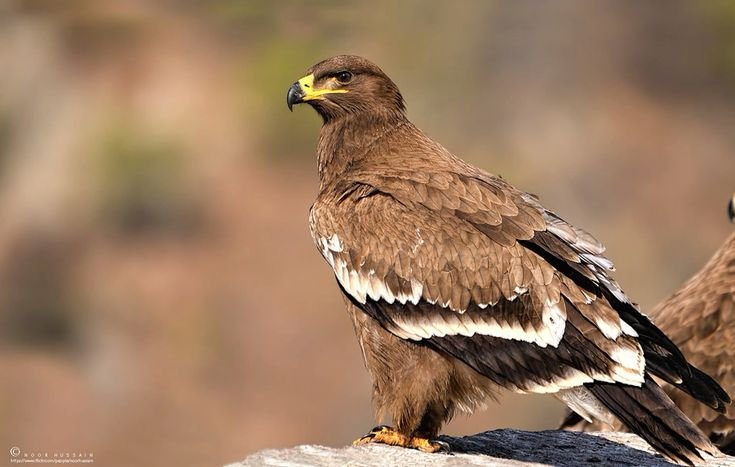
Steppe Eagle
Aquila nipalensisA large, tawny-brown eagle that migrates thousands of kilometres to winter in Tanzania.
The Steppe Eagle (Aquila nipalensis) is a large bird of prey in the family Accipitridae . It is a large, tawny-brown eagle with a length of 62-81 cm and a wingspan of 165-210 cm . This species is a migratory visitor to Tanzania, arriving from its breeding grounds in Central Asia to spend the northern winter in Africa .
Steppe Eagle Quick Facts
What Is the Steppe Eagle?
The Steppe Eagle (Aquila nipalensis) is a large bird of prey in the family Accipitridae . It is a large, tawny-brown eagle with a length of 62-81 cm and a wingspan of 165-210 cm .
The species was first described by the English naturalist Brian Houghton Hodgson in 1833, under the name Falco nipalensis . It is a long-distance migratory bird that breeds in the steppe regions of Central Asia and eastern Europe, and winters in Africa, the Middle East, and South Asia .
In Tanzania, the Steppe Eagle is a common winter visitor, arriving from October and departing by March-April .
How to Identify a Steppe Eagle
The Steppe Eagle is a large, tawny-brown eagle, often seen perched on the ground or soaring high above the savanna .
- Plumage: Tawny-brown to dark brown, with a pale head and neck .
- Head: Pale crown and nape, contrasting with the darker body .
- Bill: Large and strong, with a yellow cere .
- Eyes: Dark brown eyes .
- Legs: Yellow legs .
- Tail: Medium-length with dark bands .
Distinguishing from Other Eagles
It can be confused with the Tawny Eagle, but is larger, has a more prominent gape (mouth) line, and a longer tail . The Steppe Eagle also has a paler head and neck, and tends to soar with a flatter wing posture .
Behavior & Social Life
The Steppe Eagle is a gregarious migrant, often gathering in large numbers at carrion . In Tanzania, it is a winter visitor that spends the northern winter in open savannas .
Daily Activity
- Hunting: It hunts mainly from the ground or from a low perch, catching small mammals and insects .
- Soaring: Frequently seen soaring in pairs or larger groups, especially during migration .
- Vocalization: The call is a harsh "kraa-kraa" or "kak-kak-kak" .
Migration
The Steppe Eagle is a long-distance migrant, breeding in Central Asia and wintering in Africa and India. It is one of the most numerous eagles seen in Tanzania during the northern winter .
Habitat & Distribution
The Steppe Eagle is found in a variety of open habitats :
- Open savanna and grassland .
- Dry woodland and scrub .
- Steppe and semi-desert regions .
- Cultivated areas and near waterbodies .
Distribution: It breeds from Romania and the Ukraine east across Russia and Central Asia to Mongolia and China . In winter, it moves south to Africa, the Middle East, the Indian subcontinent, and South Asia .
Tanzania Distribution
In Tanzania, it is a common winter visitor found in the northern and southern parks, including the Serengeti, Ngorongoro, Tarangire, and Ruaha .
Steppe Eagle in Tanzania
The Steppe Eagle is a common winter visitor to Tanzania's open savannas. Here are the best locations to see it:
Serengeti National Park
Winter visitor in the Serengeti's open plains and woodlands .
Serengeti safariTarangire National Park
Found in Tarangire's open savannas and acacia woodlands during the wet season .
Tarangire safariSafari Methods
- Game drives through open savanna and woodland habitats.
- Birdwatching – watch for soaring eagles during the heat of the day .
- Wildlife photography – their large size and pale head make them striking subjects.
Best Time to See Them
Steppe Eagles are present in Tanzania from October to March, as winter visitors . They are most active during the cooler morning and evening hours .
Diet & Feeding
The Steppe Eagle is a carnivore with a varied diet .
Food Sources
- Small mammals: Ground squirrels, hares, rodents, and other small mammals .
- Birds: Small to medium-sized birds .
- Reptiles: Lizards and snakes .
- Insects: Locusts, grasshoppers, and termites .
- Carrion: Often seen at kills and carcasses .
Hunting Behavior
It hunts mainly from the ground or a low perch, catching prey by surprise attack . It is also a frequent scavenger, often seen in large groups at carcasses .
Breeding & Life Cycle
The Steppe Eagle breeds in the steppe zones of Central Asia, where it builds a nest on the ground or in a low bush .
Nesting
- Nest: A stick nest placed on the ground or in a low bush .
- Eggs: 1-3 white eggs .
- Incubation: About 45 days, performed mainly by the female .
Chicks
Chicks fledge at approximately 65 days, but remain dependent on the parents for several more weeks .
Conservation Status
The Steppe Eagle is assessed as Least Concern on the IUCN Red List .
It has an extremely large range, and although it is considered Least Concern, some populations are declining due to habitat loss, electrocution on power lines, and persecution .
Despite its secure status, it faces some local threats:
- Habitat loss due to conversion of steppe and grassland to agriculture .
- Electrocution on power lines, particularly during migration .
- Persecution in some areas .
- Poisoning at carcasses baited for other species .
Comparisons
The Steppe Eagle is sometimes confused with other brown eagles. Here are the key differences:
| Feature | Steppe Eagle | Tawny Eagle | Wahlberg's Eagle |
|---|---|---|---|
| Size | 62-81 cm | 65-72 cm | 53-61 cm |
| Wingspan | 165-210 cm | 165-185 cm | 130-146 cm |
| Migration | Long-distance migrant | Resident | Partial migrant |
| Gape | Prominent gape line | Less prominent | No prominent gape |
| Habitat | Open savanna, grassland | Open savanna, arid | Woodland, savanna |
| Status in Tanzania | Winter visitor | Resident | Resident |
Did You Know?
Long-Distance Migrant
It breeds in Central Asia and winters in Africa, covering thousands of kilometres twice a year .
Winter Visitor
In Tanzania, it is present from October to March as a winter visitor .
Scavenger
It is often seen in large groups at carcasses, making it an important scavenger in the ecosystem .
Prominent Gape
Its gape (mouth line) extends back to the eye, giving it a distinctive appearance .
Large Size
With a wingspan of up to 210 cm, it is one of the largest eagles seen in Tanzania .
Named for Breeding Area
It is named for its breeding habitat in the steppe (grassland) regions of Central Asia .
There is a quiet majesty in the Steppe Eagle. These great birds travel thousands of kilometres to spend the winter on Africa's vast savannas, gathering in numbers at carcasses and soaring high above the plains. Their presence connects Tanzania to the vast steppes of Asia, a reminder that the natural world knows no borders. Watching a group of Steppe Eagles soar on a thermal is to witness one of the great wildlife spectacles of the migration season.
Gallery
Frequently Asked Questions
The Steppe Eagle (Aquila nipalensis) is a large bird of prey in the family Accipitridae. It is a large, tawny-brown eagle with a length of 62-81 cm and a wingspan of 165-210 cm .
The Steppe Eagle is a winter visitor to Tanzania, found in open savannas, grasslands, and woodland edges. Key locations include Serengeti National Park , Ngorongoro Crater , Tarangire National Park , and Ruaha National Park .
It is a carnivore, feeding mainly on small mammals such as ground squirrels, hares, and rodents, along with carrion, birds, and reptiles .
No. The Steppe Eagle is listed as Least Concern on the IUCN Red List. However, some populations are declining due to habitat loss and persecution .
It is named for its breeding habitat in the steppe (grassland) regions of Central Asia, where it nests on the ground or on low bushes .
It breeds in the steppe zones of Central Asia, building a nest on the ground or in a low bush. The female lays 1-3 eggs, which are incubated for about 45 days, and chicks fledge at approximately 65 days .
It is present from October to March as a winter visitor .
It is identifiable by its large size, tawny-brown plumage, pale head and neck, prominent gape line, and relatively long tail .
References & Further Reading
- BirdLife DataZone – Steppe Eagle species factsheet: IUCN Least Concern, Extent of Occurrence, range, threats .
- Wikipedia – Steppe eagle: Scientific name, description, taxonomy, distribution, habitat, diet, breeding, migration .
- eBird – Steppe Eagle: Identification, vocalization, range .
- Birds of the World (Kemp & Marks, 2020) – Steppe Eagle: Detailed species account, measurements, diet, breeding .
- Raptors of the World (Ferguson-Lees & Christie, 2001) – Steppe Eagle: Identification, flight, behavior .
- Oiseaux.net – Steppe Eagle: Confirmed photo records from Tanzania .
- iNaturalist – Steppe Eagle observation records from Tanzania .