

.png)
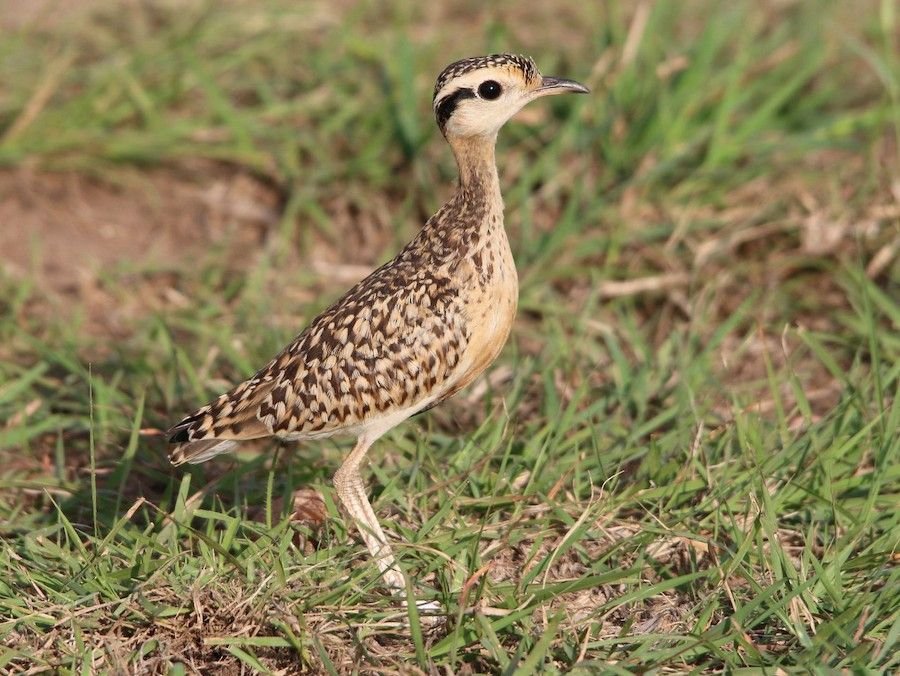
Temminck's Courser
Cursorius temminckiiA tiny, elegant runner of Africa's open plains – a master of camouflage in the burnt grasslands.
Temminck's Courser (Cursorius temminckii) is a small, slender wader in the pratincole and courser family Glareolidae. It is the smallest of all coursers and boasts the most widespread distribution of any courser species[reference:0][reference:1]. This elegant bird is a master of camouflage, its sandy-brown plumage blending perfectly with the open grasslands and burnt savannahs it inhabits across sub-Saharan Africa.
Temminck's Courser Quick Facts
What Is Temminck's Courser?
Temminck's Courser (Cursorius temminckii) is a small, elegant wader belonging to the family Glareolidae, which includes coursers and pratincoles[reference:2]. It was first described by the English naturalist William Swainson in 1822[reference:3]. The common name and Latin binomial commemorate the Dutch naturalist Coenraad Jacob Temminck[reference:4].
This species is the smallest of all coursers and has the most widespread distribution of any courser species, found across much of sub-Saharan Africa[reference:5][reference:6]. It is a nomadic or partially migratory species, with some populations breeding in the Sahel region and moving south during the austral summer[reference:7]. The Temminck's Courser is noted for its remarkable camouflage, particularly its habit of laying its dark ash-black eggs directly on the ground in burnt areas of the African savannah[reference:8][reference:9].
There are three recognised subspecies: C. t. temminckii (Senegal to Ethiopia and Kenya), C. t. ruvanensis (Tanzania to Angola, Mozambique and northeastern South Africa), and C. t. aridus (northern Namibia to western Zimbabwe)[reference:10][reference:11]. The subspecies C. t. ruvanensis is the one found in Tanzania[reference:12].
How to Identify Temminck's Courser
Temminck's Courser is a distinctive and elegant bird, easily recognised by its small size, long legs, and striking head pattern. Here are its key identifying features[reference:13][reference:14]:
- Size: The smallest of all coursers, measuring 19-21 cm (7.5-8.3 in) in length and weighing 64-80 g (2.3-2.8 oz)[reference:15][reference:16].
- Plumage: Overall sandy-brown upperparts and light brown chest, providing excellent camouflage against the savannah[reference:17][reference:18].
- Crown: Distinctive rufous (reddish-brown) crown[reference:19].
- Head pattern: White stripe above the eye (supercilium) and a black mask or line through the eye[reference:20][reference:21].
- Belly: Black patch on the belly[reference:22].
- Wings: Completely black in flight – a key identification feature[reference:23].
- Legs: Long legs, adapted for running[reference:24].
Distinguishing from Similar Species
Temminck's Courser can be distinguished from other coursers by its unique combination of features: the rufous crown, the black belly patch, and the all-black wing in flight[reference:25]. Its small size and widespread distribution also help differentiate it from other courser species.
Behavior & Social Life
Temminck's Courser is a terrestrial bird that spends most of its time on the ground, walking and running nimbly in search of food[reference:26].
Foraging Behavior
- Terrestrial habits: It prefers to run rather than fly, using its long legs to move quickly across the ground[reference:27].
- Foraging technique: Uses a characteristic 'run and stop' method, running rapidly and then pausing to peck at prey[reference:28][reference:29].
- Head ducking: Like all coursers, it ducks its head and runs across the ground at great speed[reference:30].
- Social behaviour: Usually encountered in pairs or small family groups[reference:31][reference:32].
Vocalization
- Call: A mournful, off-key, up-and-down series of notes, usually delivered in flight[reference:33].
- Detection: The distinctive call is often the first indication of the species' presence[reference:34].
Habitat & Distribution
Temminck's Courser is found in a variety of open habitats across sub-Saharan Africa, favouring areas with short or recently burned grass[reference:35].
Key habitat types include[reference:36][reference:37][reference:38]:
- Short grassland – particularly areas with sparse vegetation.
- Recently burned areas – the species is attracted to fires and may arrive within a day of a burn[reference:39].
- Semi-desert – and arid savannah.
- Overgrazed pastures – and fallow fields.
- Agricultural fields – and cultivated areas.
- Sports fields and airstrips – exhibiting a tolerance for human-modified habitats[reference:40].
Distribution: Temminck's Courser is widely distributed across sub-Saharan Africa, with an Extent of Occurrence of approximately 22,200,000 km²[reference:41][reference:42]. Its range extends from Senegal in the west to Ethiopia and Kenya in the east, and southwards to South Africa[reference:43].
Tanzania Distribution
In Tanzania, Temminck's Courser is found in open grasslands and burnt areas across the country. The subspecies C. t. ruvanensis occurs from Tanzania to Angola, Mozambique and northeastern South Africa[reference:44][reference:45]. It has been recorded in Serengeti National Park (particularly in the Mara region)[reference:46], Ngorongoro Conservation Area[reference:47], Tarangire National Park, and Ruaha National Park.
Temminck's Courser in Tanzania
Temminck's Courser is a fascinating and secretive bird of Tanzania's open grasslands. Here are the best locations to see it:
Serengeti National Park
Recorded in the Serengeti, particularly in the Mara region[reference:48]. Often found in recently burned areas and open grasslands where it can be seen running and foraging.
Serengeti safariNgorongoro Crater
Recorded in the Ngorongoro Conservation Area, especially in the open grasslands of the crater floor[reference:49]. Look for them in short grass areas and recently burned patches.
Ngorongoro safariTarangire National Park
Found in the open grasslands and short grass areas of Tarangire. Often seen in pairs or small groups foraging on the ground.
Tarangire safariRuaha National Park
A resident species in Ruaha's open grasslands and burnt areas. Often found in recently burned patches where they forage for insects.
Ruaha safariSafari Methods
- Game drives in open grasslands, burnt areas, and short grass habitats.
- Birdwatching – look for the small, sandy-brown bird with long legs, running and stopping on the ground.
- Wildlife photography – the Temminck's Courser's elegant appearance and distinctive head pattern make it a rewarding subject.
- Listen for calls – the mournful call is often the first indication of the species' presence[reference:50].
- Look for burns – the species is attracted to recently burned areas and may be seen within a day of a fire[reference:51].
Best Time to See Them
Temminck's Courser is present year-round in suitable habitat, though some populations may move seasonally[reference:52]. The dry season (June to October) is generally best for wildlife viewing as birds are more visible in the open grasslands. The breeding season is typically towards the end of the dry season when seasonal fires create their preferred breeding habitat[reference:53].
Diet & Feeding
Temminck's Courser is primarily an insectivore, feeding on a variety of small invertebrates[reference:54][reference:55].
Food Sources
- Insects: Beetles, grasshoppers, ants, and other small insects[reference:56].
- Termites: A significant part of the diet[reference:57][reference:58].
- Molluscs: Small snails and other molluscs[reference:59][reference:60].
- Seeds: Occasionally takes seeds[reference:61][reference:62].
Feeding Behavior
The Temminck's Courser forages on the ground, using a characteristic 'run and stop' technique. It runs quickly across the ground, then stops to pick insects and other small prey from the surface[reference:63][reference:64].
Breeding & Life Cycle
Temminck's Courser is a monogamous ground-nesting bird[reference:65][reference:66].
Nesting
- Breeding season: Typically towards the end of the dry season, when seasonal fires create their preferred breeding habitat[reference:67]. Being nomadic, breeding has been recorded throughout the year, particularly in arid regions[reference:68].
- Nest site: Makes no nest, laying its eggs directly on bare ground[reference:69][reference:70].
- Eggs: 1-2 dark ash-black eggs[reference:71][reference:72]. They are usually laid among ungulate droppings to disrupt the outline of the eggs[reference:73].
- Camouflage: The eggs and young bear a remarkable resemblance to burnt grass, offering excellent camouflage in an environment that provides minimal cover[reference:74].
- Incubation: About 26 days[reference:75].
- Parental care: Both sexes feed the young[reference:76]. Chicks can fly strongly by 28 days of age[reference:77].
Conservation Status
Temminck's Courser is assessed as Least Concern on the IUCN Red List[reference:78][reference:79].
Population: The global population is estimated at 40,000 to 190,000 mature individuals (60,001-285,000 total individuals)[reference:80][reference:81]. The population trend is not known, but the population is not believed to be decreasing sufficiently rapidly to approach the thresholds for Vulnerable[reference:82].
Justification: This species has an extremely large range (22,200,000 km²) and hence does not approach the thresholds for Vulnerable under the range size criterion[reference:83]. The population size may be moderately small to large, but it is not believed to approach the thresholds for Vulnerable under the population size criterion[reference:84].
Threats: While the species is not currently threatened globally, it may face local threats including habitat loss, agricultural intensification, and human disturbance.
Comparisons
Temminck's Courser is sometimes confused with other coursers. Here are the key differences:
| Feature | Temminck's Courser | Burchell's Courser | Double-banded Courser |
|---|---|---|---|
| Size | 19-21 cm | 20-22 cm | 22-24 cm |
| Crown | Rufous | Brown | Brown |
| Belly | Black patch | White | White with black bands |
| Wings in flight | Completely black | Black with white | Black with white |
| Eye stripe | Black mask | Black stripe | Black stripe |
| Range | Sub-Saharan Africa | Southern Africa | Sub-Saharan Africa |
Did You Know?
Smallest Courser
Temminck's Courser is the smallest of all coursers, measuring just 19-21 cm in length[reference:85][reference:86].
Most Widespread Courser
It has the most widespread distribution of any courser species, found across much of sub-Saharan Africa[reference:87].
Master of Disguise
It took a legendary South African ornithologist three years to find a nest of this species – the eggs blend perfectly with burnt grass[reference:88].
Fire Follower
Pairs or groups may arrive within a day or so after a burn and start nesting within a week[reference:89].
No Nest Needed
This bird makes no nest, laying its dark ash-black eggs directly on bare ground, often among ungulate droppings[reference:90].
Human-Modified Habitats
Temminck's Courser has adapted to a diverse range of human-modified habitats, including sports fields and airstrips[reference:91].
There is something almost magical about watching a Temminck's Courser on the African plains. It moves with a nervous energy, running, stopping, running again – a tiny speck of life against the vastness of the savannah. Its sandy-brown plumage blends so perfectly with the dry grass that it seems to disappear, only to reappear a few metres away, head cocked, watching the world with bright, dark eyes. It is a bird of fire and ash, of burnt grasslands and new beginnings – a creature that has learned to thrive in the spaces that others avoid. In a world of giants, the Temminck's Courser reminds us that sometimes the smallest creatures have the most remarkable stories to tell.
Gallery
Frequently Asked Questions
Temminck's Courser (Cursorius temminckii) is a small, elegant wader in the pratincole and courser family Glareolidae. It is the smallest of all coursers and has the most widespread distribution. It is known for its distinctive rufous crown, black belly patch, and all-black wings in flight.
Temminck's Coursers are found in open areas with short or recently burned grass across Tanzania. Key locations include Serengeti National Park (recorded in the Mara region), Ngorongoro Conservation Area, Tarangire National Park, and Ruaha National Park.
Temminck's Courser feeds mainly on insects, termites, and molluscs, with the occasional addition of seeds. It forages on the ground using a characteristic 'run and stop' technique.
No. Temminck's Courser is listed as Least Concern on the IUCN Red List. It has an extremely large range of 22,200,000 km² and a population estimated at 40,000-190,000 mature individuals.
It is a small, slender, long-legged bird with sandy-brown plumage, a rufous crown, a white stripe above the eye, a black mask through the eye, and a black patch on the belly. In flight, it shows completely black wings.
Temminck's Courser is the smallest of all coursers, measuring approximately 19-21 cm (7.5-8.3 in) in length and weighing 64-80 g (2.3-2.8 oz).
Temminck's Courser is a ground-nesting bird that makes no nest. It lays 1-2 dark ash-black eggs directly on bare ground, often among ungulate droppings to disrupt the outline of the eggs. The breeding season is typically towards the end of the dry season when seasonal fires create their preferred breeding habitat. Both parents incubate and feed the chicks.
In Swahili, Temminck's Courser is known as Mwamba-kombe or Kifagio-mwitu.
References & Further Reading
- BirdLife International – Temminck's Courser: IUCN Red List assessment, Least Concern status, range 22,200,000 km², population 40,000-190,000 mature individuals[reference:92].
- Birds of the World – Temminck's Courser: Introduction, smallest and most widespread courser, habitat, breeding, camouflage[reference:93].
- Wikipedia – Temminck's courser: Family, distribution, subspecies, eggs laid in burnt areas[reference:94].
- Oiseaux.net – Temminck's Courser: Subspecies, size, weight, habitat, distribution[reference:95].
- eBird – Temminck's Courser: Identification, rufous crown, black belly patch, all-black wing[reference:96].
- Birda – Temminck's Courser: Identification tips, habitat, distribution, behaviour, diet[reference:97].
- BirdForum Opus – Temminck's Courser: Identification, subspecies, habitat, diet[reference:98].