

.png)
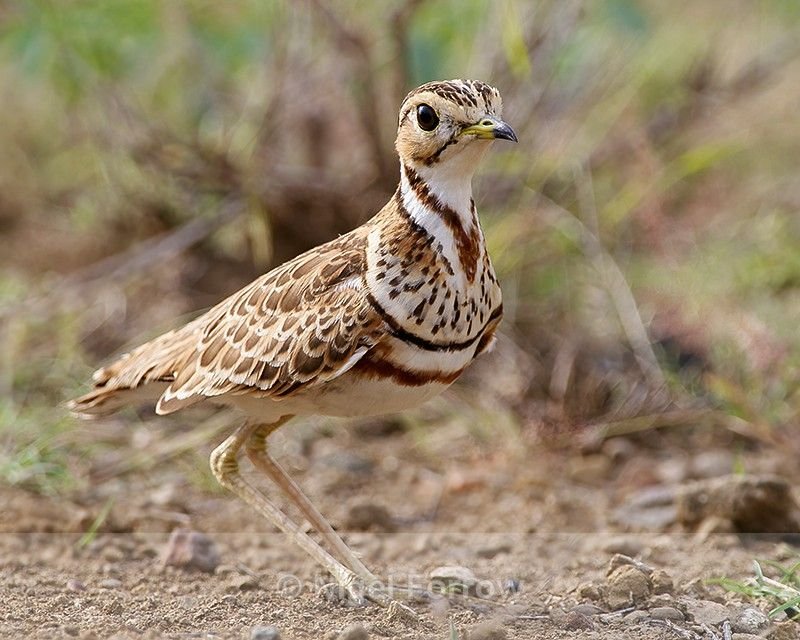
Three-banded Courser
Rhinoptilus cinctusA striking, nocturnal courser with three distinctive breast bands – a ghost of the African night.
The Three-banded Courser (Rhinoptilus cinctus) is a striking wader in the pratincole and courser family Glareolidae. Named for the three distinctive bands across its breast, this medium-sized courser is a nocturnal species, most active at night and during twilight hours. Its sandy-brown plumage and remarkable camouflage make it a ghost of the African night.
Three-banded Courser Quick Facts
What Is the Three-banded Courser?
The Three-banded Courser (Rhinoptilus cinctus) is a medium-sized wader belonging to the family Glareolidae, which includes coursers and pratincoles. It was first described by the German naturalist Johann Friedrich von Brandt in 1833. The species is named for the three distinctive bands that cross its breast, giving it both its common and scientific names (cinctus means "banded" or "girdled" in Latin).
This elegant bird is a nocturnal species, most active at night and during twilight hours. It is found across sub-Saharan Africa, inhabiting dry savannas, grasslands, and rocky areas. It is a ground-dwelling bird that relies on its remarkable camouflage to avoid detection.
There are several recognised subspecies, including R. c. cinctus (northeastern Africa), R. c. emini (eastern Africa), and R. c. maylardi (southern Africa). The subspecies R. c. emini is the one found in Tanzania.
How to Identify a Three-banded Courser
The Three-banded Courser is a distinctive and striking bird, easily recognised by the three bands across its breast. Here are its key identifying features:
- Size: A medium-sized wader, measuring 25-28 cm (10-11 in) in length and weighing 90-130 g (3.2-4.6 oz).
- Plumage: Sandy-brown upperparts and white underparts.
- Breast bands: Three distinctive black or dark bands across the breast – a double band just below the white throat, and a third band on the lower breast.
- Head pattern: Black stripe through the eye, with a white stripe above it (supercilium).
- Throat: White.
- Legs: Long and yellowish.
- Bill: Short and dark.
- In flight: Shows a distinctive white wing bar.
Distinguishing from Similar Species
The Three-banded Courser can be distinguished from the Double-banded Courser by the presence of three (rather than two) breast bands. It is larger than Temminck's Courser and has a different head pattern and wing markings.
Behavior & Social Life
The Three-banded Courser is a nocturnal and crepuscular species, most active at night and during twilight hours.
Foraging Behavior
- Nocturnal habits: It forages at night and during twilight, using the cover of darkness to avoid predators.
- Terrestrial foraging: It walks and runs on the ground, picking insects and other small prey from the surface.
- Foraging technique: Uses a characteristic 'run and stop' method, running rapidly and then pausing to peck at prey.
Social Behaviour
- Pair bonding: Three-banded Coursers are monogamous and form long-term pair bonds.
- Territoriality: They are territorial during the breeding season, defending their nesting area.
Vocalization
- Call: The Three-banded Courser has a distinctive, rapid "tick-tick-tick" or "wheet-wheet" call, often heard at night.
- Detection: The call is often the first indication of the species' presence.
Habitat & Distribution
The Three-banded Courser is found in a variety of dry, open habitats across sub-Saharan Africa.
Key habitat types include:
- Dry savanna – and open grasslands.
- Semi-desert – and arid areas.
- Rocky areas – and stony ground.
- Recently burned areas – where it forages for insects.
Distribution: The Three-banded Courser has an extremely large range, with an Extent of Occurrence of approximately 25,700,000 km². It is found across much of sub-Saharan Africa, from Senegambia in the west to Ethiopia and Kenya in the east, and southwards to South Africa.
Tanzania Distribution
In Tanzania, the Three-banded Courser is found in dry savannas, grasslands, and rocky areas across the country. The subspecies R. c. emini occurs in eastern Africa, including Tanzania. It has been recorded in Serengeti National Park, Ngorongoro Conservation Area, Tarangire National Park, and Ruaha National Park. It is also found in the Malagarasi wetlands.
Three-banded Courser in Tanzania
The Three-banded Courser is a striking and elusive bird of Tanzania's dry savannas. Here are the best locations to see it:
Serengeti National Park
Found in the Serengeti's dry grasslands and savannas. Often seen at dusk and at night, foraging on the ground in open areas.
Serengeti safariNgorongoro Crater
Recorded in the Ngorongoro Conservation Area, especially in the open grasslands of the crater floor. Look for them at twilight.
Ngorongoro safariTarangire National Park
Found in the dry savannas and rocky areas of Tarangire. Often seen in pairs or small groups foraging on the ground.
Tarangire safariRuaha National Park
A resident species in Ruaha's dry savannas and grasslands. Also found in the Malagarasi wetlands area.
Ruaha safariSafari Methods
- Game drives in dry savannas, grasslands, and rocky areas.
- Birdwatching – look for the medium-sized, long-legged bird with three distinctive breast bands, especially at dusk.
- Wildlife photography – the Three-banded Courser's striking appearance makes it a rewarding subject.
- Listen for calls – the distinctive "tick-tick-tick" call is often the first indication of the species' presence.
- Night drives – being nocturnal, it is most active at night and during twilight.
Best Time to See Them
Three-banded Coursers are resident year-round in suitable habitat. They are most active at night and during twilight hours. The dry season (June to October) is generally best for wildlife viewing.
Diet & Feeding
The Three-banded Courser is primarily an insectivore, feeding on a variety of small invertebrates.
Food Sources
- Insects: Beetles, grasshoppers, ants, termites, and other small insects.
- Small invertebrates: Spiders and other small creatures.
- Seeds: Occasionally takes seeds.
Feeding Behavior
The Three-banded Courser forages on the ground at night and during twilight. It uses a characteristic 'run and stop' technique, running quickly across the ground, then pausing to pick insects and other small prey from the surface.
Breeding & Life Cycle
The Three-banded Courser is monogamous and breeds in pairs.
Nesting
- Breeding season: Typically during the rainy season, from November to May in East Africa.
- Nest site: A shallow scrape on bare ground, often in rocky or stony areas.
- Nest construction: The nest is a simple scrape, sometimes lined with a few small stones or grass stems.
- Clutch: 1 to 2 eggs.
- Incubation: 25 to 30 days, shared by both parents.
Chicks
Chicks are precocial (born covered in down and able to move around soon after hatching). Both parents care for the chicks, feeding them and protecting them. Young fledge at about 30 days old.
Conservation Status
The Three-banded Courser is assessed as Least Concern on the IUCN Red List.
Population: The global population has not been quantified, but it is not believed to approach the thresholds for Vulnerable. The population trend is stable.
Justification: This species has an extremely large range (25,700,000 km²) and hence does not approach the thresholds for Vulnerable under the range size criterion. The population size is not believed to approach the thresholds for Vulnerable under the population size criterion.
Threats: While the species is not currently threatened globally, it may face local threats including habitat loss, agricultural intensification, and human disturbance.
Comparisons
The Three-banded Courser is sometimes confused with other coursers. Here are the key differences:
| Feature | Three-banded Courser | Double-banded Courser | Temminck's Courser |
|---|---|---|---|
| Size | 25-28 cm | 22-24 cm | 19-21 cm |
| Breast Bands | Three bands | Two bands | One band (black belly patch) |
| Head Pattern | Black eye stripe, white supercilium | Black eye stripe | Rufous crown |
| Wings in flight | White wing bar | White wing bar | Completely black |
| Activity | Nocturnal/crepuscular | Diurnal | Diurnal |
| Range | Sub-Saharan Africa | Sub-Saharan Africa | Sub-Saharan Africa |
Did You Know?
Three Distinctive Bands
The Three-banded Courser is named for the three distinctive black or dark bands across its breast – a double band just below the throat and a third on the lower breast.
Nocturnal Habits
Unlike most coursers, the Three-banded Courser is nocturnal and crepuscular, most active at night and during twilight hours.
Master of Camouflage
Its sandy-brown plumage blends perfectly with the dry savanna, making it difficult to spot during the day when it is resting.
Ground Nester
It nests in a shallow scrape on bare ground, often in rocky or stony areas where the eggs are well camouflaged.
Widespread Resident
With a range of over 25 million square kilometres, the Three-banded Courser is found across much of sub-Saharan Africa.
Active at Dusk
Often seen at dusk, running across the savanna with its characteristic 'run and stop' foraging technique.
There is a ghostly beauty to the Three-banded Courser as it moves across the African savanna at dusk. Its three breast bands catch the fading light, a striking pattern against the golden grass. It is a bird of shadows and twilight, of quiet movement and watchful stillness. As the sun dips below the horizon and the night begins to stir, the Three-banded Courser comes alive, running with a nervous energy, stopping to listen, to watch, to hunt. In a world that never stops moving, this bird reminds us that sometimes the most fascinating moments are the ones that happen in the quiet spaces between day and night.
Gallery
Frequently Asked Questions
The Three-banded Courser (Rhinoptilus cinctus) is a striking wader in the pratincole and courser family Glareolidae. It is named for the three distinctive bands across its breast. It is a nocturnal species, most active at night and during twilight hours.
Three-banded Coursers are found in dry, open habitats across Tanzania. Key locations include Serengeti National Park, Ngorongoro Conservation Area, Tarangire National Park, and Ruaha National Park. They are also found in the Malagarasi wetlands.
The Three-banded Courser feeds on insects, small invertebrates, and occasionally seeds. It forages on the ground at night, using its long legs to run and catch prey.
No. The Three-banded Courser is listed as Least Concern on the IUCN Red List. It has a large range of approximately 25,700,000 km² and a stable population.
The Three-banded Courser is a medium-sized, long-legged wader with sandy-brown upperparts and white underparts. It has three distinctive black or dark bands across the breast. The head has a black stripe through the eye and a white stripe above it.
The Three-banded Courser measures approximately 25-28 cm (10-11 in) in length and weighs 90-130 g (3.2-4.6 oz).
The Three-banded Courser is a ground-nesting bird that lays 1-2 eggs in a shallow scrape on bare ground, often in rocky or stony areas. Both parents share incubation duties, which lasts about 25-30 days.
In Swahili, the Three-banded Courser is known as Mwamba-kombe or Kifagio-mwitu.
References & Further Reading
- BirdLife International – Three-banded Courser: IUCN Red List assessment, Least Concern status, range 25,700,000 km².
- Wikipedia – Three-banded courser: Family, distribution, subspecies, identification.
- eBird – Three-banded Courser: Identification, distribution, sightings.
- Avibase – Three-banded Courser: Taxonomy, subspecies, distribution.
- Birds of the World – Three-banded Courser: Introduction, identification, habitat, behavior, breeding.
- Oiseaux.net – Three-banded Courser: Photo records from Tanzania.
- BirdForum Opus – Three-banded Courser: Identification, habitat, diet, vocalizations.