

.png)
White-bellied Bustard
Eupodotis senegalensisA distinctive grassland bustard with a white belly, blue-grey neck and bold courtship displays.
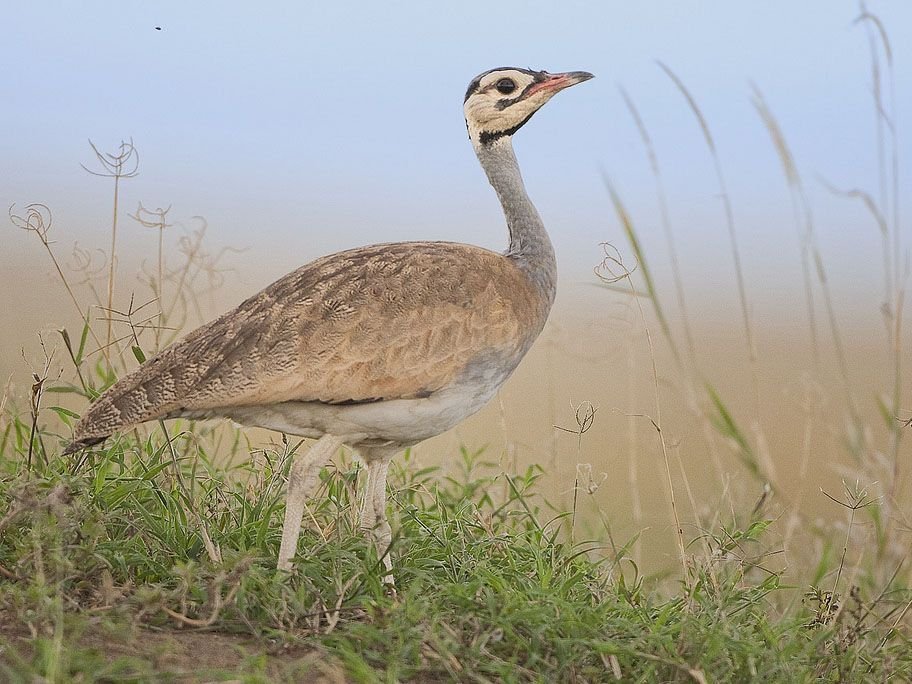
The White-bellied Bustard (Eupodotis senegalensis), also known as the White-bellied Korhaan, is a medium-sized African bustard of open grassland and savanna. It is especially recognizable by the male’s blue-grey neck, patterned head, rich brown upperparts and contrasting white belly.
White-bellied Bustard Quick Facts
What Is the White-bellied Bustard?
The White-bellied Bustard (Eupodotis senegalensis) is a distinctive African bustard of open grassland, savanna and lightly wooded country. It is also widely known as the White-bellied Korhaan.
Its most striking field marks are the contrast between the blue-grey neck, patterned head, warm buff-and-brown upperparts and clean white belly. Males can become conspicuous during display, while both sexes spend much of their time walking through grassland rather than flying.
This eagle is a common and widespread resident of wooded habitats across much of sub-Saharan Africa, from Senegal to Ethiopia and south to South Africa .
How to Identify a White-bellied Bustard
Look for a fairly compact bustard with a pale, patterned head and a blue-grey neck. The white belly contrasts strongly with the darker upperparts, helping separate it from several other small African bustards.
- White belly with darker flanks and upperparts
- Blue-grey neck, especially obvious in adults
- Distinctive black-and-white head pattern
- Buff, brown and tawny upperparts that blend with dry grass
- Long-legged, ground-dwelling posture
- Strong bill suited to a mixed diet
Key Identification Features
It can be confused with the Crowned Eagle and Verreaux's Eagle, but it is smaller and more slender, and its long, full crest and dark plumage distinguish it from these larger species .
Behavior & Social Life
The White-bellied Bustard is primarily terrestrial. It walks deliberately through open vegetation while searching for food and may freeze or lower its profile when disturbed.
Social Life
- Foraging: Walks through grassland and open woodland to locate food on the ground.
- Display: Males use visual postures and vocalizations to advertise and defend territory.
- Vocalization: Calls become especially important during breeding and territorial encounters.
Daily Activity
Breeding displays can include postures, throat or neck inflation and emphatic calling by males. Outside breeding periods, birds are often encountered alone or as pairs.
Habitat & Distribution
The White-bellied Bustard favours open habitats where vegetation is tall enough to provide cover but not so dense that ground movement becomes difficult.
- Tall grassland and savanna
- Burned or recently managed grassland
- Open woodland with grassy ground
- Dry and seasonally wet open country
Across its African range it occurs in grassland, savanna, open woodland, lightly cultivated areas and some seasonally wet open habitats.
Tanzania Distribution
In Tanzania, the White-bellied Bustard is found in most national parks and game reserves, including Serengeti, Ngorongoro, Tarangire, and Ruaha .
White-bellied Bustard in Tanzania
Tanzania is an important part of the species’ East African range, and the bird is well documented in northern Tanzania. The best encounters are usually along open grassland and savanna edges rather than dense forest.
Serengeti National Park
Open grasslands and savanna in the Serengeti provide classic habitat, with documented records from the park.
Serengeti safariTarangire National Park
The park’s extensive grassy plains, bushveld and seasonal open country offer suitable habitat.
Tarangire safariNgorongoro Conservation Area
Records from the Ngorongoro landscape include Ndutu and surrounding open plains.
Ngorongoro safariMkomazi National Park
White-bellied Bustard has been photographed and recorded in Mkomazi’s open grassland habitats.
Mkomazi safariSafari Methods
- Game drives across open plains and grassland
- Birding walks or specialist birding safaris where permitted
- Early-morning wildlife viewing when birds are easier to detect
Best Time to See Them
Because the species is resident, it can be encountered throughout the year in suitable Tanzanian habitat. Early morning is especially productive for detecting calling males and watching birds feeding before the heat of the day.
Diet & Feeding
The White-bellied Bustard is an opportunistic ground-feeder with a mixed diet. It searches through grass and bare patches for animal prey and plant foods.
Food Sources
- Insects and other invertebrates
- Seeds and grains
- Green shoots and plant matter
- Small reptiles or other tiny vertebrate prey when available
Feeding Strategy
Its diet changes with local conditions and season, allowing the bird to exploit both abundant invertebrates and available plant material.
Breeding & Life Cycle
White-bellied Bustards breed on the ground and rely on camouflage and careful placement rather than a substantial nest structure. Males advertise territories with conspicuous displays and calls.
Nesting
- Nest: A shallow ground scrape concealed among grass or other low vegetation.
- Eggs: Usually a small clutch, commonly one or two eggs.
- Incubation: Primarily by the female for roughly three weeks.
Chicks
A typical clutch is small, and the female performs most incubation and early chick care. Young remain closely associated with the female while learning to forage and avoid predators.
Conservation Status
The White-bellied Bustard is currently assessed globally as Least Concern.
Its wide sub-Saharan African distribution provides it with a large overall range, although populations can be affected locally by the loss and degradation of open grassland.
Local pressures can include conversion of natural grassland, inappropriate fire regimes, overgrazing, disturbance and changes in agricultural land use.
- Habitat loss due to deforestation and agricultural expansion .
- Persecution in some areas, though it is generally tolerated due to its rodent-control benefits .
Comparisons
The White-bellied Bustard can be confused with other medium-sized bustards and korhaans. The strongest field clues are its white belly, blue-grey neck and characteristic head pattern.
| Feature | White-bellied Bustard | Wahlberg's Eagle | Martial Eagle |
|---|---|---|---|
| Size | About 48–61 cm | About 65–75 cm | About 50–60 cm |
| Neck | Blue-grey | Warm buff to pale | Variable, often pale |
| Belly | Bright white | White to pale | White or buff |
| Habitat | Open grassland and savanna | Open plains and savanna | Dry open country and grassland |
| Habitat | Woodland, forest edge | Woodland, savanna | Open savanna |
| Diet | Rodent specialist | Reptiles, small mammals | Large gamebirds, mammals |
Did You Know?
White Belly
The clean white belly is one of the easiest field marks and inspired the English common name.
Grassland Specialist
It is strongly associated with open grassy habitats where it can walk and forage across the ground.
Korhaan Name
The alternative name “White-bellied Korhaan” reflects its traditional placement among African korhaans.
Display Bird
Males can inflate the throat/neck during threat and display postures, making breeding-season encounters especially striking.
Ground Dweller
Unlike many birds of open country, it spends much of its daily life walking rather than perching.
Camouflage
Its tawny, brown and grey plumage blends naturally with dry grass and savanna vegetation.
There is something unmistakably ancient about the White-bellied Bustard. It moves with measured steps through open grass, then suddenly becomes far more dramatic when a male raises his profile and expands his neck during a territorial encounter. In Tanzania’s wide plains, that combination of camouflage, confidence and quiet ground-foraging makes the species a memorable bustard to find.
Gallery
Frequently Asked Questions
The White-bellied Bustard (Eupodotis senegalensis) is a medium-sized African bustard, also known as the White-bellied Korhaan, associated mainly with grassland, savanna and open woodland.
Good Tanzanian areas include Serengeti National Park, Tarangire National Park, the Ngorongoro landscape around Ndutu, and Mkomazi National Park.
It has a mixed ground-foraging diet that includes insects and other invertebrates, seeds, plant matter and occasional small vertebrate prey.
Globally it is currently assessed as Least Concern, although local populations can be affected by grassland loss and habitat change.
Look for the combination of a blue-grey neck, strongly patterned head, tawny-brown upperparts and contrasting white belly.
It occurs mainly in open grassland, savanna and lightly wooded country across much of sub-Saharan Africa.
It nests on the ground, usually in a shallow scrape, with the female responsible for most incubation and early chick care.
It is resident, so suitable habitat can produce sightings year-round. Early morning is particularly good for calls and active feeding.
References & Further Reading
- BirdLife International – species assessment and conservation information for White-bellied Bustard (*Eupodotis senegalensis*).
- Tanzania Birds – White-bellied Bustard records and photographs from Serengeti, Tarangire, Mkomazi and other Tanzanian localities.
- African Bird Club – documented Tanzanian records including Ndutu, Serengeti and western Serengeti.
- Oiseaux.net – identification, habitat, measurements and conservation information.
- BirdGuides / IOC – current taxonomy and Least Concern category.
- Oiseaux.net – White-bellied Bustard: Confirmed photo records from Tanzania .
- iNaturalist – White-bellied Bustard observation records from Tanzania .