

.png)
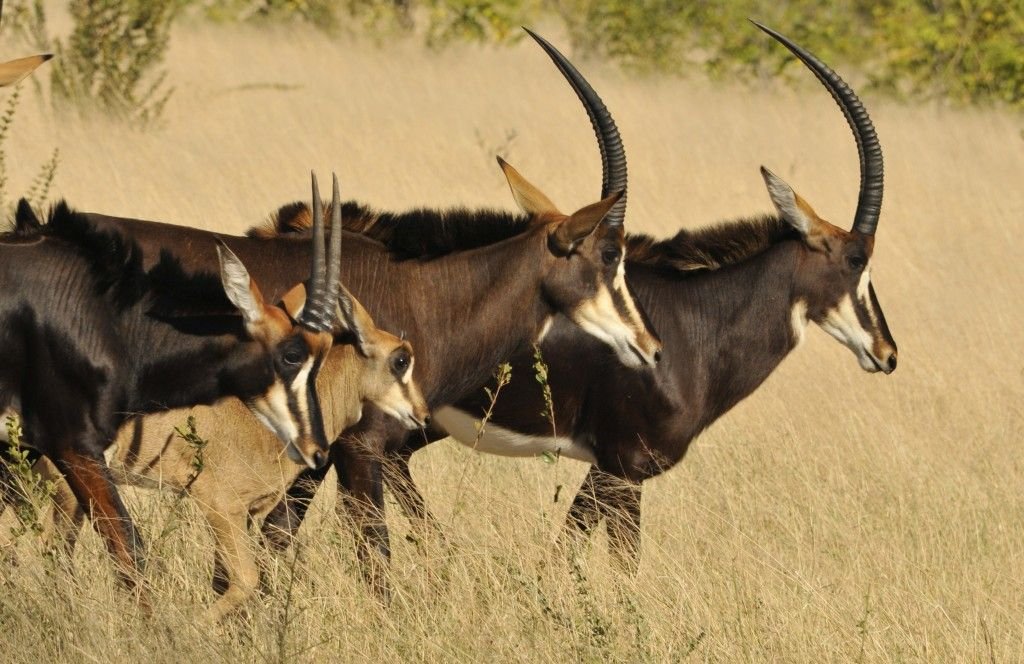
Sable Antelope
Hippotragus nigerAfrica's most dramatic woodland antelope - a glossy black bull with record-breaking backward-curving horns.
Sightings are never guaranteed and depend on local conditions. Follow your guide and respect park rules.
The sable antelope (Hippotragus niger) is a close cousin of the roan in the genus Hippotragus (the "horse antelopes"). The adult male is glossy blue-black with pure white underparts and a bold face; the female and young are rich chestnut. It is a miombo-woodland specialist of eastern and southern Africa, and Tanzania holds an important part of its eastern range - the West Tanzanian sable of Katavi and Rukwa, and the eastern sable of Nyerere (Selous) and the coastal hinterland.
Sable Antelope Quick Facts
What Is the Sable Antelope?
The sable antelope (Hippotragus niger) is one of the most striking large antelopes in Africa - a close cousin of the roan in the genus Hippotragus (the "horse antelopes") and the subfamily Hippotraginae. Its Swahili name is mbarapi. The adult male is glossy blue-black with pure white underparts and a bold face; the female and young are rich chestnut.
Sable occur across parts of eastern and southern Africa. Their range runs from south-eastern Kenya and eastern Tanzania through Mozambique, Zambia, Zimbabwe and South Africa, and extends farther west and south into Angola and Botswana. Tanzania is therefore an important part of the species' eastern range - present in two forms: the West Tanzanian sable (H. n. kirkii) of the south-west (Katavi, Rukwa, Mahale) and the eastern sable (H. n. roosevelti) east of the country's eastern escarpment, including Nyerere (Selous) and north into Mozambique and coastal Kenya. A Tanzanian sighting is very possible - but the species is far from Tanzanian alone.
Why “Sable”?
"Sable" is an old fur-trade word for a glossy black coat - a perfect fit for the mature male, whose dark pelt against a white belly is unmistakable. The scientific name Hippotragus niger means "black horse-goat", again nodding to the male's colour and horse-like build. In Swahili the antelope is the mbarapi.
Signature Features
The sable's signature is its horns - long, straight-based and sweeping dramatically backward in a deep curve, among the longest of any antelope (males regularly top one metre and can reach about 1.65 m). Both sexes carry them, though the male's are thicker and longer. Combined with the male's glossy black coat, white belly and face markings, and a thick upright neck mane, the sable is built to impress - and to fight.
Females and young are warm chestnut to dark brown with the same white belly and face pattern, and can be confused with the roan at a distance; the sable is darker, with bigger, more strongly curved horns and no pale facial mask.
Size and Body Form
Sable are big and robust. They stand 117-140 cm at the shoulder and weigh 200-270 kg (males heavier, up to about 270 kg). The build is compact and powerful, with a thick neck, tough skin and a well-developed erect mane along the neck. The general colour is rich chestnut in females and young, darkening to deep glossy black in males after about three years.
The underparts, cheek and chin are white, creating a sharp contrast with the dark back and flanks, and a wide black stripe runs over the nose. These are animals designed for standing their ground against predators and rivals alike.
Horns & Defence
Like the roan, both male and female sable carry horns. They are heavily ringed and arch backward in a pronounced curve, reaching 61-102 cm in females and 81-165 cm in males - among the longest horns of any antelope. The horns are used in displays and in serious fights, where rivals lock and wrestle, sometimes to the death.
The backward sweep and length make the sable instantly recognisable and a favourite of photographers; no other Tanzanian antelope carries quite this combination of curve and scale.
Habitat & Range
The sable is a creature of miombo woodland and the woodland-grassland mosaic: open woodlands and grassy savannas with scattered trees, the edges of miombo forest, where shelter and grazing sit close together. It avoids dense forest and very open floodplains, and it needs water - herds rarely stray far from rivers, springs or waterholes, especially in the dry season. This wooded-savanna life is exactly what makes it a close but separate partner to the roan (which favours slightly more open miombo).
Across its range the sable tracks this habitat from the miombo of Tanzania, Zambia and Mozambique to the woodlands of Zimbabwe and South Africa, and west into Angola. In Tanzania this means the wooded country of Nyerere (Selous), Ruaha and Katavi, and the eastern escarpment woodlands - classic animals of the wooded savanna mosaic rather than the open plains.
Where to See Sable in Tanzania and Africa
In Tanzania, sable are a wooded-savanna specialty of the south and east: Nyerere (the Selous), Ruaha and Katavi above all. They are resident rather than abundant, so a few patient days in the right woodland gives the best odds. Across the continent they range from Angola and Zambia through Tanzania and Kenya to Mozambique, Zimbabwe, Botswana, Malawi and South Africa, and are also seen in many southern and East African parks.
Nyerere (Selous), Tanzania
Tanzania's eastern sable stronghold - the wooded Selous holds some of the country's best sable, with the West Tanzanian form to the south-west.
Nyerere infoRuaha National Park, Tanzania
Vast southern woodland and grassland where sable herds are resident; a reliable Tanzanian park for the species.
Ruaha infoKatavi National Park, Tanzania
South-western Tanzania's miombo - home to the West Tanzanian sable (H. n. kirkii), a Vulnerable subspecies.
Katavi infoAcross E & S Africa
From south-eastern Kenya and eastern Tanzania through Mozambique, Zambia, Zimbabwe and South Africa to Angola and Botswana, sable range the wooded savanna belt.
Sable factsBehavior & Daily Life
Sable are largely diurnal grazers, moving to follow fresh grass and visiting mineral licks to top up on salts. When threatened, the dominant male may stand and face a predator rather than flee, using those long horns in defence - though calves and yearlings remain vulnerable. They are not migratory but shift locally with grass and water.
Male & Female Sable
Sable have a genuinely complex social organization - emphatically not a solitary antelope. Female social groups form the core of life, with cows and their calves moving and grazing together through the woodland. A single dominant male holds a territory (up to about 10 sq km) and keeps a harem of females, defending it through displays and horn-wrestling contests in which rivals lock horns and wrestle, sometimes to the death. Bachelor herds of younger and evicted males gather after they are driven from the female herd (often in their fourth year) and wait until they are mature enough - around five years - to challenge for a territory and a harem of their own. Female offspring tend to stay in the home range; young males must earn their place.
This mix of female groups, dominant territorial males, harems and bachelor herds is the sable's real social world - the source of those famous horn-clashing duels between black bulls at a woodland edge.
Diet & Feeding
The sable is primarily a grazer, favouring medium and tall grasses and moving across its range to find fresh growth, especially in the wet season. As the dry season bites and grass quality drops, it supplements with leaves, herbs and low shrubs, and it visits mineral licks for salts and minerals. Daily water is a must year-round.
Predators & Defense
Adult sable are formidably large and armed, but they are taken by lion and leopard, and calves and yearlings by spotted hyena, African wild dog and large raptors. Their main defence is the male's horns and the herd's collective alertness - when one flees, the others follow.
Young & Lifespan
Sable breed year-round but with a peak: mating begins at the start of the rains (around September-October) and calves are born at the end (around May-June) after a gestation of about nine months (roughly 270 days). A single calf is hidden in cover at first, then joins the nursery herd. Female offspring tend to stay in the home range; young males are expelled and must earn a harem later.
Conservation Status
The sable is listed as Least Concern at the species level, but that headline hides sharp regional declines - East African populations have dropped, and two subspecies are of real concern: the West Tanzanian sable (H. n. kirkii) is Vulnerable and the giant sable (H. n. variani) of Angola is Critically Endangered.
The main threats are poaching, conversion of habitat to farmland, and fencing that blocks the movements herds need between grazing and water. Protecting connected wooded savanna - as in Tanzania's Ruaha and Katavi - is vital to keep sable common in the wild.
Safari Experience
For a Tanzania safari, sable are a prize of the wooded south and east: Nyerere (Selous), Ruaha and Katavi. Look for a glossy black male with sweeping horns at a woodland edge or on a grassy dambo in the early morning or late afternoon - they are wary, so a calm, patient sighting is the reward rather than a certainty. Few antelopes photograph as dramatically against the Tanzanian light.
Across southern Africa the species is more numerous, and a Ruaha or Katavi trip can be paired with Zambia or South Africa for a full sense of the sable's range. African Majestic Adventure can build the wooded-savanna itinerary for you.
Sable vs Roan
The sable's closest look-alike is the roan, its Hippotragus cousin. The roan is reddish-grey with a bold black-and-white face mask and a mohawk mane; the sable is darker (black male, chestnut female), glossier, and carries bigger, more strongly backward-curving horns. Both sexes are horned in each, but the sable's horns are the longer and more dramatic.
| Feature | Sable Antelope | Roan Antelope |
|---|---|---|
| Male coat | Glossy blue-black | Reddish-grey (roan) |
| Female coat | Chestnut / dark brown | Reddish-grey |
| Face | Dark with white markings, no pale mask | Bold black-and-white mask |
| Horns | Bigger, deeper backward curve, to ~1.65 m | Scimitar, to ~100 cm |
| Habitat | Denser miombo / wooded savanna | More open miombo / wooded savanna |
| Build | Compact, powerful | Larger, horse-like |
In Tanzania the two rarely share ground: roan prefer more open miombo, sable the denser wooded savanna. See the roan antelope for the lighter, masked relative.
Did You Know?
Record horns
Male sable horns can reach about 1.65 m - among the longest of any antelope, and a favourite of trophy hunters (a threat in some ranges).
Black as he matures
A male sable is born chestnut like the female and only darkens to glossy black after about three years.
Mbarapi
In Swahili the sable is the mbarapi - and one subspecies, the giant sable of Angola, is Critically Endangered.
Harem & bachelor life
Sable run on female herds, a dominant territorial male with a harem, and bachelor herds of young evicted males - not solitary at all.
Miombo specialist
The sable belongs to the woodland-grassland mosaic - miombo and open woodland with grass, never dense forest or bare plain.
East Africa declining
Least Concern as a species, but the West Tanzanian sable is Vulnerable and East African numbers have fallen.
There are few sights on a Tanzanian safari as arresting as a black sable bull turning to face you from a woodland edge, those great curved horns framing a white face. They carry themselves with an almost royal composure - which is exactly why they have been hunted and revered across Africa for centuries. To watch a sable herd drift through the Ruaha light is to see one of the continent's true icons up close. African Majestic Adventure knows the wooded country where they show best.
Gallery
Frequently Asked Questions
Yes. Sable occur across eastern and southern Africa and are present in Tanzania - the West Tanzanian sable of Katavi and Rukwa in the south-west, and the eastern sable of Nyerere (Selous) and the eastern escarpment. Ruaha also holds them. Tanzania is an important part of the species' eastern range.
Yes - both sexes carry long, backward-curving, ringed horns. The male's reach 81-165 cm, the female's 61-102 cm.
They are primarily grazers of medium and tall grasses, switching to leaves and herbs when the dry season lowers grass quality, and they visit mineral licks. They need water daily.
Female social groups form the core, a dominant male holds a territory and a harem of females, and young/evicted males gather in bachelor herds until they can challenge for a harem. They are not solitary - harems, bachelor herds and horn-wrestling define their social life.
The species is Least Concern, but East African populations have declined and the West Tanzanian sable is Vulnerable, the giant sable of Angola Critically Endangered. Poaching and habitat loss are the main threats.
Nyerere (Selous), Ruaha and Katavi national parks - the wooded savanna of the south and east - are the most reliable Tanzanian spots. They are resident but wary, so patience helps.
Both are Hippotragus and both sexes are horned, but the sable is darker (black male, chestnut female) with bigger, deeper backward-curving horns and no pale facial mask, while the roan is reddish-grey with a bold black-and-white mask.
References & Further Reading
- IUCN Red List of Threatened Species - Hippotragus niger (Sable Antelope): Least Concern (species), with H. n. kirkii Vulnerable and H. n. variani Critically Endangered.
- Animal Diversity Web (University of Michigan) - Hippotragus niger species account: eastern Tanzania range (Ruaha, Selous) and social organization (female groups, harems, bachelor herds, territorial males).
- Animalia.bio - Sable antelope fact sheet: colour, horns (both sexes), diet and distribution including Tanzania.
- Encyclopaedia Britannica - Sable antelope: identification, herd structure and predators.
- Wikipedia - Sable antelope: subspecies including H. n. kirkii (West Tanzanian) and H. n. roosevelti (eastern).