

.png)
Black-crowned Night Heron
Nycticorax nycticoraxA compact, red-eyed heron that leaves its daytime roost as the light fades.
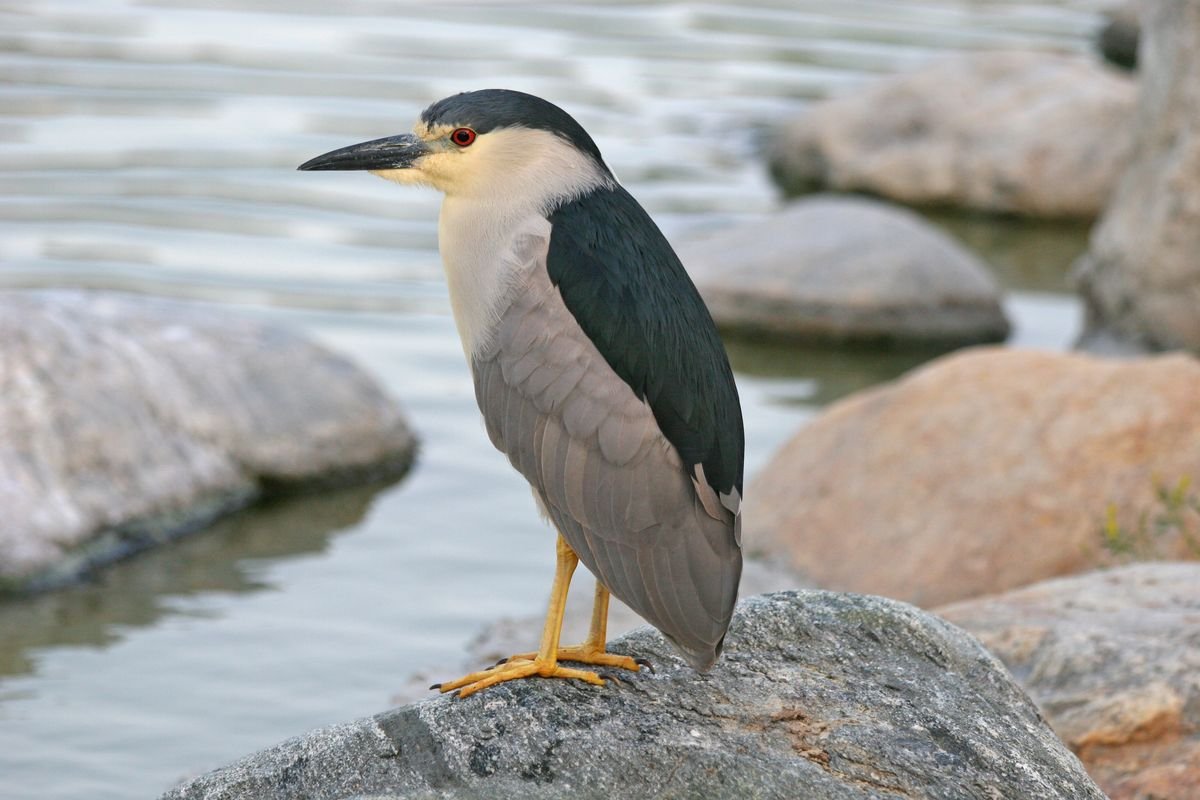
The Black-crowned Night Heron (Nycticorax nycticorax) is a stocky heron of the family Ardeidae. It is most active from dusk through the night, when it hunts along quiet water for fish, frogs, crustaceans, insects and other small animals. Adults have a black crown and back, pale grey wings and underparts, a red eye and long white head plumes in breeding condition; juveniles are brown and streaked.
Black-crowned Night Heron Quick Facts
What Is the Black-crowned Night Heron?
The Black-crowned Night Heron (<em>Nycticorax nycticorax</em>) is a medium-sized, compact heron in the family Ardeidae. It is proportionally stockier and shorter-legged than many familiar long-limbed herons, with a broad rounded head and a heavy pointed bill.
The adult's dark crown and back contrast with pale grey wings and a whitish to pale grey underside. During breeding, adults develop long white head plumes and the face and legs can show stronger breeding colors. Young birds look dramatically different, with brown plumage and pale streaking and spots.
The species is extraordinarily widespread across the world and is represented in Africa, Europe, Asia and the Americas. In Tanzania it occurs in wetlands and slow-moving waters, with modern records from Katavi, Ngorongoro, Arusha National Park, Serengeti, Shambarai Swamp, Rungwa and other locations.
How to Identify a Black-crowned Night Heron
Adult Black-crowned Night Herons have a distinctive squat silhouette. Their thick neck, broad head, heavy bill and relatively short legs separate them from taller daytime herons.
- Crown and back: glossy black or very dark crown and upper back in adults.
- Body: pale grey wings and whitish to light grey underparts.
- Eye: vivid red iris in adults, a striking feature at close range.
- Bill: thick, pointed and dark in adults; juveniles have a paler yellowish bill with dark markings.
- Legs: yellowish to yellow, often brighter in breeding condition.
- Juveniles: brown, heavily streaked and spotted, with a very different appearance from adults.
Distinguishing from Other Night Herons and Herons
In Tanzania, the stocky body, black crown, red eye and mainly crepuscular or nocturnal behavior are valuable clues. Juveniles can be confused with other brown wetland birds, so bill shape, thick neck, broad head and white spotting are useful.
Behavior & Social Life
Black-crowned Night Herons are social at roosts and colonies but commonly forage alone. They may spend daylight hours perched quietly in trees, dense vegetation or other cover before becoming active near sunset.
Daily Activity
- Daytime: rests in trees, shrubs or dense wetland vegetation, often looking hunched and inactive.
- Dusk: activity increases rapidly as birds leave roosts and travel to feeding sites.
- Night: feeds mainly along shallow water, mudflats and wet margins, usually hunting alone.
Social Life & Territory
The species nests colonially and can share breeding sites with other herons, egrets and ibises. Adults defend feeding and nesting areas, but large communal roosts may contain many birds.
Habitat & Distribution
Black-crowned Night Herons use a remarkably broad range of wetlands. They favor shallow, productive water with nearby vegetation or trees for cover and roosting.
- Marshes and swamps with shallow pools and dense cover.
- Lakes, ponds and reservoirs with quiet shorelines and aquatic prey.
- Slow-moving rivers and streams with sheltered feeding edges.
- Estuaries, lagoons and flooded fields where small aquatic animals are abundant.
The species has one of the broadest ranges of any heron, occurring across large parts of Africa, Europe, Asia and the Americas. Movement patterns differ among populations; some are resident while others make seasonal migrations.
Tanzania Distribution
Tanzania Birds documents Black-crowned Night Heron from Katavi, Ngorongoro Crater, Arusha National Park, Serengeti, Shambarai Swamp, Rungwa, Emayani and other wetland sites. A photographed bird at Lake Duluti near Arusha also illustrates its use of quiet inland waters.
Black-crowned Night Heron in Tanzania
Tanzania offers multiple opportunities for this secretive heron. The most productive strategy is to search slow water, sheltered lake margins and wetland vegetation close to sunset, then watch for birds leaving roosts.
Safari Methods
Modern Tanzania records include adults and juveniles from Katavi, confirming the species in the park's extensive wetland and slow-water systems.
Explore KataviBest Time to See Them
The species can be encountered year-round where suitable wetland habitat is present. Dusk and the early hours after sunset are the most characteristic viewing period, while breeding birds may also feed during daylight.
Explore NgorongoroArusha National Park
The species is documented from Arusha National Park, and nearby Lake Duluti also has a photographed record from northern Tanzania.
Explore ArushaSerengeti & Rungwa
Tanzania Birds records the species from Serengeti and Rungwa, showing that its Tanzanian distribution extends beyond a single wetland system.
Explore SerengetiSafari Methods
- Late-afternoon drives: concentrate on lakes, marshes and slow water just before birds become active.
- Night-aware birding: listen for calls and watch silhouetted birds moving from roosts after sunset where safe and permitted.
- Quiet observation: scan tree lines and dense vegetation around water for daytime roosts before dusk.
Best Time to See Them
Black-crowned Night Herons are present year-round in suitable habitat. They are most active during the cooler morning and evening hours .
Diet & Feeding
Black-crowned Night Herons are opportunistic predators with a much broader diet than the name 'night heron' might suggest. They take whatever small animal prey can be caught efficiently in their wetland environment.
Food Sources
- Fish: often an important food in shallow water and ponds.
- Amphibians: frogs, tadpoles and other wetland prey.
- Aquatic invertebrates: crayfish, molluscs, leeches, worms and insects.
- Small terrestrial prey: lizards, snakes, rodents, eggs, small birds and carrion may be taken opportunistically.
Hunting Behavior
The bird usually stands still or walks slowly along the edge of shallow water, waiting for prey to approach. It grasps rather than spears prey, and its heavy bill is well suited to fish and a wide range of small animals.
Breeding & Life Cycle
Black-crowned Night Herons are colonial breeders. Colonies may contain many nests in one tree, and mixed colonies with other wetland birds are common. Breeding tends to coincide with suitable local food and water conditions.
Nesting
- Nest: a platform of sticks and twigs in trees, shrubs, cattails or other vegetation, often over or near water.
- Eggs: usually about 3-5 pale greenish-blue eggs.
- Incubation: both parents incubate, usually for about 24-26 days.
Chicks
Both parents feed the young. Nestlings are helpless when newly hatched, then become increasingly mobile in the nest tree. Young may leave the nest and climb through vegetation at around four weeks and usually develop sustained flight at roughly six weeks.
Conservation Status
Black-crowned Night Heron is currently assessed globally as <strong>Least Concern (LC)</strong>. Its enormous geographic range and broad habitat tolerance support the global status.
Local populations can nevertheless be sensitive to changes in wetlands, nesting colonies and water quality. Maintaining productive shallow-water habitats and suitable roosting and nesting vegetation remains important.
Key local conservation considerations include:
- Wetland loss: drainage and conversion can remove feeding and breeding habitat.
- Water-quality decline: pollution can reduce prey availability and wetland health.
Comparisons
Its stocky proportions make the Black-crowned Night Heron quite different from long-legged herons such as Grey Heron. Age is also important because juveniles look far more brown and streaked than adults.
| Feature | Black-crowned Night Heron | Grey Heron | Little Egret |
|---|---|---|---|
| Build | Stocky, compact, thick-necked | Large, long-legged, broad-bodied | Small, slim and fine-billed |
| Head | Broad, flat, black crown in adults | Lighter head with black crown streak | Small white head with breeding plumes |
| Eye | Red in adults | Yellowish | Pale yellow to orangish depending on condition |
| Bill | Heavy and pointed, dark in adults | Long and powerful | Slim and dark |
| Behavior | Mostly dusk/night feeding | Mostly daytime, patient stalking | Active daytime wading |
| Juvenile | Brown and strongly streaked/spotted | Grey-brown juvenile with different pattern | Mostly white with immature plumage |
Did You Know?
Night by Name and Habit
The species is named for its characteristic evening and nighttime activity, when it leaves daytime roosts to feed.
Red-eyed Adult
The adult's red iris is one of its most striking field characters.
Brown Juveniles
Young birds look surprisingly different, with brown, streaky plumage and pale spotting.
Compact Heron
Its thick neck, broad head and short-legged silhouette make it look squat compared with many other herons.
Colonial Breeder
Breeding colonies can contain many nests and may be shared with other heron and egret species.
Tanzania Records
Tanzania Birds documents the species from Katavi, Ngorongoro, Arusha National Park, Serengeti, Shambarai Swamp, Rungwa and Emayani.
As daylight fades over a Tanzanian wetland, the birds that seemed motionless all afternoon suddenly come alive. The Black-crowned Night Heron slips from a roost, crosses the water with slow wingbeats and settles at the edge of a pool. Then the stillness becomes hunting: one careful step, a pause, and a quick strike. Its world begins when much of the safari day is ending.
Gallery
Frequently Asked Questions
The scientific name is Nycticorax nycticorax, a member of the family Ardeidae.
Adults are stocky, with a black crown and back, pale grey wings, a heavy bill, red eyes and relatively short legs. Juveniles are brown and streaked.
It commonly becomes active at dusk and feeds through the night, although it can also forage during the day, especially around breeding colonies.
It eats fish, frogs, insects, crustaceans, molluscs, worms, reptiles, rodents, birds and other small animals.
Tanzania Birds documents it from Katavi, Ngorongoro Crater, Arusha National Park, Serengeti, Shambarai Swamp, Rungwa and Emayani, among other places.
Tanzanian records include chicks in a nest, and the species breeds colonially in suitable wetland habitat. Exact breeding timing varies with local conditions.
No. Juveniles are brown and heavily streaked and spotted, making them much less obviously black-and-grey than adults.
The species is currently assessed globally as Least Concern.
References & Further Reading
- Tanzania Birds – Black-crowned Night-Heron: Tanzania occurrence records, age classes and photographs from Katavi, Ngorongoro Crater, Arusha National Park, Serengeti, Shambarai Swamp, Rungwa and Emayani.
- BirdLife International / IUCN-linked resources: global conservation assessment and current species framework.
- Cornell Lab of Ornithology – All About Birds: identification, measurements, habitat, diet, behavior and breeding biology.
- Smithsonian's National Zoo: nocturnal activity, social structure, nesting and diet information.
- Tanzania Birds checklist: national taxonomic treatment of Nycticorax nycticorax and the African avifauna context.
- Oiseaux.net – Black-crowned Night Heron: Confirmed photo records from Tanzania .
- iNaturalist – Black-crowned Night Heron observation records from Tanzania .