

.png)
Greater Kestrel
Falco rupicoloidesThe largest and most striking kestrel of Africa's open country – a master of the insect hunt.
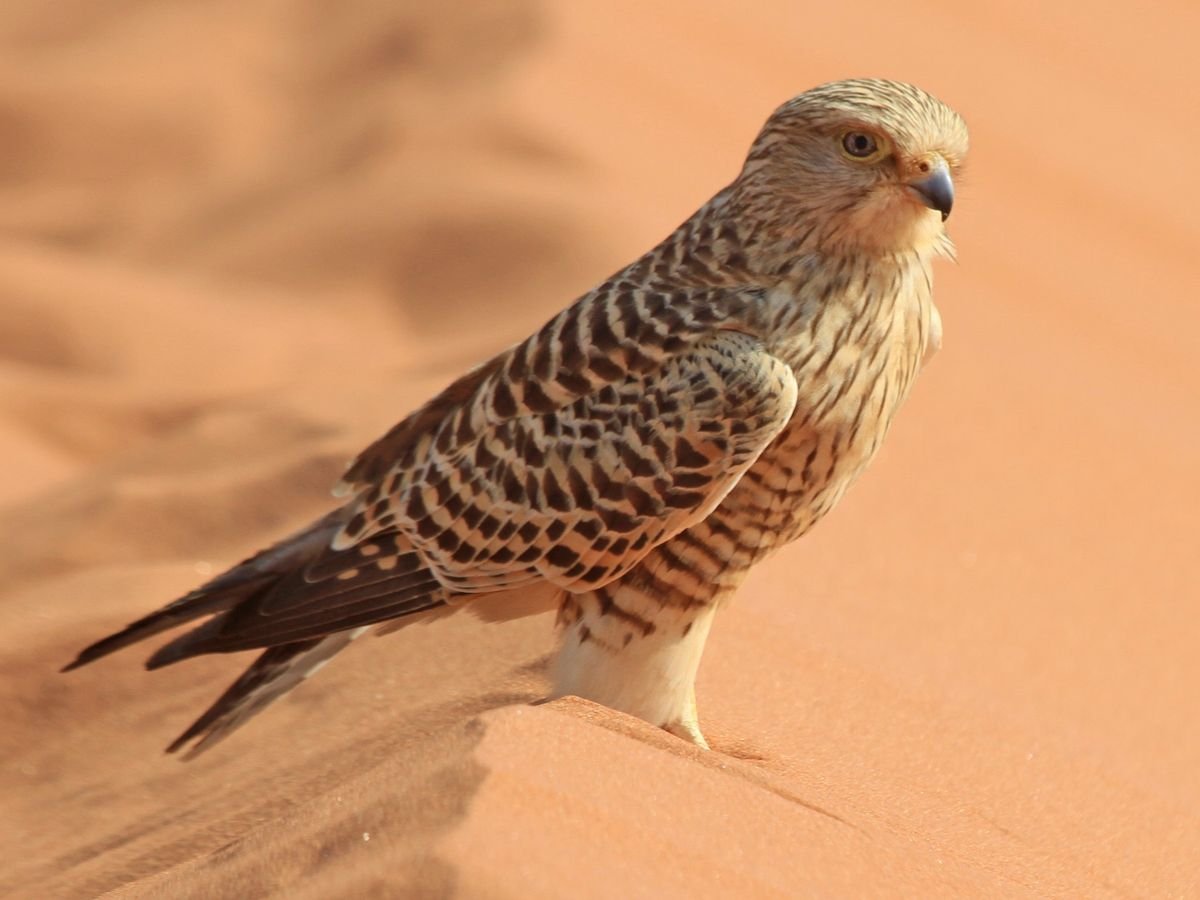
The Greater Kestrel (Falco rupicoloides), also known as the White-eyed Kestrel, is a bird of prey belonging to the falcon family Falconidae. It is one of the largest kestrels and is found in open country in southern and eastern Africa.[reference:0][reference:1] Larger than all other kestrels, it is a distinctive pale-brown raptor with a grey tail marked by broad black bands and a heavily black-marked back.[reference:2]
Greater Kestrel Quick Facts
What Is the Greater Kestrel?
The Greater Kestrel (Falco rupicoloides), also known as the White-eyed Kestrel, is a bird of prey belonging to the falcon family Falconidae. It was first described by the Scottish zoologist Andrew Smith in 1829.[reference:3][reference:4] It is one of the largest kestrels and is found in open country in southern and eastern Africa.[reference:5]
The species is a member of the genus Falco, which includes the true falcons. The name "rupicoloides" means "resembling a rock-dweller" (from Latin rupicola, rock-dweller). The common name "Greater Kestrel" distinguishes it from the smaller Common Kestrel and Lesser Kestrel found in the same regions.
Three subspecies are recognised: F. r. rupicoloides (southern Africa), F. r. arthuri (Kenya and northeastern Tanzania), and F. r. fieldi (Ethiopia and Somalia).[reference:6] The subspecies F. r. arthuri is smaller than the nominate form, weighing about 165-252 g (0.364-0.556 lb), while the nominate subspecies weighs about 181-334 g (0.400-0.736 lb).[reference:7] The northern subspecies F. r. fieldi is also small and is paler than the others.[reference:8]
How to Identify a Greater Kestrel
The Greater Kestrel is the largest and most striking of all kestrels, easily recognised by its size, plumage, and distinctive pale eyes. Here are its key identifying features:
- Size: The largest kestrel, measuring 29-37 cm (11-15 in) in length with a wingspan of 68-84 cm (27-33 in).[reference:9] It is larger than all other kestrels, but similar in size to smaller falcons.[reference:10]
- Plumage: Overall colouration is pale rufous (light ginger-brown) both above and below.[reference:11] The back, upperwing and flanks are barred with black.[reference:12]
- Head: The head, throat and neck are finely streaked.[reference:13] The streaks become bolder and more prominent on the breast and belly.[reference:14]
- Tail: The rump and tail are grey with black bars; the tail has a white tip.[reference:15] The grey tail with broad black bands is a key identification feature.[reference:16]
- Eyes: Adults have striking pale whitish irises (white eyes) – the most distinctive feature distinguishing this bird from any similar species.[reference:17][reference:18]
- Underwing: In flight, the whitish underwing contrasts with the darker body.[reference:19] The under wings are white with indistinct, grey-barred flight feathers.[reference:20]
- Bill and legs: The bill is mainly blue-grey, and the feet and cere are yellow.[reference:21] The bare skin around the eyes is also yellow.[reference:22]
- No malar stripe: Unlike the Common Kestrel and Lesser Kestrel, the Greater Kestrel has no black malar stripe on the face.[reference:23]
Juvenile vs Adult
Juveniles resemble adults but have dark-coloured (not pale grey) eyes.[reference:24] They are generally darker rufous in colour and have larger black markings than the adults.[reference:25] Juvenile birds also have rufous instead of grey on the tail and streaked flanks.[reference:26]
Distinguishing from Other Kestrels
The Greater Kestrel is most likely to be mistaken for females and juveniles of the Rock Kestrel (Falco rupicolis) and Lesser Kestrel (Falco naumanni). Both are smaller and slimmer than the Greater Kestrel and have smaller, less rounded looking heads.[reference:27] The white eye of the adult Greater Kestrel is diagnostic.
Behavior & Social Life
Greater Kestrels are normally found singly or in pairs and sometimes in loose groups of several birds.[reference:28] They are conspicuous birds that perch prominently on vantage points.
Perching & Flight
- Perching: Often perches conspicuously on whatever vantage points are available, such as termite mounds, trees, telephone poles, pylons and fences.[reference:29]
- Territorial display: Advertises to conspecifics that a territory is occupied by perching conspicuously.[reference:30]
- Flight: The flight is buoyant, interspersed with flapping and gliding. It seldom soars but frequently hovers in windy conditions.[reference:31]
Hunting Behavior
- Hunting methods: Most hunting is done from a perch, but they also hunt aerially, usually by hovering into the wind.[reference:32]
- Prey capture: Prey is generally captured on the ground but may occasionally catch small birds, termite alates and locusts in flight.[reference:33]
- Sex differences: Males tend to perch-hunt more often than females, and females have better hunting success when aerial hunting.[reference:34]
- Hunting success: Both sexes are 98-99% successful at catching invertebrates, with males making more strikes.[reference:35]
Vocalization
The Greater Kestrel is usually silent but has a shrill, repeated call.[reference:36] Calls are described as high-pitched squealing notes and much lower barks.[reference:37]
Habitat & Distribution
The Greater Kestrel is a bird of open, arid and semi-arid areas ranging from desert scrub to dry, open woodlands and grassland.[reference:38] It is most abundant in the Kalahari and Karoo vegetation types and is also widespread in the grasslands of central South Africa.[reference:39]
Key habitat types include:
- Semi-desert and arid savanna – the primary habitat.[reference:40]
- Grassland – especially open veld with short vegetation and moderate to low rainfall.[reference:41]
- Dry open woodland.
- Cultivated areas – it is expanding its distribution into cultivated areas in north-eastern South Africa.[reference:42]
Elevation: Found from sea level up to 2,780 metres (9,120 feet).[reference:43]
Distribution: The Greater Kestrel has a disjunct distribution in the drier regions of Southern and East Africa.[reference:44] It occurs patchily in East Africa from northern Tanzania, up through Kenya to Ethiopia.[reference:45] It is more widespread in Southern Africa, occurring over a large part of western and central South Africa and throughout Namibia and Botswana.[reference:46] It is sparsely distributed in Zimbabwe, western Zambia and eastern Angola.[reference:47] The species has an Extent of Occurrence of 15,000,000 km².[reference:48]
The Greater Kestrel is considered a non-migrant resident species.[reference:49] The distribution is believed to have expanded due to the clearing of woodlands for cultivation.[reference:50] However, the loss of natural grasslands to agriculture and bush encroachment could be a concern.[reference:51]
Tanzania Distribution
In Tanzania, the Greater Kestrel occurs in the northeastern part of the country. The subspecies F. r. arthuri is found in Kenya and northeastern Tanzania.[reference:52][reference:53] It has been recorded in Serengeti National Park (Mara region),[reference:54][reference:55] and can also be seen in Ngorongoro Conservation Area, Tarangire National Park, and Ruaha National Park. There are also recorded calls from the Engikaret Lark Plains in Arusha.[reference:56]
Greater Kestrel in Tanzania
The Greater Kestrel is the largest and most striking kestrel of Tanzania's open country and savannas. Here are the best locations to see it:
Serengeti National Park
Recorded in the Serengeti, particularly in the Mara region. Often seen perched conspicuously on termite mounds or isolated trees in the open savanna.[reference:57][reference:58]
Serengeti safariNgorongoro Crater
Found in the Ngorongoro Conservation Area, often seen in the open grasslands of the crater floor or perched on vantage points along the rim.
Ngorongoro safariTarangire National Park
Found in the park's acacia woodlands and open savanna habitats, where it can be seen perched in trees or hovering over grasslands.
Tarangire safariRuaha National Park
A resident species in Ruaha's miombo woodland and dry savanna habitats. Also recorded in the Engikaret Lark Plains in Arusha.[reference:59]
Ruaha safariSafari Methods
- Game drives through open savanna, grassland, and semi-desert habitats.
- Birdwatching – watch for the distinctive white eyes, large size, and pale rufous plumage.
- Wildlife photography – the Greater Kestrel's striking appearance and conspicuous perching behaviour make it an excellent photographic subject.
- Look for perches – Greater Kestrels often perch conspicuously on termite mounds, dead trees, telephone poles, and fences.[reference:60]
- Watch for hovering – they frequently hover in windy conditions while hunting.[reference:61]
Best Time to See Them
Greater Kestrels are resident year-round in suitable habitat. They are most active during the cooler morning and evening hours when hunting is at its peak. The dry season (June to October) is generally best for wildlife viewing as animals congregate around water sources, increasing the chances of observing these magnificent kestrels.
Diet & Feeding
The Greater Kestrel is primarily an insectivore, but it is also an opportunistic predator that takes a variety of prey.
Food Sources
- Invertebrates: The staple diet consists of grasshoppers, termites, beetles and solifugids (sun spiders).[reference:62] It also eats scorpions, spiders and centipedes.[reference:63]
- Reptiles: Lizards and sometimes snakes.[reference:64][reference:65]
- Small birds: Occasionally takes small birds.[reference:66]
- Small mammals: Occasionally takes small mammals.[reference:67]
Hunting Behavior
Greater Kestrels hunt by hovering into the wind or from a prominent perch, swooping down to capture prey on the ground.[reference:68] They may occasionally catch termite alates, locusts, and small birds in flight.[reference:69] Both sexes are 98-99% successful at catching invertebrates, with males making more strikes.[reference:70] Invertebrates are the staple food before incubation, when vertebrates become more important in the diet.[reference:71]
Breeding & Life Cycle
Greater Kestrels are monogamous and territorial.
Nesting
- Nest site: Usually uses an old nest of a Cape Crow (Corvus capensis) or Pied Crow (Corvus albus), placed 2-20 metres above the ground.[reference:72]
- Nest location: In a tree, or on a pole or pylon.[reference:73]
- Clutch: 2-7 eggs, usually 3 or 4.[reference:74]
- Incubation: 22-23 days, mainly by the female.[reference:75]
- Incubation behaviour: Incubatory behaviour begins at least a week before the eggs are laid. The male incubates for about 23% and the female for about 72% of the daylight time observed.[reference:76]
Chicks
Young fledge in 30-34 days but remain close to parents for a further 26 days or more.[reference:77] A nestling period of about 32 days has been recorded.[reference:78] In Kenya and Tanzania, breeding occurs throughout the year with a concentration between April and July.[reference:79]
Conservation Status
The Greater Kestrel is assessed as Least Concern on the IUCN Red List.[reference:80][reference:81]
Justification: This species has an extremely large range (Extent of Occurrence of 15,000,000 km²) and hence does not approach the thresholds for Vulnerable.[reference:82] The population size has not been quantified, but it is not believed to approach the thresholds for Vulnerable.[reference:83] The population trend appears to be stable, and hence the species does not approach the thresholds for Vulnerable.[reference:84] The population is suspected to be stable in the absence of evidence for any declines or substantial threats.[reference:85]
Population: The estimated population is 100,000 (2010 estimate).[reference:86]
Distribution expansion: The distribution of the Greater Kestrel is believed to have expanded due to the clearing of woodlands for cultivation. However, the loss of natural grasslands to agriculture and bush encroachment could be a concern.[reference:87]
The species is listed on CITES Appendix II.[reference:88]
Comparisons
The Greater Kestrel is sometimes confused with other kestrels. Here are the key differences:
| Feature | Greater Kestrel | Lesser Kestrel | Rock Kestrel |
|---|---|---|---|
| Size | 29-37 cm | 23-28 cm | 27-32 cm |
| Wingspan | 68-84 cm | 58-72 cm | 60-75 cm |
| Eyes | White (pale) in adults | Dark | Dark |
| Malar Stripe | Absent | Present | Present |
| Tail | Grey with broad black bands | Grey with narrow black bands | Grey with black bands |
| Head Shape | Rounded, fairly large | Smaller, slimmer | Smaller, slimmer |
Did You Know?
The Largest Kestrel
The Greater Kestrel is the largest of all kestrels – larger than the Common Kestrel, Lesser Kestrel, and Rock Kestrel.[reference:89]
White-Eyed Wonder
Adults have striking pale whitish eyes – a unique feature among African kestrels that makes identification easy.[reference:90]
Nearly Perfect Hunter
Greater Kestrels are 98-99% successful at catching invertebrates – an astonishing success rate.[reference:91]
Nomadic Wanderings
The species is known for nomadic wanderings, with individuals moving extensively in search of food.[reference:92]
Crow's Nest Thief
Greater Kestrels usually use old crow nests for breeding, reusing nests of Cape Crows or Pied Crows.[reference:93]
Expanding Range
The Greater Kestrel's distribution has expanded due to the clearing of woodlands for cultivation.[reference:94]
There is something almost regal about the Greater Kestrel. It perches with an air of authority on its chosen vantage point – a termite mound, a dead tree, a telephone pole – surveying its domain with pale, penetrating eyes. When it hunts, it hovers with a grace that belies its size, then drops like a stone onto its prey with near-perfect accuracy. It is a bird of contradictions: the largest of the kestrels, yet one of the most efficient hunters of the smallest creatures. In a world of giants, the Greater Kestrel reminds us that sometimes the most successful predators are the ones that master the art of the small.
Gallery
Frequently Asked Questions
The Greater Kestrel (Falco rupicoloides), also known as the White-eyed Kestrel, is a bird of prey belonging to the falcon family Falconidae. It is one of the largest kestrels and is found in open country in southern and eastern Africa.[reference:95]
The Greater Kestrel occurs patchily in East Africa from northern Tanzania up through Kenya to Ethiopia. Key locations in Tanzania include Serengeti National Park (with records from the Mara region), Ngorongoro Conservation Area, Tarangire National Park, and Ruaha National Park.[reference:96][reference:97]
The Greater Kestrel feeds mainly on invertebrates such as grasshoppers, termites, beetles and solifugids. It also takes lizards and sometimes small birds, mammals and snakes.[reference:98]
No. The Greater Kestrel is listed as Least Concern on the IUCN Red List. It has an extremely large range of 15,000,000 km² and a stable population trend.[reference:99][reference:100]
The Greater Kestrel is a large pale-brown kestrel with a grey tail that has broad black bands. The back is heavily marked with black, and the head, throat and neck are finely streaked. Adults have striking pale white eyes, distinguishing them from similar species.[reference:101][reference:102]
The Greater Kestrel is 29-37 cm (11-15 in) long with a wingspan of 68-84 cm (27-33 in). It is larger than all other kestrels, but similar in size to smaller falcons.[reference:103][reference:104]
Greater Kestrels usually use an old nest of a Cape Crow or Pied Crow, placed 2-20 m above the ground in a tree, or on a pole or pylon. They lay 2-7 eggs, usually 3 or 4, with an incubation period of 22-23 days, mainly by the female. Young fledge in 30-34 days but remain close to parents for a further 26 days or more.[reference:105]
In Swahili, the Greater Kestrel is known locally as Kozi or Kipanga, though local names can vary across regions.
References & Further Reading
- BirdLife International – Greater Kestrel: IUCN Red List assessment, range 15,000,000 km², stable population, Least Concern.[reference:106]
- eBird – Greater Kestrel: Identification, plumage, vocalisation, habitat.[reference:107][reference:108]
- Avibase – Greater Kestrel: Taxonomy, subspecies, distribution.[reference:109]
- BDI – Greater Kestrel: Identification, distribution, habitat, behaviour.[reference:110]
- Wikipedia – Greater kestrel: Description, habitat and range, subspecies.[reference:111]
- Birdpedia – Greater Kestrel: Size, habitat, food, nesting, incubation, fledging.[reference:112]
- Oiseaux.net – Greater Kestrel: Photo records from Serengeti National Park, Tanzania.[reference:113]