

.png)
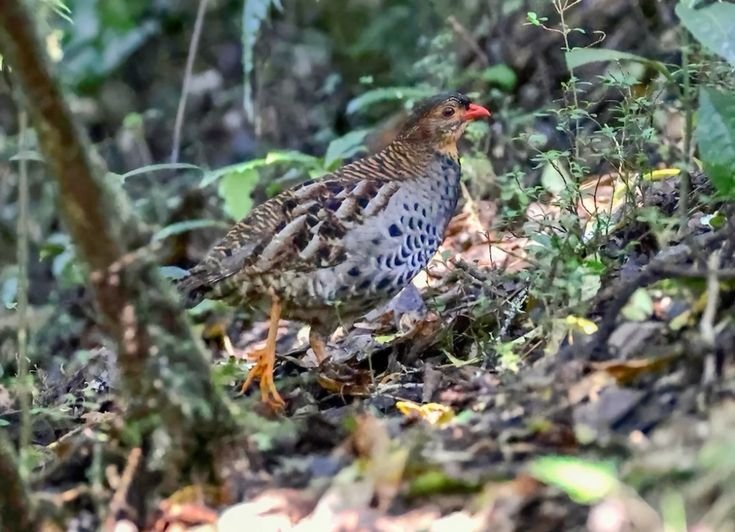
Udzungwa Partridge
Xenoperdix udzungwensisAn ancient and iconic Tanzanian endemic – discovered in a cooking pot in 1991.
The Udzungwa Partridge (Xenoperdix udzungwensis) is a small, approximately 29 cm long, boldly barred, brownish partridge with a rufous face, grey underparts, olive-brown crown and upperparts. It has a red bill, brown iris and yellow legs. It inhabits and is endemic to forests of the Udzungwa Mountains in Tanzania. Due to ongoing habitat loss, small population size, limited range and overhunting in some areas, it is classified as Endangered on the IUCN Red List [citation:2][citation:5].
Udzungwa Partridge Quick Facts
What Is the Udzungwa Partridge?
The Udzungwa Partridge (Xenoperdix udzungwensis) is a small, approximately 29 cm long, boldly barred, brownish partridge with a rufous face, grey underparts, olive-brown crown and upperparts. It has a red bill, brown iris and yellow legs [citation:2][citation:5].
This bird is so distinctive that its genus, Xenoperdix, is considered unique within the order Galliformes, highlighting its remarkable evolutionary lineage [citation:4]. It is a captivating and little-known bird species native to the lush montane forests of Tanzania. This elusive bird has drawn the attention of ornithologists and conservationists alike due to its striking appearance, secretive behaviour, and highly restricted habitat [citation:4].
The Extraordinary Discovery
On 3 July 1991, the discovery of the Udzungwa Partridge in a montane forest in Tanzania's Udzungwa Mountains not only added a new species of bird to Africa, but a whole new genus with affinities to the hill-partridges Arborophila of the Indo-Malayan region. This was probably among the most unexpected and spectacular bird discoveries in Africa since the Congo Peacock in the 1930s [citation:6].
The bird was first noticed as a pair of strange feet in a cooking pot in a Tanzanian forest camp [citation:2]. Within a few years it became clear that in the Udzungwa Mountains, the new partridge occurs only in the large Ndundulu-Luhombero Forest (where it was first discovered) and in the nearby, smaller Nyumbanitu Forest [citation:6].
Researchers determined that it was not only a new species, but an entirely new genus with no close relatives in Africa. Its uniqueness has made it a key focus in conservation efforts, as its survival is closely tied to the fragile ecosystem of the Udzungwa Mountains [citation:4].
Scientific Classification
Two subspecies are recognised [citation:5]:
- X. u. udzungwensis: Udzungwa Mountains of Tanzania.
- X. u. obscuratus: Rubeho highlands of Tanzania. This subspecies has sometimes been considered as a separate species, the Rubeho forest partridge [citation:5].
How to Identify an Udzungwa Partridge
An unusual forest-dwelling partridge with a tiny range in the mountains of central Tanzania [citation:8]. Here are its key identification features:
- Plumage: The back is brown and boldly barred; the underparts are grey with black scallops [citation:8].
- Face: Rufous face and red bill [citation:2][citation:5].
- Legs: Yellow legs [citation:2][citation:5].
- Eyes: Brown iris [citation:2][citation:5].
- Size: Approximately 29 cm (11 in) long [citation:2][citation:5].
- Sexes: Both sexes are similar [citation:2][citation:5].
- Call: Most often detected by call: a repeated "kur-kur-kree" chant [citation:8].
Distinguishing from Other Partridges
Somewhat similar to Scaly Francolin, but separated by smaller size and far more colorful markings [citation:8]. It is also distinctive from other African partridges because of its rufous face, grey underparts, and yellow legs.
Behavior & Social Life
The Udzungwa Partridge is a highly secretive and elusive bird, most often detected by its distinctive call [citation:8]. It is a ground-dwelling bird that prefers an open forest floor with leaf litter and sedges [citation:6].
Group Size
Flocks of up to eight individuals have been observed tossing away dead leaves to uncover seeds and invertebrates [citation:6]. Most of the observed flocks consisted of only 3 or 4 birds (probably comprising two adults and one or two chicks), suggesting that the Udzungwa Partridge may have a low reproductive potential compared to other Galliformes, thereby making its small populations more vulnerable to stochastic events [citation:6].
Communication
The bird is most often detected by its call: a repeated "kur-kur-kree" chant [citation:8]. This call carries well through the dense forest canopy, allowing birders to locate the species.
Breeding
The species' breeding ecology is poorly known, and its nest has never been found. Observations of adults with chicks in November to January suggest that the breeding season starts at the beginning of the rainy season [citation:6].
Habitat & Distribution
The Udzungwa Partridge is endemic to the montane forests of the Udzungwa Mountains in south-central Tanzania, part of the ancient Eastern Arc Mountain range [citation:4].
Habitat Requirements
- Montane evergreen forest [citation:6].
- Elevation: Found at 1,360-2,060 m, with sightings recorded up to 2,200 m [citation:4][citation:6].
- Forest floor: Prefers an open forest floor with leaf litter and sedges (Cyperus) for feeding and cover [citation:6][citation:12].
- Terrain: Found very locally in steep areas with bamboo [citation:8].
Distribution
The species is confined to isolated patches of montane forest within the Udzungwa Mountains. Sightings are largely limited to two key areas [citation:4][citation:6]:
- Ndundulu-Luhombero Forest: Supports the largest population.
- Nyumbanitu Forest: A smaller population persists, though it may now be very rare or extinct here.
A closely related but distinct species, the Rubeho Forest Partridge, inhabits the Rubeho Highlands, approximately 100 km to the north [citation:4][citation:6].
Udzungwa Partridge in Tanzania
The Udzungwa Partridge is one of Africa's most sought-after endemic birds, confined to a single forest block in Tanzania. Here is the best place to look for it:
Udzungwa Mountains NP
The only place in the world where this species occurs. Focus on the Ndundulu-Luhombero Forest within the park .
Udzungwa safariNdundulu-Luhombero Forest
Supports the largest population of approximately 2,800 individuals within Udzungwa Mountains NP [citation:6][citation:12].
Explore ParkNyumbanitu Forest
This forest is now part of Kilombero Nature Reserve. The species appears to have become very rare or extinct here [citation:6].
Explore DestinationsRubeho Mountains
The habitat of the closely related subspecies X. u. obscuratus, sometimes considered a separate species [citation:5][citation:12].
Explore DestinationsSafari Methods
- Guided birding walks: The best way to see this species is on foot with an experienced guide.
- Listening for calls: The bird is most often detected by its repeated "kur-kur-kree" chant [citation:8].
- Playback surveys: Birding expeditions often use playback to locate the species [citation:11][citation:12].
- Patience: These birds are shy and hard to see, but dedicated birders can be rewarded with satisfying views [citation:11].
Best Time to See Them
The best time to visit Udzungwa Mountains National Park is during the dry season from June to October when trails are easier to hike [citation:15]. Birding tours specifically targeting this species often recommend two full days in the northern Udzungwas to increase chances of a sighting [citation:11].
Diet & Feeding
The Udzungwa Partridge has an omnivorous diet, consisting mainly of beetles, ants and seeds [citation:2][citation:5].
Foraging Behavior
Flocks of up to eight individuals have been observed tossing away dead leaves to uncover seeds and invertebrates on the forest floor [citation:6]. The bird prefers an open forest floor with leaf litter and sedges (Cyperus) for feeding and cover [citation:6][citation:12].
Evolutionary Significance
Genetic and morphological studies reveal that the Udzungwa forest partridge is most closely related to hill partridges found in the forests of Southeast Asia, including countries such as Thailand, Vietnam and China. Some scientists believe that millions of years ago, ancestral forest partridges were distributed across a vast belt stretching from Asia to Africa [citation:4].
As the climate changed and forests receded, much of this population disappeared. In Asia, surviving groups diversified into more than 20 species. In Africa, however, nearly all were lost—except for this isolated population in the Udzungwa Mountains [citation:4].
This surviving lineage is thought to have persisted for over 30 million years, making the Udzungwa forest partridge not only a rare species, but also a remarkable living relic of an ancient evolutionary history [citation:4].
Conservation Status: Endangered
The Udzungwa Partridge is classified as Endangered on the IUCN Red List of Threatened Species [citation:1][citation:2].
The population is estimated at around 3,000 individuals, with 2,800 in Ndundulu-Luhombero Forest and 200 in Rubeho Mountains. The population is confined to less than 150 km² [citation:6][citation:12].
Threats
- Illegal hunting: The primary driver of decline, especially via snare traps. At least 25 traps and snares were found during surveys conducted in 2002-03 in the Nyumbanitu Forest [citation:1][citation:6].
- Habitat loss and fragmentation: The Udzungwa Mountains are fragmented by valleys and human settlements, separating forest blocks and limiting movement [citation:4].
- Disturbance: Pole cutting, honey collection, and tourist trail clearance are ongoing concerns [citation:1].
Conservation Actions
- Protected Areas: Ndundulu and Nyumbanitu Mountains lie within Kilombero Nature Reserve. Half of the Ndundulu forest is inside the Udzungwa Mountains National Park [citation:1].
- Patrolling: Since 2021, arrangements have been made with rangers from the National Park to also carry out patrols in Nyumbanitu Forest to reduce illegal hunting pressure [citation:6].
- Research: A PhD project assessing the effectiveness of the Joint Forest Management programme was carried out from 2007-2011 [citation:1].
There is a risk that this species could go extinct without notice if the Tanzanian authorities do not tackle two envisaged main drivers: fragmentation of the evergreen forest area over the last few centuries and current illegal hunting. It seems crucial to allow natural expansion of its forest habitat and to eliminate hunting in the other forest within its recently known distribution where the population has presumably been extirpated [citation:12].
Comparisons
The Udzungwa Partridge is sometimes confused with other partridges. Here are the key differences:
| Feature | Udzungwa Partridge | Scaly Francolin | Stone Partridge |
|---|---|---|---|
| Size | ~29 cm | ~33 cm | ~25 cm |
| Face | Rufous face, red bill | Brown face, dark bill | Red skin around eye, red bill |
| Legs | Yellow | Red | Red |
| Underparts | Grey with black scallops | Scaly grey-brown | Orange-cream (male), pale cream (female) |
| Habitat | Montane evergreen forest | Dry savanna, woodland | Rocky savanna |
| Range | Udzungwa Mtns, Tanzania | Sub-Saharan Africa | Wide sub-Saharan Africa |
Did You Know?
Found in a Cooking Pot
In 1991, this species was first noticed as a pair of strange feet in a cooking pot in a Tanzanian forest camp [citation:2].
Ancient Lineage
This surviving lineage is thought to have persisted for over 30 million years, making it a remarkable living relic [citation:4].
Asian Affinities
Its closest relatives are hill-partridges found in the forests of Southeast Asia, not Africa [citation:4][citation:6].
Flagship Species
It is used as a flagship species for the Udzungwa Mountains, which has one of the highest concentrations of endemic species on Earth [citation:12].
Low Reproductive Rate
Most observed flocks consist of only 3 or 4 birds, suggesting a low reproductive potential compared to other Galliformes [citation:6].
Found by Call
The bird is most often detected by its repeated "kur-kur-kree" chant, not by sight [citation:8].
There is a profound sense of wonder in finding an Udzungwa Partridge. This bird is a window to a prehistoric world, a living relic whose ancestors once roamed a vast belt stretching from Asia to Africa. Discovered in a cooking pot in 1991, it is now a flagship for the Udzungwa Mountains, a place with one of the highest concentrations of endemic species on Earth. To hear its "kur-kur-kree" chant echoing through the ancient montane forest is to connect with an evolutionary story millions of years in the making.
Gallery
Frequently Asked Questions
The Udzungwa Partridge (Xenoperdix udzungwensis) is a small, approximately 29 cm long, boldly barred, brownish partridge with a rufous face, grey underparts, olive-brown crown and upperparts. It has a red bill, brown iris and yellow legs. It is endemic to the forests of the Udzungwa Mountains in Tanzania [citation:2][citation:5].
It was discovered in 1991 when a pair of strange feet was found in a cooking pot in a Tanzanian forest camp [citation:2]. This discovery added a whole new genus to Africa, with affinities to the hill-partridges of the Indo-Malayan region [citation:6].
The Udzungwa Partridge is confined to the Udzungwa Mountains National Park in south-central Tanzania. Sightings are largely limited to the Ndundulu-Luhombero Forest, which supports the largest population, and the Nyumbanitu Forest [citation:4][citation:6].
Its diet consists mainly of beetles, ants and seeds [citation:2][citation:5]. It forages by tossing away dead leaves to uncover seeds and invertebrates on the forest floor [citation:6].
Yes. The Udzungwa Partridge is classified as Endangered on the IUCN Red List of Threatened Species [citation:1][citation:2]. The population is estimated at around 3,000 individuals, confined to less than 150 km² [citation:6][citation:12].
This bird is a living relic of an ancient evolutionary history. Its closest relatives are hill partridges found in Southeast Asia, suggesting that ancestral forest partridges were once distributed across a vast belt from Asia to Africa. This surviving lineage is thought to have persisted for over 30 million years [citation:4].
Based on studies from 2016 and 2018, the total population was estimated at 3,000 individuals, with 2,800 in Ndundulu-Luhombero Forest and 200 in the Rubeho Mountains [citation:6][citation:12].
The species is confined to isolated patches of montane forest within the Udzungwa Mountains. The Udzungwa Mountains themselves are fragmented by valleys and human settlements, separating forest blocks and limiting movement between them [citation:4].
References & Further Reading
- BirdLife DataZone – Udzungwa Forest-partridge: IUCN Endangered status, threats, conservation actions underway and needed [citation:1].
- Wikipedia – Udzungwa forest partridge: Description, taxonomy, discovery story, diet, conservation status [citation:2][citation:5].
- Birds of the World – Udzungwa Partridge: Discovery history, habitat, population estimates, breeding ecology [citation:6].
- eBird – Udzungwa Partridge: Identification features, call description [citation:8].
- ITIS – Xenoperdix udzungwensis: Taxonomic classification [citation:9].
- Dinesen et al. (2023) – Bird Conservation International: Population status and habitat description thirty years after discovery [citation:12].
- Daily News Tanzania – The story of the beautiful forest partridges of Udzungwa National Park: Discovery narrative, evolutionary significance, habitat details [citation:4].
- Halisi Travel – Udzungwa Mountains: Endemic species, best time to visit [citation:3].
- Charles Tour – 13-day Birding Adventure: How to see the species on a dedicated birding tour [citation:11].
- Top Guide Adventures – Udzungwa Forest Birding Expedition: How to integrate this species into a custom itinerary [citation:7].