

.png)
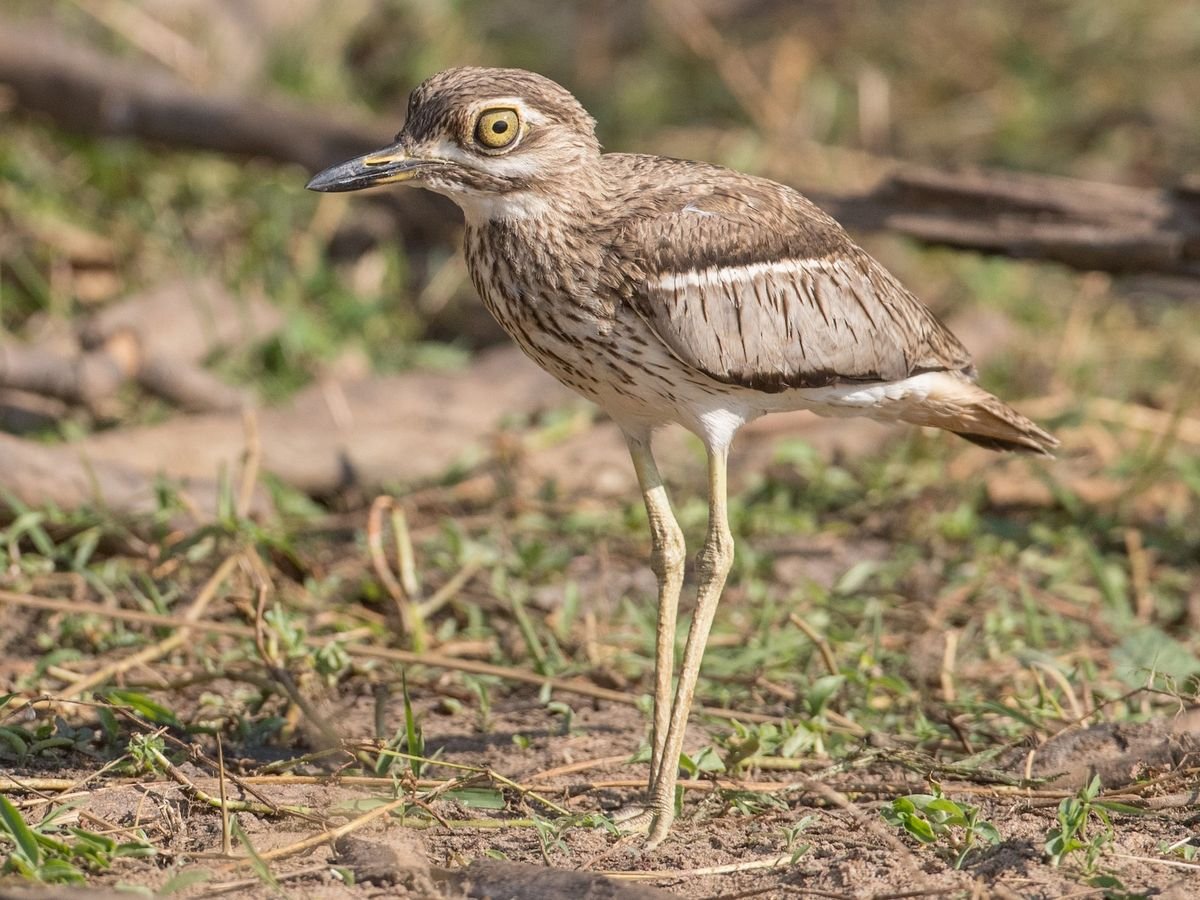
Water Thick-knee
Burhinus vermiculatusA striking water-edge thick-knee of African rivers, lakeshores and seasonal wetlands — watchful, cryptic and mainly active after dark.
The Water Thick-knee (Burhinus vermiculatus) is a large member of the thick-knee family Burhinidae. It is more closely tied to water than many other thick-knees, using shorelines, riverbanks, floodplains, lake margins and nearby open ground. Its oversized eyes support low-light activity, while its streaked plumage helps it disappear against stones, mud and dry vegetation.
Water Thick-knee Quick Facts
What Is the Water Thick-knee?
The Water Thick-knee (Burhinus vermiculatus), also known as the Water Dikkop in some regional birding literature, is a robust, long-legged shorebird-like bird in the family Burhinidae. Despite its wader-like appearance, it spends much of its time on open ground beside water rather than constantly feeding in shallow water.
It is closely associated with rivers, lake shores, marsh edges, floodplains and other well-drained ground near water. In Tanzania this ecology brings it into view around major wetlands, river systems and coastal water bodies as well as some large inland lakes.
The species is widespread across much of sub-Saharan Africa. Its cryptic brown, grey and buff plumage, huge eyes and deliberate posture can make it surprisingly difficult to detect until it moves or gives its distinctive call.
How to Identify a Water Thick-knee
The Water Thick-knee is best recognized by its combination of large size, long legs, very large eyes and subtle streaked colouring.
- Head and eyes: Very large pale-yellow to yellow eyes adapted to activity in dim light.
- Plumage: Grey-brown and streaked upperparts provide excellent camouflage on dry ground beside water.
- Wing pattern: A strong white wing-bar is visible in flight and helps separate it from the Senegal Thick-knee.
- Legs: Long, sturdy legs suited to walking over firm banks and open ground.
- Bill: Strong, slightly hooked at the tip, suited to a mixed animal diet.
- Posture: Often stands very still during the day, relying on camouflage rather than constant movement.
Distinguishing from Other Thick-knees
The Water Thick-knee can be confused with the Spotted Thick-knee, but it is generally more closely associated with water and shows a conspicuous white wing-bar. The Spotted Thick-knee is more strongly patterned overall and is typically more terrestrial away from wet margins.
Behavior & Social Life
The Water Thick-knee is generally quiet and watchful, spending daylight hours resting or standing motionless where its cryptic plumage blends into sand, gravel, dry vegetation and mud edges.
Daily Activity
- Foraging: It walks slowly over open ground and wetland margins, picking up prey from the surface or probing with its bill.
- Night activity: Much of its feeding and calling activity occurs after sunset, when its large eyes are especially useful.
- Calling: Its loud, far-carrying calls can reveal birds that remain almost invisible in darkness.
Movement
The species is not a long-distance migrant in the manner of many shorebirds. Local movements can occur in response to water levels, food availability and changing conditions along rivers and wetlands.
Habitat & Distribution
The Water Thick-knee is characteristically found close to water, but it is not confined to marsh vegetation. It often prefers open ground where it can walk and hunt efficiently.
- Riverbanks and sandy or gravelly channels.
- Lake shores and exposed mud or firm ground around water.
- Floodplains and seasonal wetlands with nearby dry resting areas.
- Open ground near wetlands, including lightly vegetated or rocky margins.
Distribution: The species occurs widely across sub-Saharan Africa, especially in areas where suitable permanent or seasonal water is available.
Tanzania Distribution
In Tanzania, the Water Thick-knee is documented from a range of habitats and locations, including the Serengeti, Tarangire, Lake Eyasi and coastal Dar es Salaam. The species can occur wherever open water margins provide suitable feeding and resting habitat.
Water Thick-knee in Tanzania
Tanzania offers several strong opportunities for finding the Water Thick-knee, especially around rivers, lake margins and open wetland edges. The birds can be easy to miss during the day, so patient scanning is important.
Serengeti National Park
Water Thick-knee is documented in the Serengeti, including streamside habitat in the western part of the park.
Serengeti safariTarangire National Park
Recorded around riverine and wetland-associated habitats, including areas where water attracts a rich mix of invertebrate prey.
Tarangire safariLake Eyasi
Documented photographic records show the species using the Lake Eyasi landscape and its water-edge habitats.
Lake Eyasi safariDar es Salaam
Coastal records include nesting birds around Oyster Bay and observations at Kunduchi and other water-associated sites.
Coastal wildlifeSafari Methods
- Game drives along rivers and wetland margins.
- Birdwatching with careful scanning of open ground and shaded banks.
- Night or evening observation where permitted and guided, when activity increases.
Best Time to See Them
Look for the Water Thick-knee at dawn and dusk, or during the day when birds are standing quietly near water. Wetland edges can be especially productive when exposed feeding areas concentrate prey.
Diet & Feeding
The Water Thick-knee is an opportunistic animal-eater. It searches the ground around water rather than relying on a specialized filter- or probing-feeding method.
Food Sources
- Insects: Beetles, grasshoppers and other terrestrial insects.
- Crustaceans and molluscs: Small aquatic or shoreline prey when available.
- Small vertebrates: Frogs, lizards and other small prey can supplement the diet.
- Other invertebrates: Worms and assorted shoreline arthropods.
Hunting Behavior
It walks deliberately, pauses, watches and then picks up prey with a quick movement. Feeding activity is often stronger in lower light, using its large eyes and acute awareness to locate prey while remaining inconspicuous.
Breeding & Life Cycle
The Water Thick-knee usually breeds on the ground in open habitat close to water. Its nest is a simple scrape rather than a substantial constructed platform.
Nesting
- Nest: A shallow scrape or slight depression on bare or sparsely vegetated ground.
- Eggs: Usually a small clutch, commonly one or two eggs.
- Incubation: Both parents may share incubation duties, helping keep the nest concealed.
Chicks
The young are precocial: they are covered in down and able to leave the nest area soon after hatching. Parents continue to guard and guide them while they learn to move and feed safely around the water's edge.
Conservation Status
The Water Thick-knee is currently assessed as Least Concern globally. Its broad sub-Saharan African distribution and use of many wetland and riverine habitats give it a relatively secure overall position.
Even so, local populations can be affected when wetlands are degraded, riverbanks are heavily altered or water quality declines. Disturbance near breeding sites can also matter because the birds nest directly on the ground.
Important local conservation priorities include:
- Wetland protection so feeding and nesting margins remain available.
- River and lake shoreline management that limits unnecessary disturbance.
- Monitoring of breeding sites and important wetland populations.
Comparisons
The Water Thick-knee can be confused with other thick-knees that occur in Tanzania. The following field comparison focuses on the most useful differences.
| Feature | Water Thick-knee | Spotted Thick-knee | Senegal Thick-knee |
|---|---|---|---|
| Water association | Strong; usually close to water | More terrestrial overall | Often associated with dry open country |
| Wing pattern | Conspicuous white wing-bar | More heavily mottled and spotted | Different wing pattern |
| Activity | Mainly nocturnal, can stand during day | Mainly nocturnal | Mainly nocturnal |
| Typical habitat | Riverbanks, lake shores, floodplains | Dry savanna and open ground | Semi-arid and dry open habitats |
| Family | Burhinidae | Burhinidae | Burhinidae |
Did You Know?
Huge Eyes
Its very large eyes are one of the clearest clues to its low-light and nocturnal lifestyle.
Water Specialist
It is more strongly associated with water than many other thick-knees.
White Wing-bar
The white wing-bar is especially useful for separating it from the Senegal Thick-knee in flight.
Cryptic by Day
During daylight it may simply stand or sit motionless, blending into the ground beside the water.
Ground Nester
Breeding takes place on the ground, usually in a shallow scrape rather than a built nest.
Urban Surprise
Documented records include breeding birds on rooftops in Dar es Salaam, showing how adaptable the species can be.
The Water Thick-knee is a master of disappearing in plain sight. Beside a Tanzanian river or lake it may look like an oddly patterned patch of earth until the huge eye catches the light or the bird suddenly walks into view. At dusk the stillness gives way to purposeful movement, as it patrols the water's edge for insects and other small prey. That contrast — motionless by day, remarkably alert after dark — is part of what makes this bird such a rewarding safari discovery.
Gallery
Frequently Asked Questions
The Water Thick-knee (Burhinus vermiculatus) is a large thick-knee of the family Burhinidae that is strongly associated with rivers, lakes, floodplains and other water-edge habitats in sub-Saharan Africa.
Documented Tanzanian locations include Serengeti National Park, Tarangire National Park, Lake Eyasi and coastal Dar es Salaam, especially around suitable riverbanks, lake shores and wetland edges.
It feeds on insects and a range of other invertebrates, with small crustaceans, molluscs and small vertebrates such as frogs or lizards also taken opportunistically.
No. The Water Thick-knee is currently assessed as Least Concern globally, although local wetland degradation and disturbance can affect habitat quality.
It is called a Water Thick-knee because, compared with many other thick-knees, it is strongly associated with water bodies and wetland margins.
It nests on the ground, usually in a shallow scrape near suitable water-edge habitat, with a small clutch commonly of one or two eggs and precocial young.
Look for the very large eyes, long legs, grey-brown streaked plumage, strong white wing-bar and its characteristic habit of standing quietly beside water.
Yes. It is mainly nocturnal, although birds are often visible standing or resting during the day before becoming more active around dusk and through the night.
References & Further Reading
- Tanzania Birds – Water Thick-knee species page and documented Tanzanian records, including Lake Eyasi, Tarangire and other sites.
- eBird / Cornell Lab of Ornithology – Species identification, range, behaviour and observation data.
- BirdLife International / IUCN Red List framework – Current global conservation assessment: Least Concern.
- ITIS / IOC taxonomy sources – Scientific name Burhinus vermiculatus and family placement.
- Macaulay Library – Documented breeding record of Water Thick-knees in Dar es Salaam, Tanzania.
- African Bird Club – Species identification, family and conservation information.
- Regional birding records – Field observations from Serengeti and other Tanzanian water-associated habitats.