

.png)
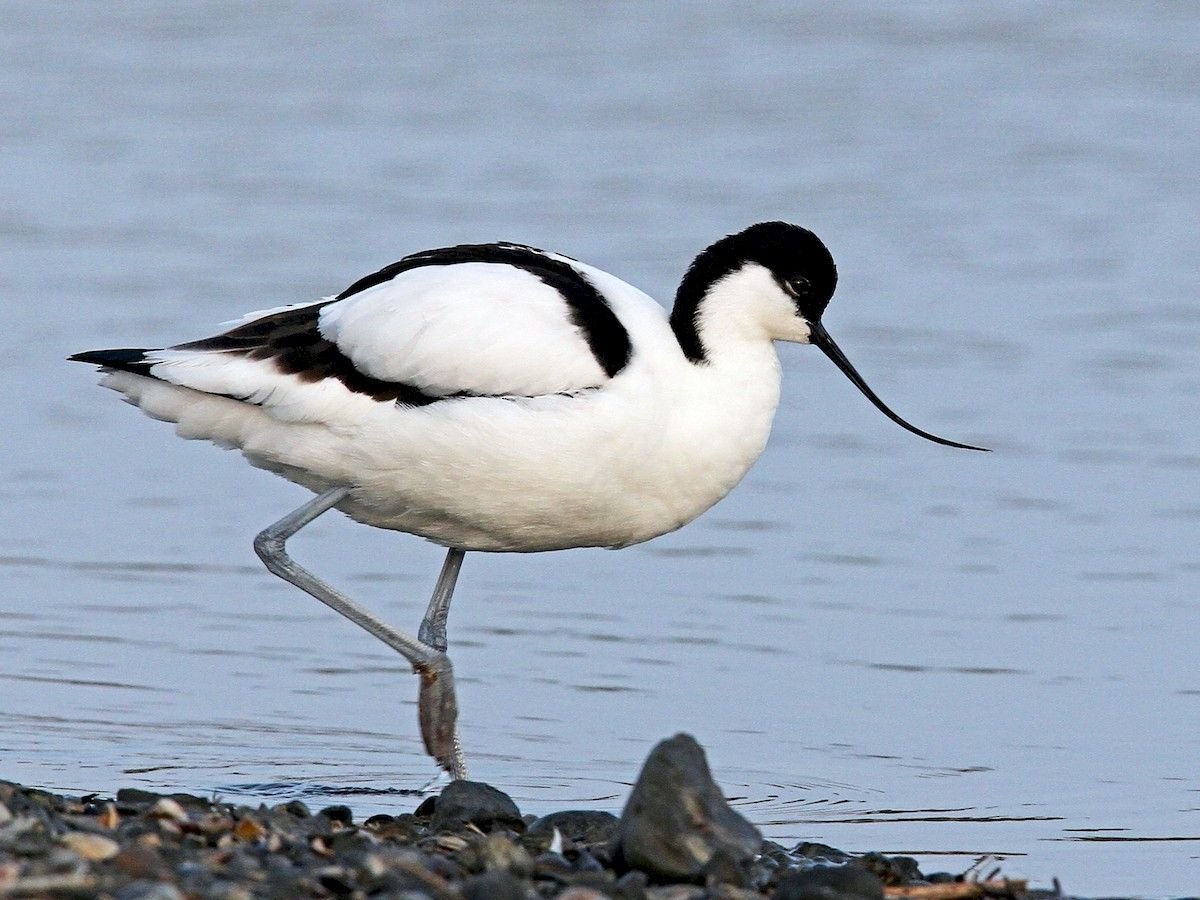
Pied Avocet
Recurvirostra avosettaAn elegant black-and-white wetland wader whose upcurved bill sweeps life from the shallows.
The Pied Avocet (Recurvirostra avosetta) is a striking long-legged wader of shallow lakes, saline flats, lagoons, pans, and other open wetlands. Its sharply upturned bill, bold black-and-white plumage, and distinctive feeding movements make it one of Africa’s most recognizable waterbirds. In Tanzania, it is strongly associated with productive Rift Valley wetlands.
Pied Avocet Quick Facts
What Is the Pied Avocet?
The Pied Avocet (Recurvirostra avosetta) is a medium-sized wader in the family Recurvirostridae. It is instantly recognizable by its crisp black-and-white plumage, long pale legs, and long bill that curves strongly upward.
The species is specialized for shallow-water foraging. Instead of probing deeply into mud, it sweeps its bill from side to side through water or soft sediment, detecting small prey as it walks steadily across a feeding flat.
Pied Avocets occur across a broad Eurasian and African range. In East Africa, populations may be resident in suitable wetlands while also making local and regional movements in response to rainfall, lake levels, and changing food availability.
How to Identify a Pied Avocet
The Pied Avocet is usually unmistakable once the bill shape is noticed. Its black-and-white body pattern, long pale legs, and dramatically upturned bill create a distinctive silhouette both at rest and in flight.
- Bill: Long, slim, and strongly upcurved, with a specialized sweeping action through shallow water.
- Plumage: Bright white body with bold black areas on the head, neck, back, and wings.
- Head: Black crown and nape contrast sharply with the white face and throat.
- Legs: Long, slender, and pale grey to bluish-grey in appearance.
- Body shape: Elegant, long-legged profile with the bill held slightly upward.
- Flight: Long neck and legs extend beyond the body, framed by striking black-and-white wings.
Distinguishing from Other Long-legged Waders
The Black-winged Stilt is a common comparison in Tanzanian wetlands. The stilt has extremely long bright-red legs and a straighter bill, whereas the Pied Avocet has a distinctly upturned bill and stronger black-and-white head and wing pattern.
Behavior & Social Life
Pied Avocets are social wetland birds that may gather in pairs, family groups, or larger flocks where shallow feeding habitat is abundant. Their numbers and movements can change with water level, rainfall, food supply, and disturbance.
Daily Activity
- Feeding: Walks through shallow water while sweeping the bill side to side in repeated arcs.
- Foraging: Concentrates on muddy margins, open shallows, saltpans, and wetland flats where prey is accessible.
- Vocalization: Gives sharp calls around feeding groups, breeding areas, and during alarm or territorial interactions.
Migration
In East Africa, Pied Avocets are best understood as flexible wetland birds rather than as purely resident or purely migratory. Rainfall and changing water conditions can trigger movements between suitable feeding and breeding sites.
Habitat & Distribution
Pied Avocets favour open wetlands where shallow water and exposed mud or salt-encrusted margins provide access to food and safe visibility.
- Alkaline lakes and shallow Rift Valley shores.
- Saltpans, lagoons, dams, and seasonal pans.
- Flooded flats, marsh edges, and open mudflats with sparse vegetation.
- Shallow coastal and inland wetlands where small invertebrate prey is abundant.
Distribution: The species has a broad range across Europe, Asia, and Africa. African populations are associated with major inland and coastal wetlands, with eastern Africa supporting an important population centred on Rift Valley lakes.
Tanzania Distribution
Tanzania Distribution: Tanzania is an important part of the East African Pied Avocet range. Lake Manyara is especially notable, while documented records and population work also identify Lake Eyasi, Lake Kitangire, Ndutu, Momela and other suitable wetland systems.
Pied Avocet in Tanzania
For birdwatchers in Tanzania, the strongest opportunities come from open alkaline lakes, shallow pans, and wetland margins where Pied Avocets can feed in the shallows or gather in resting flocks.
Lake Manyara National Park
One of Tanzania’s best-known Pied Avocet sites. Historical waterbird counts recorded several thousand birds here, highlighting the importance of its alkaline shallows and exposed feeding flats.
Lake Manyara safariLake Eyasi Wetlands
Lake Eyasi is part of the important East African avocet landscape and has supported substantial historical counts when wetland conditions are favourable.
Lake Eyasi birdingLake Kitangire
This Rift Valley lake has also supported large numbers of Pied Avocets and demonstrates how productive shallow alkaline wetlands can be.
Northern Tanzania safariNdutu & Momela Wetlands
Wetlands around Ndutu and Momela provide additional Tanzanian records and illustrate the species’ use of seasonally suitable open water habitats.
Tanzania birding safariSafari Methods
- Game drives and wetland stops where shallow water is visible from roads and tracks.
- Birdwatching with binoculars or a long lens, especially early when waterbirds are active.
- Wildlife photography from respectful distances along open wetland margins.
Best Time to See Them
Pied Avocets can occur year-round in parts of East Africa, but numbers and movements vary with rainfall and water conditions. For the most productive views, focus on periods when shallow feeding flats are exposed and wetland bird concentrations are high.
Diet & Feeding
The Pied Avocet is primarily a wetland invertebrate feeder. Its most remarkable feeding adaptation is the upturned bill, which allows the bird to sweep through shallow water and soft sediment rather than relying mainly on deep probing.
Food Sources
- Aquatic insects and larvae: Important prey in shallow water and muddy margins.
- Small crustaceans: Tiny aquatic crustaceans are taken during sweeping movements.
- Other invertebrates: Molluscs and similar prey are consumed where available.
- Seeds and plant matter: May supplement the diet, especially when animal prey is less accessible.
Hunting Behavior
The classic feeding action is a repeated side-to-side sweep. The avocet walks steadily forward with the bill slightly open, filtering through the upper water column and surface sediment for small prey. Groups can work across broad feeding flats together.
Breeding & Life Cycle
Breeding is closely linked to suitable water levels and open ground near wetlands. Pied Avocets may nest in pairs or loose colonies where shallow feeding habitat is close by.
Nesting
- Nest: A shallow scrape or small nest lined with plant material on mud, sand, or low open ground near water.
- Eggs: Usually about 3-5 eggs, with both adults involved in parental duties.
- Incubation: Roughly 23-25 days, shared by the adults.
Chicks
Young leave the nest soon after hatching and follow the adults to feeding areas. Parents guard and guide the chicks while they learn to forage and develop the strength needed for flight.
Conservation Status
The Pied Avocet is globally assessed as Least Concern. Its broad geographic range and ability to use a variety of wetland habitats provide resilience, but important local populations remain dependent on healthy shallow-water systems.
Wetland degradation can reduce feeding and breeding opportunities. Water extraction, pollution, altered hydrology, wetland conversion, disturbance, and loss of open mudflats may all affect local abundance even when the global species category remains secure.
Effective conservation therefore depends on protecting major wetlands, maintaining natural or ecologically suitable water regimes, reducing pollution, safeguarding breeding areas, and continuing waterbird monitoring at sites that regularly support large concentrations.
- Wetland conversion or degradation can remove feeding and nesting habitat.
- Changes in lake levels and water extraction can eliminate shallow feeding zones.
Comparisons
The Pied Avocet is most often compared with the Black-winged Stilt and other long-legged wetland waders. Bill shape, leg colour, and wing pattern are reliable field clues.
| Feature | Pied Avocet | Black-winged Stilt | Blacksmith Lapwing |
|---|---|---|---|
| Bill | Long, strongly upcurved | Straight and slender | Straight, medium length |
| Legs | Pale grey-blue | Bright red | Yellow to yellow-orange |
| Plumage | Bold black and white | Mostly white with black wings | Brown, grey, black and white |
| Habitat | Shallow lakes, pans, saltpans | Shallow wetlands, lagoons, mudflats | Grassland, wetland edges, open country |
| Feeding | Sweeps bill through shallows | Probes and picks prey in shallows | Pecks and probes on ground |
| Diet | Aquatic invertebrates, crustaceans, larvae | Aquatic invertebrates and small fish | Invertebrates and other ground prey |
Did You Know?
Upturned Bill
The sharply upcurved bill is the Pied Avocet’s signature adaptation for sweeping prey from shallow water.
Wetland Specialist
It thrives where open shallow water, exposed mud, and productive wetland edges provide easy access to invertebrates.
Black-and-White Pattern
The clean contrast of black and white makes a feeding flock especially conspicuous against pale lake shores.
Rift Valley Bird
East African Rift Valley lakes are a major part of the species’ African story, including important Tanzanian sites.
Flock Behaviour
Where food is abundant, Pied Avocets can gather in groups and move together across broad shallow feeding areas.
Rainfall Matters
Rainfall and changing water levels influence where the birds can feed, breed, and move between wetlands.
There is something almost graphic about a Pied Avocet in an African wetland: black and white plumage, long pale legs, and a bill curved like a crescent over the shallows. Watch closely and the beauty becomes biology—the bird is sweeping its bill through water and soft sediment, turning a quiet shoreline into a finely searched feeding ground. Around Tanzania’s Rift Valley lakes, a flock of avocets can turn an apparently still wetland into a scene of constant, elegant motion.
Gallery
Frequently Asked Questions
The Pied Avocet (Recurvirostra avosetta) is an elegant wetland wader recognized by its black-and-white plumage, long pale legs, and strongly upcurved bill.
Important Tanzanian sites include Lake Manyara, Lake Eyasi, Lake Kitangire, Ndutu, Momela and other Rift Valley wetlands where shallow water and open feeding flats are available.
It mainly feeds on small aquatic invertebrates such as insect larvae and tiny crustaceans, with other invertebrates and some plant material taken opportunistically.
No. The Pied Avocet is globally assessed as Least Concern, although local wetland populations can be affected by habitat loss, pollution and changes in water levels.
The upturned bill is a feeding adaptation. The bird sweeps it from side to side through shallow water and soft sediment to detect prey.
It nests on open ground near water, usually lays about 3-5 eggs, and adults share incubation and chick-rearing duties.
Look for the black-and-white body pattern, long pale legs, and especially the long, sharply upcurved bill. The Black-winged Stilt has bright red legs and a straighter bill.
Tanzania supports an important East African resident component, while birds can also move between wetlands in response to rainfall, water levels, and food availability.
References & Further Reading
- BirdLife International – Pied Avocet species information and global conservation assessment.
- Tanzanian Birds & Butterflies – Tanzania bird checklist and Pied Avocet occurrence records.
- Wetlands International – East African Pied Avocet population and waterbird information.
- BirdLife International – Lake Manyara Important Bird Area and waterbird significance.
- eBird – Pied Avocet identification, distribution, seasonality and observations.
- Birds of the World – Pied Avocet ecology, feeding and breeding biology.
- BirdLife South Africa – Pied Avocet identification and wetland ecology resources.