

 Ngorongoro Conservation Area
 Volcanoes National Park


White-tailed Mongoose
Ichneumia albicauda
White-tailed Mongoose — Quick Facts
Important notice
This profile describes a species associated with the Mount Kilimanjaro ecological landscape. Checklist or locality records do not confirm a sighting on every route, camp or altitude. Route records are listed only when verified; none are asserted here.
Introduction
The white-tailed mongoose is one of Africa's larger mongoose species, recognised by its grey-brown body, long legs and conspicuous pale tail. Unlike many mongooses active by day, it is primarily nocturnal, resting in a sheltered den during daylight and foraging after dark. On Mount Kilimanjaro it is documented by historical accounts and by strong modern camera-trap evidence from nine study plots.
How to Identify the Animal
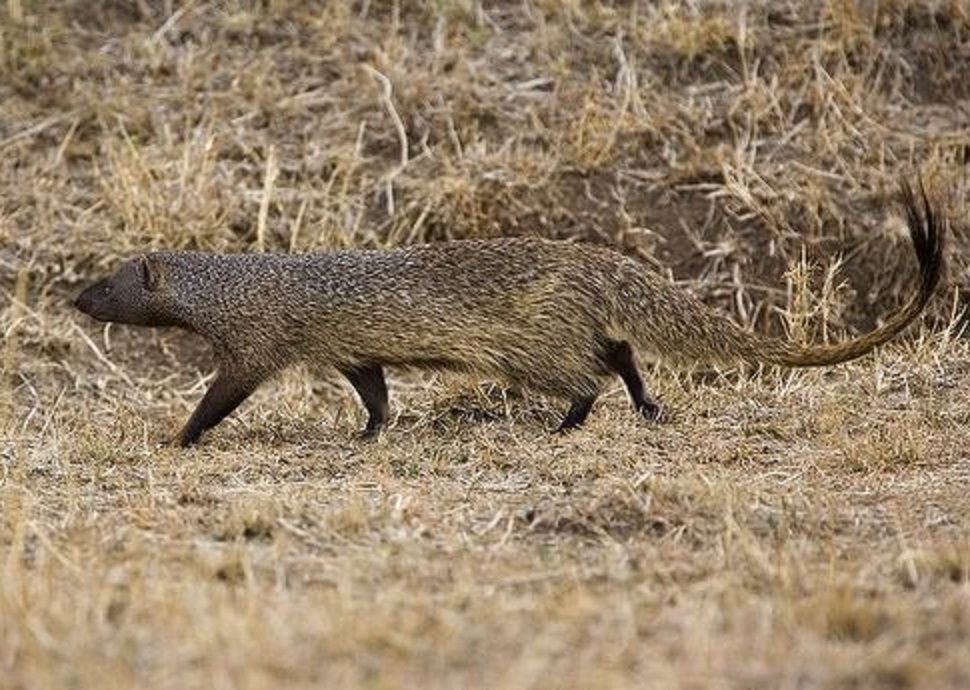
A relatively large, elongated mongoose with grey or grey-brown fur formed partly from long black-and-white banded guard hairs. The tail is long and conspicuously pale or white, contrasting with the darker body, and the feet and claws are adapted for ground movement and investigating soil or termite mounds. The white tail is the key visual feature: the Egyptian mongoose has a darker tail tip instead. The Kilimanjaro research identifies the subspecies as Ichneumia albicauda ibeana; that name is retained as a research identification, not a separate species.
Habitat and Distribution on Mount Kilimanjaro
The 1995 publication The Mammals of Kilimanjaro reported the white-tailed mongoose as common in the cultivated zone, often seen on roads at night, and noted an earlier northern-slope forest record reported by Newmark and colleagues in 1991. Modern evidence comes from the survey conducted from May to September 2016 across 66 study plots: the species was recorded at nine plots between approximately 866 and 1,788 metres, with 37 camera-trap observations. The 37 observations are detections, not 37 different animals or a population estimate. The elevation range is the range of plots where it was detected, not its complete natural range. In wider Africa the species uses woodland, wooded savanna, grassland with cover, bushland, open woodland edges and some agricultural land. No high-altitude moorland or alpine occurrence is claimed, and no route is assigned.
Nocturnal Activity
Nocturnal activity is typical. Daytime hours are spent in shelter, with emergence after dark to search for insects and other prey. No sightings are guaranteed.
Kilimanjaro Research and Evidence
The Mount Kilimanjaro mammal survey was conducted from May to September 2016 and used camera traps and indirect observations across 66 study plots. The white-tailed mongoose was recorded at nine plots, with 37 camera-trap observations at elevations of approximately 866–1,788 metres. The research table identifies the animal as Ichneumia albicauda ibeana. Camera-trap observations count detections at a plot, not individual animals, and the study is not a 2026 survey or a population census.
Diet and Feeding Behaviour
Primarily carnivorous, feeding on termites, beetles and other insects, small mammals, reptiles and other small animals found while foraging on the ground. It uses its sense of smell to locate prey. Fruit and plant material are not presented as the main diet.
Behaviour and Social Life
Mainly nocturnal, resting by day and foraging after dark. Usually solitary except for females with young. It is a ground-dwelling animal that may use abandoned termite mounds and sheltered depressions around trees as dens, often moving with a steady trot and the pale tail trailing behind.
Predators and Natural Threats
Potential predators include larger carnivores and birds of prey, with young more vulnerable. Habitat change and persecution may affect populations in parts of its wider range; no specific Kilimanjaro predator is claimed.
Communication and Calls
Scent marking is important; animals may raise or arch the tail during scent-marking behaviour. The exact purpose of every tail movement is not established here, and no vocal call is claimed or attributed to Kilimanjaro.
Reproduction and Breeding
Published accounts suggest females usually give birth to one to three young, with maternal care and dependence during early development. Information on breeding season and reproductive timing is incomplete and varies between accounts; no Kilimanjaro breeding season is asserted.
Ecological Importance
As a ground-foraging predator of termites, beetles and other small animals, the white-tailed mongoose forms part of woodland and grassland food webs and may influence some prey numbers. It can also serve as prey for larger predators. No measured ecological impact on Kilimanjaro is claimed.
Conservation Status
The global IUCN assessment published in 2015 lists the white-tailed mongoose as Least Concern. This global category does not prove that every local population is secure, and habitat quality and human pressures can still matter. No Kilimanjaro population estimate or trend is asserted.
Wildlife Watching on Kilimanjaro
The species has been documented in the lower-elevation Kilimanjaro study area and historically on roads at night in cultivated parts of the wider region. Its nocturnal habits make it unlikely during daytime wildlife viewing. Visitors should never approach, feed or interfere with its shelter or young, and no sighting can be promised.
Route and Habitat Occurrence
Historical records: cultivated zone and northern-slope forest in the wider Kilimanjaro area. Modern records: nine camera-trap plots between 866 and 1,788 metres with 37 observations. No occurrence is claimed on Machame, Marangu, Lemosho, Shira, Rongai, Northern Circuit, Umbwe, Mweka or Kilema.
Honest Expectations
Camera-trap records confirm presence at sampled plots during the survey. They do not mean the species is regularly seen by visitors, especially during daytime activity, and no sighting can be guaranteed.
Frequently Asked Questions
About White-tailed Mongoose on Kilimanjaro
What is the White-tailed mongoose?
A large, mostly nocturnal mongoose with a conspicuous pale tail.
What is its scientific name?
Ichneumia albicauda.
Which family does it belong to?
Herpestidae.
Why is it called the White-tailed mongoose?
Its long pale or white tail contrasts sharply with its darker body.
Is it found on Mount Kilimanjaro?
Yes. Historical records and modern camera-trap records document it.
How many Kilimanjaro study plots recorded it?
Nine study plots.
What do the 37 camera-trap observations mean?
They are detection records at sampled plots, not 37 individual animals or a population estimate.
At what elevations was it recorded on Kilimanjaro?
Approximately 866–1,788 metres at the detected study plots.
Is the White-tailed mongoose nocturnal?
Yes, it is primarily active at night.
What does it eat?
Termites, beetles and other insects, small mammals, reptiles and other small animals.
Does it eat termites?
Yes. Termites are among its documented general foods.
How large is the White-tailed mongoose?
It is one of Africa’s larger mongooses, with an elongated body; no local measurements are claimed.
Does it live alone?
Usually, except for females accompanied by young.
Where does it sleep during the day?
In sheltered dens, including abandoned termite mounds and depressions around trees.
Does it use termite mounds as shelter?
Yes, abandoned termite mounds can serve as dens.
How does it communicate?
Through scent marking and tail postures; no Kilimanjaro vocal record is claimed.
How many young can a female have?
Published accounts suggest one to three young.
Is the White-tailed mongoose endangered?
No. Its global IUCN status is Least Concern.
Can visitors see it during a Kilimanjaro climb?
Not reliably. It is nocturnal and not an expected climbing-route sighting.
How is it different from the Egyptian mongoose?
It is larger, mostly nocturnal and has a pale tail; the Egyptian mongoose is generally diurnal with a dark-tipped tail.
Sources and Further Reading
Research foundations
Grimshaw, J.M., Cordeiro, N.J. & Foley, C.A.H. (1995). The Mammals of Kilimanjaro. African Journal of Ecology.
Elevational Distribution and Ecology of Small Mammals on Africa's Highest Mountain (2014 field study).
Tanzania National Parks — Kilimanjaro National Park official information.
UNEP-WCMC — Kilimanjaro World Heritage Datasheet.
Discover Kilimanjaro’s Wildlife
Explore the mountain responsibly with African Majestic Adventure and learn about its animals with local guides.