

.png)
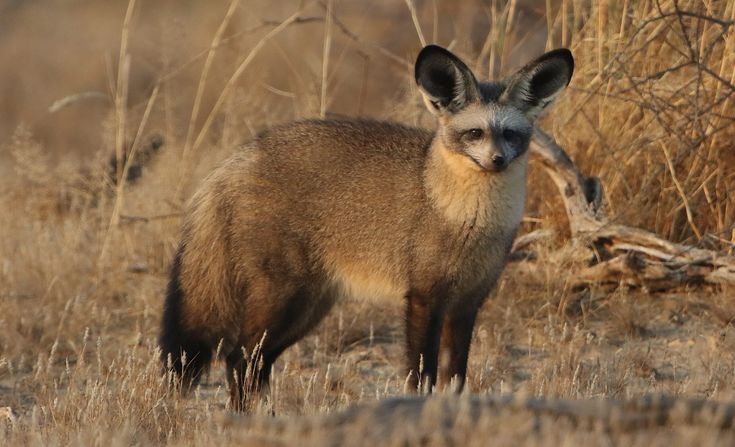
Bat-eared Fox
Otocyon megalotisThe small African canid that hunts by listening for insects beneath the ground.
Sightings are never guaranteed and depend on local conditions. Follow your guide and respect park rules.
A remarkable insect-eating canid of Africa's open grasslands and savannas, built to locate prey by sound.
Bat-eared Fox Quick Facts
What Is a Bat-Eared Fox?
The bat-eared fox (Otocyon megalotis) is a small, unmistakable member of the dog family (Canidae) and the sole living species in its genus, Otocyon. Despite the name, it is not a true fox of the genus Vulpes — it is a distinct African canid that has evolved to feed almost entirely on insects.
Its most famous feature — those enormous, bat-like ears — give the species its common name and its scientific one: Otocyon means “ear dog” in Greek, while megalotis means “large-eared.” It is the only African canid whose diet is dominated by termites and beetles rather than vertebrate prey.
Why It Is Unusual Among Canids
Where most canids chase prey, the bat-eared fox listens for it. Its insect-dominated diet, unusually high tooth count, social family structure and unusual jaw anatomy all set it apart from other African predators. In the ecosystems it shares with bigger carnivores, the bat-eared fox quietly plays a specialist role: keeping termite and beetle populations in check across the short-grass plains.
Why Does the Bat-Eared Fox Have Such Huge Ears?
Its ears are typically 12–15 cm long (about 5 inches) — proportionally enormous for a canid this size — and they serve two vital jobs at once.
1. Hearing
The ears are exquisitely tuned to detect the faint sounds of insects moving underground. A bat-eared fox can locate a beetle grub or termite colony beneath the soil simply by listening, a feeding strategy that drives almost everything about how it lives.
2. Thermoregulation
The ears are heavily vascularised — criss-crossed with blood vessels close to the skin. On hot days, blood flowing through the ears radiates heat away, helping the fox cool down in the intense heat of the African savanna. Zoos such as the Smithsonian and London Zoo both highlight the link between the large ears, sensitive hearing and heat regulation.
What Does the Bat-Eared Fox Eat?
The bat-eared fox is one of Africa's most specialised insect-eaters. Insects and other arthropods make up the bulk of its diet, supplemented on occasion by small vertebrates and plant material.
- Termites — harvester termites are a dietary staple in many regions.
- Dung beetles — adults and larvae are hunted out of the soil.
- Other insects — grasshoppers, crickets, beetles and larvae.
- Arthropods — spiders and scorpions are taken when encountered.
- Occasional small vertebrates — rodents, lizards, bird eggs and chicks.
- Some plant material — fruits and berries are eaten seasonally.
Animal Diversity Web describes insects and other arthropods as the primary diet, with small rodents, lizards, bird eggs and chicks, and plant material taken occasionally.
How Does It Hunt?
Hunting is a study in patience and precision. Rather than chasing prey, the fox walks slowly across the grassland, ears swivelling as it listens for activity beneath the soil.
This educational mini-story is exactly how a safari guide explains it: a fox that feeds almost entirely by ear, converting sound into a meal.
Where Does the Bat-Eared Fox Live?
The bat-eared fox is found in the drier grasslands and savannas of Africa. Animal Diversity Web describes two major, disjunct populations — one in eastern Africa and one in southern Africa.
Eastern Africa
- Tanzania
- Kenya
- Ethiopia and neighbouring areas
Southern Africa
- South Africa
- Botswana
- Namibia
- Angola and surrounding regions
Preferred Habitat
It favours arid grasslands, short-grass plains and savanna — open country where the ground is easy to dig and insects are abundant. It tends to avoid dense forest and closed woodland, preferring the visibility that open ground provides for spotting danger early.
Bat-Eared Fox in Tanzania
Bat-eared foxes occur in suitable open grassland habitats within Tanzania, although sightings can be less predictable than those of larger, more conspicuous safari species. Their small size and habit of hunting quietly through the grass means many visitors drive past without noticing them — until a pair of huge ears breaks the skyline.
Where Sightings May Occur
- Serengeti ecosystem — open short-grass plains offer ideal hunting habitat.
- Ngorongoro ecosystem — suitable open grasslands on the crater floor and surrounding plains.
- Other suitable open-grassland habitats — including drier savanna country across northern Tanzania.
Guides recommend scanning the short-grass plains slowly around dawn and dusk, when foxes are most likely to be moving and hunting.
Where Can You See a Bat-Eared Fox on Safari?
Bat-eared foxes are present across suitable open grasslands of East Africa, but sightings require patience and a good eye. The table below gives a realistic guide to habitat suitability.
| Destination | Habitat suitability | Sightings |
|---|---|---|
| Serengeti | High — extensive open short-grass plains | Possible |
| Ngorongoro | Suitable open grassland habitats | Possible |
| Other East African grasslands | Varies with season and habitat | Possible |
Want to explore Tanzania's lesser-known wildlife?
Bat-Eared Fox Behavior
Social behavior
Typically seen in pairs or small family groups. Monogamous pairs often raise young together, with older siblings helping to care for pups.
Communication
Uses a mix of soft calls, body language and scent marking for social interaction and group coordination.
Activity
Mostly nocturnal in many populations, resting in shaded dens by day and hunting in the cooler hours.
Defense
Relies on vigilance, agility and speed to avoid predators, using its den as a refuge when threatened.
Burrows
Uses underground dens — often enlarged from aardvark or other diggers' holes — for shelter, resting and rearing young.
Animal Diversity Web documents the species' denning behavior, sociality, nocturnal activity and predator-avoidance adaptations.
Bat-Eared Fox Family Life
Family life is at the heart of bat-eared fox society. Pairs form strong bonds and cooperate closely to raise their young — an unusual commitment for a canid of this size.
After mating, the pair selects and prepares an underground den. Pups are born inside and, as they grow, begin exploring the den entrance under close adult supervision. Both parents feed and guard the young, and in some family groups older offspring remain to help rear the next litter. As the pups grow, adults demonstrate how to listen, dig and capture insects — passing on the skills a specialist insect-eater needs to survive.
How Many Teeth Does a Bat-Eared Fox Have?
46–50 teeth — an unusually high number for a canid, and a striking feature of the species' skull.
Animal Diversity Web describes 46–50 teeth and notes that the dental structure is highly unusual among canids. The Smithsonian similarly highlights the 46–50 tooth count. The extra cheek teeth — with their high, pointed cusps — are adapted for shearing and grinding the tough exoskeletons of the insects that form the bulk of the diet.
This unusual biology is a beautiful example of adaptation: a jaw evolved not for tearing meat, but for crunching beetles and termites.
Bat-Eared Fox vs Fennec Fox
Two of the most remarkable-eared canids on Earth, yet they could hardly be more different in lifestyle and range.
| Feature | Bat-Eared Fox | Fennec Fox |
|---|---|---|
| Region | East & Southern Africa | North Africa (Sahara) |
| Genus | Otocyon | Vulpes |
| Main diet | Mostly insects | Mixed diet |
| Habitat | Grasslands & savanna | Desert |
| Ears | Very large | Extremely large |
| Family | Canidae | Canidae |
Bat-Eared Fox vs Other African Predators
How does Africa's specialist insect-eater compare with the continent's other canids and predators? Compare the bat-eared fox with:
- Golden Jackal — a flexible omnivore of similar size.
- Black-backed Jackal — a more carnivorous cousin of the open plains.
- Side-striped Jackal — a woodland and moist-savanna canid.
- African Wild Dog — a highly social, pack-hunting canid.
- Aardwolf — another insect specialist, feeding on termites.
- Lion, Leopard & Cheetah — the apex predators that share its savanna.
Each comparison is explored on its own species page, building a wildlife knowledge graph across this guide.
Predators of the Bat-Eared Fox
For such a small canid, the world is full of danger. It is important to distinguish between predators of adults and the greater threats facing young animals.
Predators of Adults
- Jackals — larger canids that compete with and may prey on bat-eared foxes.
- Larger carnivores — including hyenas and big cats, though adults are fast and alert.
- Birds of prey — large eagles can take foxes caught in the open.
Threats to Young Animals
- Birds of prey — including eagles and owls that target unattended pups.
- Snakes — occasionally threaten pups at or near the den.
- Smaller carnivores — and stray dogs may take young foxes.
Den safety, group vigilance and an early warning system of large ears are the fox's principal defences.
Conservation Status
Least Concern does not mean the species has no conservation challenges. It means the species is not currently assessed in a higher IUCN threat category at the global level.
Habitat conversion and the reduction of open grassland can affect local populations, even though the species remains widespread overall. Protecting the short-grass plains of Tanzania's parks — including the Serengeti and Ngorongoro — safeguards this specialist insect-eater for the future.
Did You Know?
The bat-eared fox is unusual among canids because its diet is dominated by insects rather than large vertebrate prey.
With 46–50 teeth — among the most of any canid — its jaws are adapted for crushing insect shells.
Its ears are typically 12–15 cm long (about 5 inches) and act like cooling radiators as well as precision listening devices.
Unlike most foxes, both parents raise the pups — and older siblings often help look after the new litter.
Safari Guide's Perspective
In open African grassland, the bat-eared fox is easy to miss until its enormous ears break the horizon of the grass. Watch quietly and you will see it pause, tilt its head, and suddenly dig — pulling a beetle from the soil with astonishing precision.
From real guiding experience: the best bat-eared fox encounters come at the edges of the day — dawn and dusk on the open plains — when foxes are moving between burrows. Patience is the secret — the more still you sit, the more the savanna reveals.
Bat-Eared Fox in Pictures
A closer look at the Bat-eared Fox in its natural East African habitat — its striking appearance, habitat and behaviour are best appreciated up close.
Frequently Asked Questions
It belongs to the dog family Canidae and is called a fox, but it is not a true fox of the genus Vulpes. It is the sole living species in its own genus, Otocyon.
The huge ears give exceptional hearing for locating insects underground and, being heavily vascularised, they also help radiate heat to keep the fox cool.
Primarily insects and other arthropods — especially termites and dung beetles — with occasional small vertebrates and plant material.
Across open grasslands and savannas of Africa, with two main populations: eastern Africa (Tanzania, Kenya, Ethiopia) and southern Africa (South Africa, Botswana, Namibia, Angola).
No. It is currently listed as Least Concern on the IUCN Red List, though local habitat changes can still affect populations.
Yes — in suitable open grassland habitats such as the Serengeti and Ngorongoro ecosystems, although sightings are less predictable than those of larger safari species.
Approximately 46–66 cm in body length and 3–5.3 kg in weight — around the size of a domestic cat.
Primarily nocturnal and crepuscular, though activity patterns vary by region, season and temperature. Late afternoons, dusk and cool early mornings can all be good times to spot them moving between burrows.
46–50 teeth — among the highest counts of any canid — adapted for grinding the hard shells of its insect prey.
Otocyon megalotis — from Greek for "ear dog" and "large-eared", a name that perfectly describes its most famous feature.
References & Further Reading
- IUCN Red List: Otocyon megalotis — Least Concern
- Animal Diversity Web (University of Michigan): Species account for Otocyon megalotis, including body size, diet, dental formula and behavior.
- Smithsonian National Zoo & Conservation Biology Institute: Bat-eared fox fact sheet — large ears, hearing and thermoregulation.
- London Zoo (ZSL): Notes on the relationship between large ears, sensitive hearing and heat regulation.
- Estes, R. (1991). The Behavior Guide to African Mammals. University of California Press.
- Kingdon, J. (2015). The Kingdon Field Guide to African Mammals. Bloomsbury.
- About these facts: Weight, speed and lifespan are approximate adult ranges. They can vary with sex, age, season, location and the measurement method; conservation status should be checked against the current IUCN assessment.