

.png)
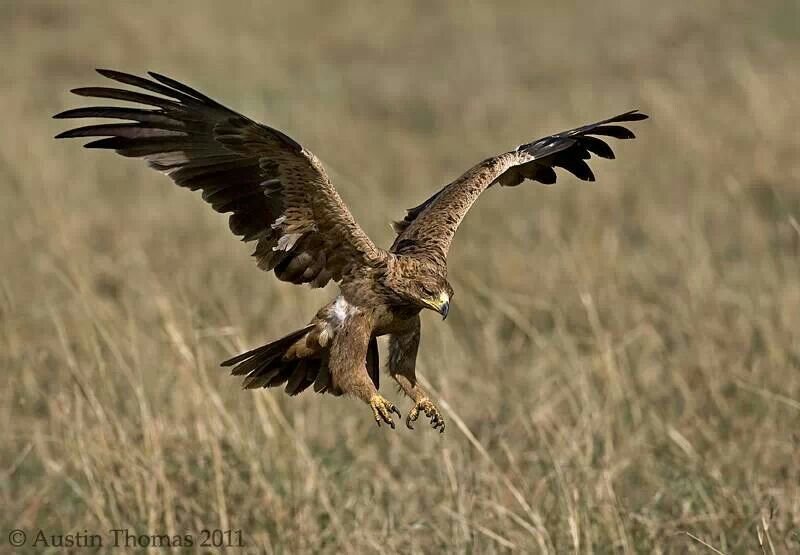
Tawny Eagle in Tanzania
Aquila rapax — true eagleWhat Is the Tawny Eagle?
The Tawny Eagle (Aquila rapax) is a true eagle of open and semi-open habitats — a versatile opportunistic predator and scavenger of savanna, grassland and dry woodland.
Variable in appearance from tawny sandy-brown to darker brown and mottled forms, with feathered legs, broad wings and a barred tail, it exploits prey from termites and insects to reptiles, birds, mammals, fish and carrion. In Tanzania it is a familiar raptor of Serengeti, Ngorongoro, Mkomazi and Ndutu.
Scientific Classification
A true eagle within Accipitridae — not a family-level concept.
How to Identify a Tawny Eagle
- Tawny/sandy-brown coloration, with darker morphs and mottled forms and pale or streaked head and neck in some birds.
- Feathered legs, broad wings and barred tail with a hooked bill and strong eagle profile.
Why Do Tawny Eagles Look So Different?
Tawny Eagles show striking plumage variation: light tawny birds, darker brown birds, mottled/spotted birds and juvenile variation with geographical and individual differences. In Tanzania, Tanzania Birds documents light and dark morphs and a rare spotted form. Not every brown eagle is a Tawny Eagle.
Identification caution: Tawny Eagles can be confused with other brown eagles, especially immature Steppe Eagles. Identification should combine plumage, wing shape, tail, bill, structure, habitat and geographic context.
Male vs Female
Females are generally larger than males. No male core-leader or female family-leader template is used.
How Does the Tawny Eagle Hunt?
- Elevated observation scanning open ground from perch or flight.
- Opportunistic strikes and terrestrial foraging where appropriate.
- Scavenging is part of the strategy — not defined by speed.
Daily Behaviour and Social Life
Tawny Eagles are diurnal. No diurnal label or 6am timetable is used. Activities include hunting, soaring, scanning, foraging, scavenging, resting, preening and territorial behaviour.
Social Behaviour
Generally solitary outside breeding or occurring as pairs. Breeding adults are territorial; juveniles may remain dependent for a period after fledging. No Group Living, group vigilance or dominance interactions.
Communication
- Vocal calls, aerial displays, posture, courtship and territorial displays.
- No scent communication.
Movement
Generally resident in many African populations; local or regional movements can occur with rainfall, prey or environmental conditions. Not a routine long-distance migrant in Tanzania.
Habitat: Open and Semi-Open Country
- Savanna, grassland, open woodland, dry woodland, semi-desert and semi-open country including cultivated open countryside.
Dense forest is not the normal habitat, and protected-area status is not presented as a habitat type. Core requirements are suitable open/semi-open habitat, prey availability, perching sites and nesting sites — water is not universally essential, though birds may drink and exploit prey near water.
Global Distribution
The Tawny Eagle has a broad distribution across Africa and parts of Asia. Tanzania is an important part of its East African range, but phrases such as "found primarily in Tanzania" or "Tanzania is the best place" are not used.
Tawny Eagle in Tanzania
In Tanzania, the Tawny Eagle is documented in Serengeti, Ngorongoro, Mkomazi, Ndutu, Manyara Ranch, Olasiti and Yaida Valley and other suitable landscapes — where current records support the statement. No national population estimate is invented.
Where to See Tawny Eagles in Tanzania
Serengeti National Park
Country: Tanzania | Region: Northern Tanzania
Open savanna and grassland — opportunistic predator and scavenger.
Good opportunity in suitable open-country habitats
Ngorongoro Conservation Area
Country: Tanzania | Region: Northern Tanzania
Crater rim and open woodland — territorial pairs.
Good opportunity in suitable open-country habitats
Mkomazi National Park
Country: Tanzania | Region: Northern Tanzania
Dry savanna and semi-desert — termite emergence opportunities.
Good opportunity in suitable open-country habitats
Ndutu / Southern Serengeti
Country: Tanzania | Region: Northern Tanzania
Short-grass plains and woodland — nest sites and scavenging.
Good opportunity in suitable open-country habitats
Sightings vary by location, habitat, prey availability and bird activity — never guaranteed.
Birding Methods
- Game drives, specialist raptor birding, wildlife photography and open-country birdwatching.
Best Time to See Them
Tawny Eagles can be encountered throughout the year. Dry-season visibility may improve in some open landscapes, and temporary prey events such as termite emergences can create localized opportunities. No June–October universal rule is imposed.
Tawny Eagle in Pictures
A closer look at the Tawny Eagle in its natural East African habitat — its striking appearance, habitat and behaviour are best appreciated up close.
Where to Spot the Tawny Eagle on Safari
Plan your trip around the destinations and safaris where the Tawny Eagle is easiest to see. Explore the parks, itineraries and tour packages by destination below.
What Does the Tawny Eagle Eat?
A highly opportunistic predator and scavenger:
- Termites, large insects, lizards and snakes where opportunistically taken; small/medium birds and eggs; rodents and small mammals; fish and carrion.
Not reduced to "carnivore."
Why Do Tawny Eagles Eat Termites?
At Mkomazi National Park, documented Tanzania evidence shows termite emergences can create concentrated, temporary feeding opportunities. Termites are not the primary diet.
Do Tawny Eagles Scavenge?
Yes — they take carrion, opportunistic feeding and food left by other animals, with interactions among birds where documented. Not a pure scavenger.
Tawny Eagle Breeding and Nesting
No gestation, birth or parental feeding:
- Territorial breeding pair with a tree nest of sticks and grass, frequently reused and growing large over repeated use.
- 1–3 eggs laid at roughly three-day intervals.
- Incubation approximately 40–45 days, commonly around 44–45 days; female performs most incubation while the male provides much early food.
- Fledging around 76–85 days.
Where Does the Tawny Eagle Build Its Nest?
- Trees with sticks and grass, reused nests that can become large over repeated use.
Why Does the Younger Chick Often Struggle?
Due to asynchronous hatching, size difference and food competition, the younger chick may die when food is insufficient. It is not described as parents intentionally killing the second chick, and 1–3 eggs is not confused with one chick.
Tawny Eagle Chick Development
- White down initially, feather development over weeks and increasing mobility.
- First flight roughly around 10 weeks with continued nest and parent dependence afterward.
- Fledging around 76–85 days.
Natural Threats to Eggs and Chicks
Adult tawny eagles have few natural predators. Threats include nest predators, egg predation, chick predation and nest disturbance.
Conservation Status: Least Concern
Global IUCN Status: Least Concern. Some regional populations have experienced declines.
Potential pressures: habitat alteration, poisoning, persecution, prey depletion, nesting-tree loss, disturbance and infrastructure risks where supported. Global LC is not presented as having no conservation concerns.
How Can a Least Concern Eagle Still Have Regional Problems?
Global status summarizes the species across its entire range; individual populations can decline substantially. South African regional assessments are clearly labelled as regional and do not change global IUCN status.
Generic African Parks/WWF/TAWIRI/KWS/UWA conservation claims are removed unless Tawny Eagle-specific evidence exists; focus is on habitat protection, reducing poisoning, protecting nests, preserving prey and maintaining suitable open landscapes.
Tawny Eagle Facts
Tawny Eagle vs Steppe Eagle
| Feature | Tawny Eagle | Steppe Eagle |
|---|---|---|
| Scientific name | Aquila rapax | Aquila nipalensis |
| Range | Africa + Asia, resident | Breeds Palearctic, migrates to Africa/Asia |
| ID | Tawny morphs; dark morphs | Juvenile with white band; adult darker |
| Tanzania | Year-round | Migrant visitor |
Tawny Eagle vs Bateleur
| Feature | Tawny Eagle | Bateleur |
|---|---|---|
| Tail | Barred, medium length | Very short |
| Plumage | Tawny/brown variable | Black, chestnut, white |
| Hunting | Predator + scavenger | Scavenger + hunter, low flight |
Tawny Eagle vs African Fish Eagle
| Feature | Tawny Eagle | African Fish Eagle |
|---|---|---|
| Habitat | Open savanna/grassland | Wetlands, lakes, rivers |
| Diet | Opportunistic, termites to carrion | Mainly fish |
| Voice | Harsh calls | Iconic ringing call |
Tawny Eagle vs Martial Eagle
| Feature | Tawny Eagle | Martial Eagle |
|---|---|---|
| Size | 65–72 cm, 1.6–2.5 kg | 78–96 cm, larger, powerful |
| Habitat | Open savanna | Broad, often woodland |
Why the Tawny Eagle Matters to Tanzania's Ecosystems
- Predator role, scavenging, prey regulation, ecological interactions and birdwatching value.
Photographing the Tawny Eagle
- Perched adult, soaring, hunting, termite feeding, scavenging, pair, juvenile, nest and fledgling — with light/dark morphs.
- Tanzania examples: Serengeti, Ngorongoro, Mkomazi and Ndutu.
Do not disturb nests.
Frequently Asked Questions
The Tawny Eagle (Aquila rapax) is a true eagle within Accipitridae — an adaptable, opportunistic predator and scavenger of open savanna, grassland and dry woodland across Africa and parts of Asia.
Aquila rapax.
Accipitridae within Accipitriformes.
Yes. It is a true eagle in the genus Aquila within Accipitridae.
Approximately 65–72 cm long in common field references; published adult mass commonly falls around 1.6–2.5 kg, varying by sex, age, region and individual.
They show light tawny, darker brown, mottled/spotted and juvenile variations, with geographical and individual differences. Tanzania Birds documents light and dark morphs and a rare spotted form.
Termites, large insects, lizards, snakes where opportunistically taken, small/medium birds and eggs, rodents/small mammals, fish and carrion.
Yes. In Mkomazi National Park, termite emergences create concentrated, temporary feeding opportunities, though termites are not the primary diet.
Yes. They take carrion, feed opportunistically and exploit food left by other animals, without being pure scavengers.
By elevated observation scanning open ground from perch or flight, with opportunistic strikes, terrestrial foraging where appropriate and scavenging.
Across a broad distribution in Africa and parts of Asia, occupying savanna, grassland, open woodland, dry woodland and semi-desert.
Savanna, grassland, open and dry woodland and semi-desert — semi-open country, not dense forest.
Serengeti, Ngorongoro, Mkomazi, Ndutu, Manyara Ranch, Olasiti, Yaida Valley and other suitable landscapes where current records support the statement.
Yes. Serengeti's open savanna and grassland provide opportunistic predator habitat.
Yes. Ngorongoro's open woodland and crater surrounds support territorial pairs.
Yes. Mkomazi's dry savanna is notable for termite-feeding aggregations.
Generally solitary outside breeding or occurring as pairs; breeding adults are territorial and juveniles may remain dependent for a period after fledging.
Generally resident in many African populations, with local or regional movements depending on rainfall, prey and environmental conditions — not routine long-distance migrants in Tanzania.
In trees — a stick and grass construction frequently reused and growing large over repeated use.
Usually 1–3 eggs, laid at roughly three-day intervals.
Approximately 40–45 days, commonly around 44–45 days.
Fledging around 76–85 days, with first flight roughly around 10 weeks and continued dependence afterward.
Asynchronous hatching creates a size difference and food competition; the younger may die when food is insufficient — not described as parents intentionally killing the second chick.
Globally Least Concern, though some regional populations have declined substantially.
Least Concern globally — regional Endangered assessments are clearly labelled as regional and do not change the global category.
Global status summarizes across the entire range; individual populations can still decline from poisoning, persecution, habitat alteration, prey depletion or nesting-tree loss.
Tawny is resident in Africa/Asia with variable tawny morphs; Steppe is a Palearctic breeder that migrates to Africa/Asia, with juvenile white bands and different wing structure — identification requires multiple features, not one trait.
Throughout the year, with dry-season visibility improving in some open landscapes and temporary termite emergences creating local opportunities — no fixed June–October universal rule.
Yes. Perched adults, soaring, hunting, termite feeding and scavenging in Serengeti, Ngorongoro, Mkomazi and Ndutu — using long lenses and without disturbing nests.
Related Safari Packages & Tours
Book a safari to see the Tawny Eagle and the rest of Africa's incredible wildlife with our expert guides.
References & Further Reading
- ITIS / BirdLife: Aquila rapax — Accipitridae, Accipitriformes — Least Concern.
- Tanzania Birds: Serengeti, Ngorongoro, Mkomazi, Ndutu, Manyara Ranch records; light/dark/rare spotted morphs.
- Mkomazi research: termite-emergence feeding opportunities.
- Ornithological guides: 65–72 cm, 44–45 d incubation, 76–85 d fledging, solitary/pair territorial.
- About these facts: measurements vary by source and individual.
Sightings are never guaranteed and depend on local conditions.