

.png)
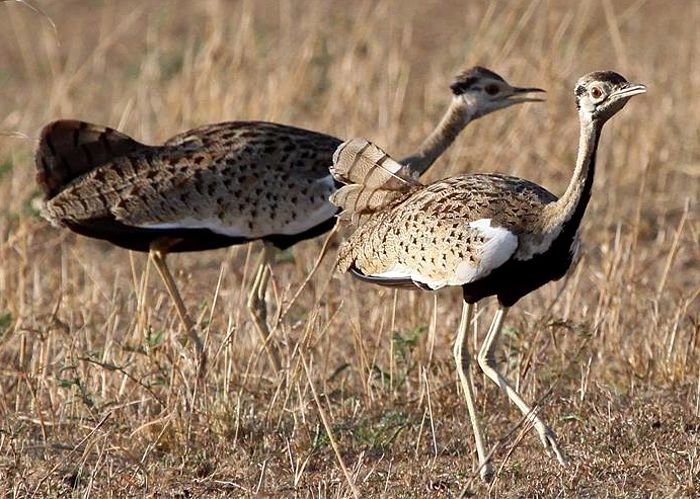
Black-bellied Bustard
Lissotis melanogasterA striking African bustard with a boldly patterned head, pale wings and a dramatically black underbody in males.
The Black-bellied Bustard (Lissotis melanogaster) is a ground-dwelling bustard of open grasslands and savanna in sub-Saharan Africa. Males are especially distinctive, combining richly marked tawny upperparts with black underparts, white cheeks outlined in black, a grey chin and bright wing panels. It is a terrestrial bird that walks deliberately through grassland, feeding on a mixture of invertebrates and plant material.
Black-bellied Bustard Quick Facts
What Is the Black-bellied Bustard?
The Black-bellied Bustard (Lissotis melanogaster) is an African ground-dwelling bustard in the family Otididae. It is a substantial but elegant grassland bird, especially notable for the male’s black underparts, pale cheeks edged with black and patterned tawny-brown upperparts.
Its long legs and upright posture give it a distinctive profile as it walks through open grassland. Unlike many birds that depend on dense cover, it often uses open or lightly wooded country where visibility is high and tall grass provides feeding and nesting cover.
In Tanzania it is a characteristic bird of suitable grasslands in northern and southern parts of the country, with documented records from Serengeti, Ngorongoro, Tarangire and other localities.
How to Identify a Black-bellied Bustard
The Black-bellied Bustard is easiest to recognize from the combination of body shape, bold head pattern and strong sexual dimorphism. Adult males are particularly striking at close range or in flight.
- Head pattern Bold black, white and buff markings, with white cheeks enclosed by a fine dark line.
- Underparts Adult male has strikingly black belly and lower underparts; females are much paler below.
- Upperparts Tawny-buff ground colour with black and brown patterning.
- Wings Upperwing shows broad pale/white areas contrasting with darker flight feathers.
- Bill and legs Bill and legs are dull yellow to yellowish.
- Shape Long-legged, long-necked and upright, with the deliberate walking style typical of bustards.
Distinguishing from Other Bustards
Compared with similar medium and large bustards, the Black-bellied Bustard combines a dark lower body in the male with a pale-cheeked, finely outlined face and prominent white wing areas.
Behavior & Social Life
The Black-bellied Bustard is generally terrestrial and spends much of its time walking through grassland. It may be encountered singly or in loose groups, while males can become conspicuous during territorial and courtship displays.
Daily Activity
- Walking Moves steadily through grass, pausing frequently to inspect the ground and vegetation.
- Calling Males give distinctive display-associated calls that can carry across open grassland.
- Display Territorial and courtship displays may include posturing, calling and short display flights.
Movement
It is mainly active by day, moving between feeding sites and displaying areas. After rain, males may become especially vocal and conspicuous as they court or defend display territories.
Habitat & Distribution
The Black-bellied Bustard favours open country dominated by grass rather than closed woodland. It can use tall or dense grassland, grassy savanna and open country in both flatter landscapes and gently rolling terrain.
- Tall grassland Often associated with relatively tall grass that provides cover and abundant invertebrate prey.
- Grassy savanna Uses open savanna where scattered shrubs or trees do not eliminate large feeding areas.
- Seasonally greener plains May concentrate where rainfall produces fresh grass and insect activity.
- Open woodland margins Can occur around lightly wooded edges when enough open ground remains.
Its broad African distribution includes eastern and southern parts of the continent. In Tanzania it is documented from a number of major wildlife landscapes, including Serengeti and Ngorongoro and, in appropriate grassland habitat, Tarangire and southern protected areas.
Tanzania Distribution
In Tanzania, the Black-bellied Bustard is found in most national parks and game reserves, including Serengeti, Ngorongoro, Tarangire, and Ruaha .
Black-bellied Bustard in Tanzania
Tanzania offers several excellent landscapes for seeing the Black-bellied Bustard, especially broad grasslands where the bird can walk, feed and display.
Serengeti National Park
Documented widely in the Serengeti, including records from the Mara River area and other open grasslands.
Serengeti safariNgorongoro Conservation Area
Recorded around the Ngorongoro Crater, with both adult and juvenile birds documented.
Ngorongoro safariTarangire National Park
Suitable open grasslands and savanna provide habitat, with photographed records from the park.
Tarangire safariRuaha National Park
Southern Tanzanian records include Ruaha, where open grassland and savanna mosaics provide suitable habitat.
Ruaha safariSafari Methods
- Game drives scan open grassland edges and plains slowly, especially where large ungulates have opened feeding lanes.
- Birdwatching use binoculars to pick out the long-legged silhouette and bold male plumage before approaching closely.
- Wildlife photography early morning or late afternoon light can emphasize the bird’s head pattern and wing contrast.
Best Time to See Them
The species can be encountered year-round in resident areas. Visibility is often best in the morning and late afternoon, while the onset of rains can increase activity, insect abundance and male display behaviour.
Diet & Feeding
The Black-bellied Bustard is an opportunistic omnivore. Its food varies with season and availability, allowing it to exploit both animal prey and plant material in grassland environments.
Food Sources
- Insects Grasshoppers, locusts, beetles and other arthropods can form an important part of the diet.
- Seeds Seeds and other small plant foods are taken when available.
- Green vegetation Leaves, shoots and other plant material supplement animal prey.
- Small animal prey Other small invertebrates may be taken opportunistically.
Foraging Behavior
It usually feeds on the ground, walking and picking items from vegetation or the soil surface rather than making long pursuits.
Breeding & Life Cycle
Breeding is linked to suitable grassland conditions, and males may establish display areas where they can attract females. The species is believed to be polygynous, with females nesting separately from male display sites.
Nesting
- Nest A shallow scrape on the ground, often among grass tufts or near low vegetation.
- Eggs Usually one egg, cryptically coloured to blend with the surroundings.
- Incubation About 23 days in available breeding accounts, performed by the female.
Chicks
The nest is a simple shallow scrape on the ground, usually concealed among grass or other low vegetation. A typical clutch consists of a single well-camouflaged egg.
Conservation Status
The Black-bellied Bustard is currently treated as Least Concern globally. BirdLife’s current species framework uses *Lissotis melanogaster* and the IUCN category system for global assessments.
Even species with a broad range can experience local pressure where grassland is converted, intensively grazed, repeatedly burned at unsuitable times or disturbed during breeding. Maintaining intact grassland mosaics is therefore important.
In Tanzania, protection of open plains within national parks and other conservation landscapes provides important refuge. Careful land management outside protected areas can also help retain feeding and nesting habitat.
- Habitat conversion Loss of natural grassland to cultivation and infrastructure can reduce suitable areas.
- Disturbance Heavy disturbance around display and nesting areas can reduce breeding opportunities.
Comparisons
The Black-bellied Bustard can be compared with other East African bustards by body pattern, habitat and size.
| Feature | Black-bellied Bustard | Hartlaub’s Bustard | White-bellied Bustard |
|---|---|---|---|
| Size | 58–65 cm | About 65 cm | About 50–60 cm |
| Wingspan | Broad, rounded wings | Broad wings | Broad wings |
| Belly / underparts | Male black; female pale | Pale to buff with contrasting pattern | Male and female largely pale below |
| Head pattern | White cheeks with fine dark edging | Bold pale/dark facial pattern | Blue-grey neck and contrasting face |
| Habitat | Grassland and grassy savanna | Dry grassland and savanna | Tall/burned grassland |
| Diet | Insects, seeds, plant matter | Mixed plant and animal foods | Mixed plant and animal foods |
Did You Know?
Black Belly
The adult male has a strikingly black belly and lower underparts that contrast strongly with its patterned upper body.
Fine Facial Line
White cheeks bordered by a fine black line help separate the species from several other bustards.
Grassland Specialist
It is strongly associated with open grassland and grassy savanna rather than dense forest.
Display Flights
Males can become highly conspicuous during territorial and courtship displays, especially after rains.
Ground Nest
The nest is a simple scrape on the ground, usually hidden among grass.
Tanzania Records
Documented Tanzanian records include Serengeti, Ngorongoro, Tarangire, Selous and Ruaha landscapes.
There is something wonderfully deliberate about the Black-bellied Bustard. In open Tanzanian grassland, it walks with an upright, measured rhythm, then suddenly becomes dramatic when a male displays. The black belly, pale cheeks and patterned wings turn an otherwise quiet grassland bird into a memorable wildlife sighting.
Gallery
Frequently Asked Questions
The Black-bellied Bustard (Lissotis melanogaster) is a ground-dwelling African bustard of open grasslands and savanna. Adult males are especially distinctive because of their black underparts and boldly patterned head.
Documented Tanzanian localities include Serengeti, Ngorongoro, Tarangire, Selous and Ruaha. The best habitat is open grassland and grassy savanna.
It has an omnivorous diet that includes grasshoppers, locusts, beetles and other invertebrates, along with seeds and plant material.
No. The Black-bellied Bustard is currently assessed globally as Least Concern.
Look for a long-legged bustard with a patterned head; adult males show black underparts, white cheeks edged in black and pale wing panels.
It nests on the ground in a shallow scrape. The clutch is usually one egg, and incubation is about 23 days in available breeding accounts.
It inhabits open grasslands, grassy savanna and other open country across sub-Saharan Africa.
It is treated as a resident across much of its range, including suitable areas of Tanzania, although local movements can occur with rainfall and food availability.
References & Further Reading
- BirdLife DataZone – Black-bellied Bustard (*Lissotis melanogaster*) species factsheet and global Red List framework.
- Tanzanian Birds – Black-bellied Bustard: documented Tanzania photographs and records from Ngorongoro, Serengeti and other localities.
- Oiseaux.net – Black-bellied Bustard: morphology, systematics and conservation information.
- Tanzania Birding – Black-bellied Bustard ecology, grassland habitat and breeding observations.
- eBird / Macaulay Library – Documented Black-bellied Bustard records from Tanzania, including Ngorongoro.
- BirdLife Taxonomic Checklist – Taxonomic framework and current use of *Lissotis melanogaster*.
- IUCN/BirdLife Red List framework – Global conservation categories and assessment methodology.