

.png)
Denham's Bustard
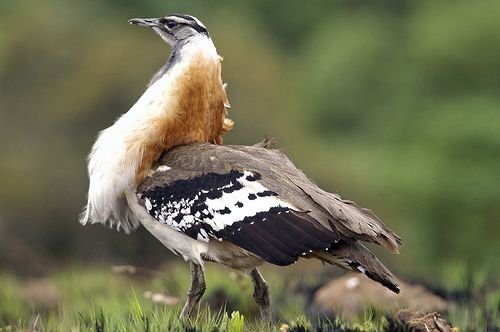
Neotis denhamiA majestic African bustard of open grasslands, known for its orange hindneck and spectacular courtship display.
Denham's Bustard (Neotis denhami) is a large terrestrial bird of the bustard family Otididae. It occupies open grasslands, floodplains, lightly wooded plains and some cultivated landscapes, where its size, pale underparts and orange hindneck make it a memorable sight. In Tanzania it is an uncommon grassland bird recorded from sites including the Serengeti, Tarangire and Ngorongoro landscapes, with additional records from Katavi.
Denham's Bustard Quick Facts
What Is Denham's Bustard?
Denham's Bustard (Neotis denhami) is a large, ground-dwelling member of the bustard family Otididae. It is built for life in open country: long legs for walking, a broad body for carrying substantial weight, and long wings that allow strong but relatively infrequent flight.
Denham's Bustard (Neotis denhami) is a large, ground-dwelling member of the bustard family Otididae. It is built for life in open country: long legs for walking, a broad body for carrying substantial weight, and long wings that allow strong but relatively infrequent flight.
Unlike forest birds or wetland specialists, Denham's Bustard is closely tied to open landscapes where visibility is high. Rainfall, grass height, food availability and seasonal land use can influence where birds occur and how far they move.
How to Identify Denham's Bustard
The most useful field mark is the warm orange to rufous hindneck, set against a pale grey head and neck, brown upperparts and white underparts. The sexes differ strongly in size, with males much larger than females.
- Crest: the rusty-orange nape is the clearest field character in the species' range.
- Plumage: grey crown bordered with darker feathering, with a pale eyebrow and dark eye-line.
- Belly: generally pale to white below, contrasting with the browner upperparts.
- Eyes: males are markedly larger and heavier than females.
- Tail: long, pale legs suited to walking through open grassland.
- Legs: broad wings provide powerful flight, but the species is primarily terrestrial and spends much time walking.
Distinguishing Denham's Bustard from Other Bustards
In Tanzania it can be separated from Kori Bustard and other large bustards by its orange hindneck, different head pattern and smaller overall size than Kori. Careful attention to shape, neck colour and habitat is more reliable than size alone.
Behavior & Social Life
Denham's Bustard is predominantly terrestrial and diurnal. Birds often walk steadily through open grassland while scanning for food. Males may gather at display areas, where posture, inflated throat and contrasting white plumage become conspicuous.
Daily Activity
- Hunting: walks and pecks through short or medium grass, searching for insects, small vertebrates and plant foods.
- Soaring: males may perform elaborate courtship displays, inflating the throat and exposing concealed white neck and breast feathers.
- Vocalization: outside breeding activity, birds may be encountered singly or in loose groups, especially where food is concentrated.
Movements
The species is not a strict long-distance migrant everywhere. Populations can be sedentary or make local and seasonal movements, especially in response to rainfall, grass condition and food availability.
Habitat & Distribution
Denham's Bustard favours open, relatively dry to seasonally wet country where vegetation remains open enough for walking and visual detection of predators. Habitats include grasslands, floodplains, open plains, grassy Acacia landscapes, light woodland edges and some agricultural mosaics.
- Open grassland and plains with enough visibility for walking and displaying males.
- Floodplains and seasonally wet grassland where insects and other foods become abundant.
- Grassy Acacia-studded landscapes and lightly wooded country with an open ground layer.
- Agricultural and disturbed mosaics can be used where suitable open feeding habitat remains.
In Tanzania, documented records include the Serengeti, Tarangire, Ngorongoro/Ndutu and Katavi landscapes. The species is uncommon and local rather than one of the country's most frequently encountered large birds.
Tanzania Distribution
In Tanzania, the Denham's Bustard is found in most national parks and game reserves, including Serengeti, Ngorongoro, Tarangire, and Ruaha .
Denham's Bustard in Tanzania
The best Tanzanian opportunities are in open grassland landscapes where the species has documented records. It is not uniformly common, so sightings are a rewarding birding bonus rather than a guaranteed safari encounter.
Serengeti National Park
Soguna Kopjes and the wider Serengeti grasslands have documented Denham's Bustard records.
Serengeti birdingNgorongoro & Ndutu
Recent eBird/Macaulay records document Denham's Bustard around Ngorongoro and the Ndutu marsh plains route.
Ngorongoro birdingTarangire National Park
The Tarangire checklist includes Denham's Bustard among the park's large open-country birds.
Tarangire birdingKatavi National Park
Tanzania Birds documents a Denham's Bustard photographed in flight in Katavi, confirming occurrence in western Tanzania.
Katavi birdingBirding Methods
- Game drives drives through open grassland and plains, especially where birding stops allow careful scanning. through woodland and savanna habitats.
- Birdwatching from a vehicle or on foot with a guide in suitable open-country habitat. – watch for perched birds and soaring during the day .
- Wildlife photography binoculars or a long lens to distinguish the orange hindneck and head pattern at distance. – the long crest makes it a striking subject.
Best Time to See It
Sightings can occur year-round in resident or seasonally mobile areas, but local movements are strongly influenced by rainfall and grass conditions. Early morning and late afternoon are often the most comfortable times for watching large terrestrial birds in open country.
Diet & Feeding
Denham's Bustard is omnivorous. Its diet changes with season and availability, combining insects and other small animals with plant material.
Food Sources
- Rodents: grasshoppers, beetles, weevils, caterpillars, mantids and other invertebrates can be important prey.
- Small birds: lizards, snakes, frogs, nestlings and small rodents may be taken opportunistically.
- Reptiles: grasses, leaves, shoots, flowers, berries and other available plant matter supplement the animal foods.
- Insects: dung-associated beetles and other insects may be taken where large herbivores create feeding opportunities.
Foraging Behavior
It forages mainly by walking and pecking or probing at the ground. Insects become especially important when available in large numbers, while plant foods help broaden the diet across seasons.
Breeding & Life Cycle
Denham's Bustard is polygynous. Males advertise to females with conspicuous display behaviour, while the female assumes the main work of incubation and chick care. Breeding timing varies geographically and is often associated with favourable rainfall.
Nesting
- Nest: a simple shallow scrape on the ground, positioned where vegetation provides concealment.
- Eggs: usually 1–2 eggs are laid per clutch.
- Incubation: about 23–25 days, carried out by the female.
Chicks
The chicks are precocial, leaving the nest soon after hatching and following the female. She remains the principal provider and protector while the young develop foraging and predator-avoidance skills.
Conservation Status
Denham's Bustard is currently assessed globally as **Near Threatened (NT)**. BirdLife's current regional assessment for southern Africa lists it as **Vulnerable (VU)**, reflecting a declining regional population and ongoing pressures on open-country habitat.
Across its range, the principal pressures include conversion or degradation of grasslands, hunting, disturbance and collisions with power infrastructure. The species' large range does not eliminate local vulnerability because suitable open habitat can be fragmented and populations can be sparse.
Conservation priorities include protecting intact grasslands and floodplains, reducing unnecessary disturbance around display and nesting areas, and improving awareness of bustards as important flagship birds of African open landscapes.
- Habitat loss: Grassland conversion and degradation can reduce feeding and nesting habitat.
- Persecution: Hunting pressure can affect slow-breeding adult birds and locally small populations.
Comparisons
Denham's Bustard can be confused with other large East African bustards. The table highlights the field differences most useful to birders.
| Feature | Denham's Bustard | Kori Bustard | White-bellied Bustard |
|---|---|---|---|
| Size | 80–100 cm; males much heavier | Up to about 120–130 cm; substantially larger | About 50–60 cm; smaller |
| Neck | Pale grey with orange hindneck | Pale/grey neck; no orange hindneck | Blue-grey neck |
| Upperparts | Brown, variable by sex | Pale sandy to grey-brown | Brown with contrasting pale underparts |
| Habitat | Open grassland, floodplain, plains | Open savanna and grassland | Tall or burned grassland and open savanna |
| Diet | Omnivorous; insects, small vertebrates, plants | Omnivorous; broad plant and animal diet | Mostly invertebrates and plant matter |
| Display | Male inflates throat and exposes white neck/breast plumes | Male shows impressive size and patterned plumage | Male displays with distinctive posture and wing movement |
Did You Know?
Orange Hindneck
The orange to rufous hindneck is one of the most useful clues for separating Denham's Bustard from other large bustards in Tanzania.
Huge Sexual Size Difference
Males are dramatically larger than females, one of the strongest examples of sexual dimorphism among African bustards.
Balloon Display
During courtship a male can inflate concealed white neck and breast feathers, creating a striking rounded “balloon” effect.
Ground Nest
The nest is a shallow scrape on the ground rather than a stick structure in a tree.
Mostly a Walker
Despite its powerful flight, much of its daily life is spent walking through grassland while searching for food.
Range & Movement
Populations vary from sedentary to seasonally mobile, with movement often linked to rainfall and changing grass conditions.
There is something extraordinary about seeing a Denham's Bustard walking through open Tanzanian grassland. Its scale is impressive, but the real magic comes when the bird pauses, raises its head and reveals the warm orange hindneck that makes it so distinctive. In a landscape dominated by fast-moving mammals and soaring raptors, this great terrestrial bird reminds us that the open plains have their own quieter specialists.
Gallery
Frequently Asked Questions
Denham's Bustard (Neotis denhami) is a large terrestrial bustard of the family Otididae, associated with open grasslands and other open-country habitats across sub-Saharan Africa.
Documented Tanzanian records include the Serengeti, Tarangire, Ngorongoro/Ndutu and Katavi landscapes. The species is uncommon and local, so sightings are not guaranteed.
It is omnivorous, taking insects and other small animals as well as seeds, leaves, flowers, berries and other plant material.
It is currently classified globally as Near Threatened (NT). BirdLife's 2025 southern African regional assessment is more severe, listing the regional population as Vulnerable.
Look for its large size, grey head and neck, brown upperparts, pale underparts and especially the orange hindneck. Males are much larger than females.
It is polygynous. The female lays a clutch of usually one or two eggs in a shallow ground scrape and incubates them for about 23–25 days.
Not all populations behave the same way. The species can be sedentary or make local and seasonal movements, often responding to rainfall and food conditions.
As a large omnivorous ground bird, it is part of the ecological fabric of open grasslands and serves as an indicator of the condition of extensive, relatively undisturbed open-country habitat.
References & Further Reading
- BirdLife South Africa – Denham's Bustard: current taxonomy, global Near Threatened status and 2025 southern African regional assessment.
- Tanzania Birds – Denham's Bustard: Tanzania records, field identification and documented photographs from the Serengeti and Katavi.
- Tanzania Birds checklist – Denham's Bustard (Neotis denhami) listed among Tanzania's bustards.
- Macaulay Library / eBird – documented Denham's Bustard records from Ngorongoro and the Ndutu marsh plains route, Tanzania.
- Oiseaux.net – morphology, diet, breeding, range and current conservation treatment for Neotis denhami.
- Biodiversity Explorer – habitat, omnivorous diet, display and ground-nesting ecology of Denham's Bustard.
- BirdForum Opus – summary of breeding strategy, clutch size and incubation period, with links to source literature.