

.png)
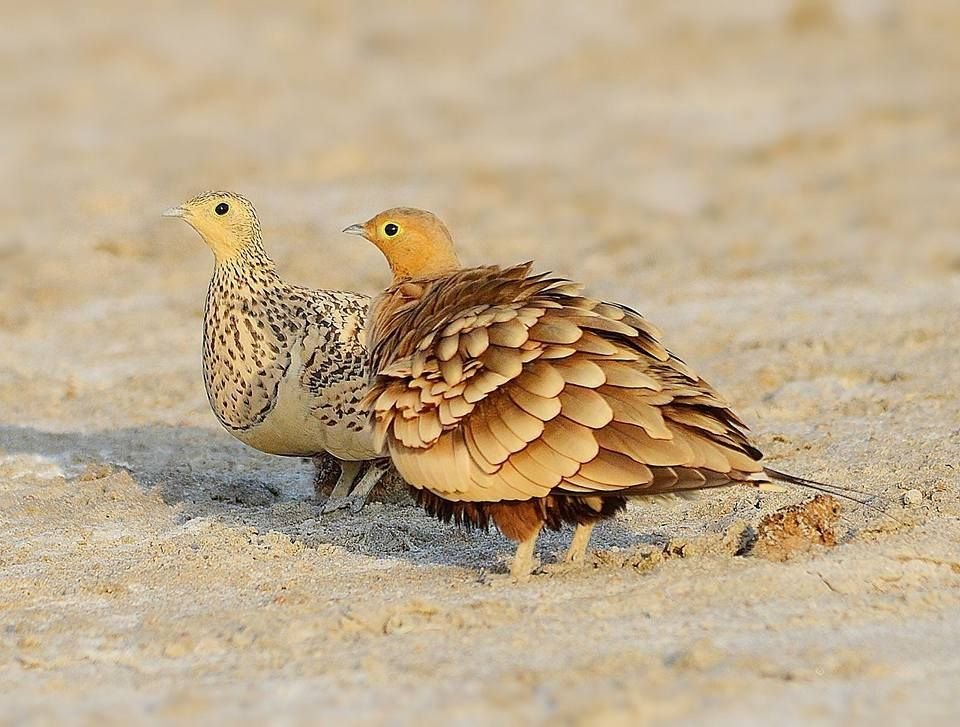
Chestnut-bellied Sandgrouse
Pterocles exustusA plump, dove-like bird of the arid plains – a master of survival in the harshest of African landscapes.
The Chestnut-bellied Sandgrouse (Pterocles exustus), also known as the Common Sandgrouse, is a plump, dove-like bird found in the arid and semi-arid regions of Africa and Asia. Named for the male's distinctive chestnut-brown belly, this remarkable bird is a master of survival, capable of travelling up to 80 kilometres in a single day to reach water in the desert.
Chestnut-bellied Sandgrouse Quick Facts
What Is the Chestnut-bellied Sandgrouse?
The Chestnut-bellied Sandgrouse (Pterocles exustus) is a plump, dove-like bird belonging to the family Pteroclidae, which includes the sandgrouse. It was first described by the Dutch zoologist Coenraad Jacob Temminck in 1825. The species name exustus is from the Latin exurere, meaning "to burn out", perhaps referring to the bird's arid habitat[reference:0].
This species is also known as the Common Sandgrouse. It is a sedentary and nomadic species that naturally inhabits bare semi-deserts from Senegambia and Mauritania to Egypt, Sudan, Ethiopia and Somalia[reference:1]. There are six recognised subspecies, with the subspecies P. e. olivascens found in southeastern South Sudan, southern Ethiopia, southwestern Somalia, Kenya, and northern Tanzania[reference:2][reference:3].
Sandgrouse belong to the order Pterocliformes, which means they are more closely related to pigeons and doves and are not a type of grouse[reference:4]. The Chestnut-bellied Sandgrouse is sexually dimorphic in plumage colouration and varies in overall plumage colouration between the six subspecies[reference:5].
How to Identify a Chestnut-bellied Sandgrouse
The Chestnut-bellied Sandgrouse is a distinctive and easily recognisable bird, especially in its breeding plumage. Here are its key identifying features:
- Size: A large, plump, dove-like bird measuring 31-33 cm (12-13 in) in length with a pointed tail[reference:6][reference:7].
- Male: Sandy brown overall with a thin black breast band and a solid chestnut-brown belly[reference:8][reference:9]. The face and throat are yellowish[reference:10].
- Female: Sandy brown with black bars on the back and a mottled neck[reference:11][reference:12]. Females have extensively mottled breasts and necks, with a thin black line across the breasts[reference:13].
- Flight: Fast and direct; often seen in flocks[reference:14][reference:15]. In flight, it has a stout bullet-shaped body[reference:16].
- Underwing: Dark[reference:17][reference:18].
- Tail: Elongated and pointed central tail feathers[reference:19][reference:20].
- Legs: Very short, giving the bird a low profile when grounded[reference:21].
Distinguishing from Similar Species
The Chestnut-bellied Sandgrouse can be distinguished from other sandgrouse by the male's distinctive chestnut belly and thin black breast band. The female can be confused with the female Yellow-throated Sandgrouse, but the latter lacks the broad pale area on the breast[reference:22]. The overall buffy beige plumage, unmarked head, and heavily mottled upperparts are also characteristic[reference:23].
Behavior & Social Life
The Chestnut-bellied Sandgrouse is a diurnal bird that is often seen in flocks[reference:24][reference:25]. It is a social species, particularly outside the breeding season.
Foraging Behavior
- Diet: Chestnut-bellied Sandgrouse are selective feeders which primarily subsist on seeds, often preferring to consume small seeds in large amounts[reference:26][reference:27]. Their diet also includes shoots, leaves, and occasionally insects[reference:28].
- Water dependence: Despite living in hot, arid climates, they are heavily reliant on water[reference:29][reference:30]. They have been known to travel up to 50 miles (80 kilometres) in one day in search of water[reference:31][reference:32].
- Drinking: They typically gather in large flocks to drink at waterholes, often in the mid-morning[reference:33].
Vocalization
- Call: In flight, it has a penetrating kut-ro call, which though not particularly loud, is often heard long before the bird comes into view[reference:34]. The call is a loud, carrying call with a resonant quality[reference:35].
- Flight call: The flight call is a rhythmic three-syllable sound: "whit!-kt-arrr"[reference:36].
Habitat & Distribution
The Chestnut-bellied Sandgrouse is a bird of barren, semi-deserts[reference:37]. It is found in a variety of arid and semi-arid habitats.
Key habitat types include:
- Semi-desert – and arid plains[reference:38][reference:39].
- Dry plains – and sparsely vegetated scrubby areas[reference:40][reference:41].
- Bushy, arid land – common in central and northern Africa[reference:42].
Distribution: The Chestnut-bellied Sandgrouse has an extremely large range, with an Extent of Occurrence of approximately 32,300,000 km² for resident/breeding populations[reference:43][reference:44]. It is found across northern and central Africa and further east towards western and southern Asia[reference:45][reference:46].
The species has a native range encompassing Mauritania, Senegal, Gambia, Mali, Niger, Chad, Sudan, Eritrea, Ethiopia, Somalia, Kenya, Tanzania, Saudi Arabia, Yemen, Oman, the United Arab Emirates, Iran, Pakistan and India[reference:47].
Six subspecies are recognised, with ranges as follows: P. e. exustus (Mauritania and Senegambia east to Sudan), P. e. floweri (formerly widespread in the Nile Valley of Egypt, probably extinct but recent records suggest survival)[reference:48], P. e. ellioti (eastern Sudan, Eritrea, northern Ethiopia, and northern and central Somalia), P. e. olivascens (southeastern South Sudan, southern Ethiopia, southwestern Somalia, Kenya, and northern Tanzania), P. e. erlangeri (western and southern Arabian Peninsula), and P. e. hindustan (southeastern Iran to Pakistan and India)[reference:49][reference:50].
Tanzania Distribution
In Tanzania, the Chestnut-bellied Sandgrouse is found in the northern part of the country. The subspecies P. e. olivascens occurs in northern Tanzania[reference:51][reference:52]. It has been recorded in Serengeti National Park (particularly in the Mara region)[reference:53][reference:54], Ngorongoro Conservation Area (including the Ndutu area)[reference:55], Tarangire National Park, and Ruaha National Park.
Chestnut-bellied Sandgrouse in Tanzania
The Chestnut-bellied Sandgrouse is a fascinating bird of Tanzania's arid and semi-arid regions. Here are the best locations to see it:
Serengeti National Park
Recorded in the Serengeti, particularly in the Mara region. Often seen in flocks on short grass plains feeding on seeds, or flying to waterholes in the mid-morning[reference:56].
Serengeti safariNgorongoro Crater
Recorded in the Ngorongoro Conservation Area, including the Ndutu area[reference:57]. Often seen in the open grasslands and scrubby areas.
Ngorongoro safariTarangire National Park
Found in the dry plains and scrubby areas of Tarangire. Often seen in flocks foraging on the ground for seeds.
Tarangire safariRuaha National Park
A resident species in Ruaha's semi-arid habitats. Often found in open areas with sparse vegetation.
Ruaha safariSafari Methods
- Game drives in semi-desert, dry plains, and scrubby areas.
- Birdwatching – look for the plump, dove-like bird with a pointed tail, often seen in flocks on the ground or flying to waterholes.
- Wildlife photography – the Chestnut-bellied Sandgrouse's distinctive appearance and flocking behaviour make it an interesting photographic subject.
- Look for water sources – sandgrouse gather in large flocks to drink at waterholes, often in the mid-morning.
- Listen for calls – the penetrating kut-ro call is often the first indication of the species' presence.
Best Time to See Them
Chestnut-bellied Sandgrouse are resident year-round in suitable habitat. They are most active during the cooler morning and evening hours. The dry season (June to October) is generally best for wildlife viewing as birds congregate around remaining water sources.
Diet & Feeding
The Chestnut-bellied Sandgrouse is primarily a granivore, with a diet consisting mainly of seeds.
Food Sources
- Seeds: The primary food source. They are selective feeders that prefer to consume small seeds in large amounts[reference:58][reference:59].
- Shoots and leaves: Occasionally takes mustard leaves and other plant material[reference:60].
- Insects: Occasionally takes insects[reference:61].
Foraging Behavior
The Chestnut-bellied Sandgrouse forages on the ground, often in flocks. It uses its bill to pick seeds from the surface of the soil. Breeding is timed to occur when seeds are likely to be most abundant[reference:62].
Breeding & Life Cycle
The Chestnut-bellied Sandgrouse is monogamous, with pairs nesting on the ground[reference:63].
Nesting
- Breeding season: Breeding occurs when seeds are likely to be most abundant[reference:64]. In northern India, the breeding season is from March to May[reference:65].
- Nest site: A simple ground scrape, which may or may not be lined[reference:66]. The nest is often in very exposed terrain where camouflage is essential[reference:67].
- Clutch: 2 to 3 eggs[reference:68][reference:69].
- Incubation: 22 to 23 days, shared by both parents[reference:70]. The male sits on the eggs overnight[reference:71].
Chicks
Chicks are precocial (born covered in down and able to move around soon after hatching)[reference:72]. They follow the parents on their forage trips soon after hatching[reference:73]. Both parents care for the chicks[reference:74].
Conservation Status
The Chestnut-bellied Sandgrouse is assessed as Least Concern on the IUCN Red List[reference:75][reference:76].
Population: The global population size has not been quantified, but it is not believed to approach the thresholds for Vulnerable[reference:77]. The population trend is stable[reference:78][reference:79].
Justification: This species has an extremely large range (32,300,000 km²) and hence does not approach the thresholds for Vulnerable under the range size criterion[reference:80]. The population trend appears to be stable, and hence the species does not approach the thresholds for Vulnerable under the population trend criterion[reference:81].
Threats: While the species is not currently threatened globally, the subspecies P. e. floweri endemic to the Nile Valley of Egypt was thought to be extinct until its rediscovery in 2012[reference:82][reference:83]. Local threats may include habitat loss, human disturbance, and hunting in some areas.
Comparisons
The Chestnut-bellied Sandgrouse is sometimes confused with other sandgrouse. Here are the key differences:
| Feature | Chestnut-bellied Sandgrouse | Yellow-throated Sandgrouse | Black-bellied Sandgrouse |
|---|---|---|---|
| Size | 31-33 cm | 25-28 cm | 28-32 cm |
| Male Belly | Chestnut | Pale with black belly | Black |
| Male Breast Band | Thin black band | Thin black band | Thick black band |
| Female Plumage | Brown with black bars | Brown with pale breast | Brown with black bars |
| Throat | Yellowish | Yellow | Buff |
| Range | Africa & Asia | East Africa | Africa & Asia |
Did You Know?
Long-Distance Traveller
The Chestnut-bellied Sandgrouse is known to travel up to 80 kilometres in a single day to reach water sources in the desert[reference:84].
Water-Carrying Ability
Like other sandgrouse, male Chestnut-bellied Sandgrouse can carry water in their breast feathers to transport it to their chicks.
Six Subspecies
There are six recognised subspecies of Chestnut-bellied Sandgrouse, varying in plumage colouration across their range[reference:85].
Not a Grouse
Despite their name, sandgrouse are more closely related to pigeons and doves than to true grouse[reference:86].
Rediscovered Subspecies
The Egyptian subspecies floweri was thought to be extinct for over 30 years until it was rediscovered in the Nile Valley in 2012[reference:87].
Penetrating Call
The Chestnut-bellied Sandgrouse has a penetrating kut-ro call that is often heard long before the bird comes into view[reference:88].
There is something almost miraculous about the Chestnut-bellied Sandgrouse. In the harshest, most unforgiving landscapes of Africa, where water is a distant memory and the sun beats down without mercy, this bird not only survives but thrives. It rises before the dawn, flies for miles across the desert, drinks its fill, and returns to its chicks with water carried in its feathers. It is a testament to the power of adaptation, a reminder that life finds a way even in the most unlikely places. To watch a flock of sandgrouse descend on a waterhole, their wings cutting through the still morning air, is to witness one of the great spectacles of the natural world.
Gallery
Frequently Asked Questions
The Chestnut-bellied Sandgrouse (Pterocles exustus), also known as the Common Sandgrouse, is a plump, dove-like bird found in the arid and semi-arid regions of Africa and Asia. It is named for the male's distinctive chestnut-brown belly and is known for its remarkable ability to travel long distances to water.
Chestnut-bellied Sandgrouse are found in semi-desert, dry plains, and sparsely vegetated scrubby areas across northern Tanzania. Key locations include Serengeti National Park (particularly the Mara region), Ngorongoro Conservation Area, Tarangire National Park, and Ruaha National Park.
The Chestnut-bellied Sandgrouse is a selective feeder that primarily subsists on seeds, often preferring to consume small seeds in large amounts. It may also take shoots, leaves, and occasionally insects.
No. The Chestnut-bellied Sandgrouse is listed as Least Concern on the IUCN Red List. It has an extremely large range of over 32 million km², a stable population trend, and is not believed to approach the thresholds for Vulnerable.
It is a large, plump, and dove-like bird with a pointed tail. Males are sandy brown with a thin black breast band and a solid chestnut belly. Females are sandy brown with black bars on the back and a mottled neck. The flight is fast and direct.
The Chestnut-bellied Sandgrouse measures 31-33 cm (12-13 in) in length.
The Chestnut-bellied Sandgrouse is monogamous and nests on the ground in a simple scrape. The female lays 2-3 eggs, which are incubated by both parents for about 22-23 days. Chicks are precocial and mobile soon after hatching.
In Swahili, the Chestnut-bellied Sandgrouse is known as Kanga-mwitu or Kanga-mbuga.
References & Further Reading
- BirdLife International – Chestnut-bellied Sandgrouse: IUCN Red List assessment, Least Concern status, range 32,300,000 km²[reference:89].
- Wikipedia – Chestnut-bellied sandgrouse: Description, distribution, subspecies, diet, behaviour[reference:90].
- eBird – Chestnut-bellied Sandgrouse: Identification, plumage, vocalisation[reference:91][reference:92].
- Avibase – Chestnut-bellied Sandgrouse: Taxonomy, subspecies, distribution[reference:93].
- BirdForum Opus – Chestnut-bellied Sandgrouse: Identification, distribution, subspecies[reference:94].
- Oiseaux.net – Chestnut-bellied Sandgrouse: Records from Serengeti National Park, Tanzania[reference:95].
- Animal Diversity Web – Pterocles exustus: Geographic range, habitat, diet, behaviour.