

.png)
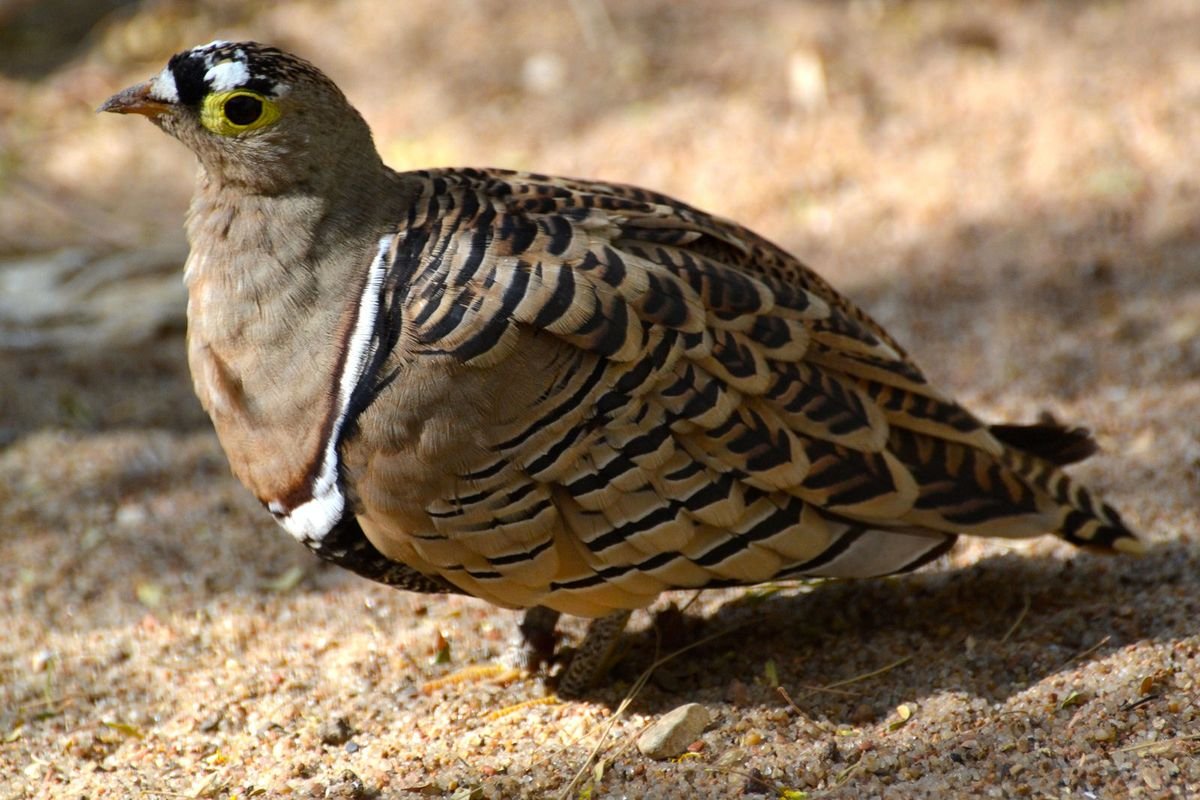
Four-banded Sandgrouse
Pterocles quadricinctusA small, intricately marked sandgrouse with distinctive black bands – a master of the African savanna.
The Four-banded Sandgrouse (Pterocles quadricinctus) is a medium-sized bird in the sandgrouse family Pteroclidae. Known for the male's distinctive black and white bands on the forehead and across the chest, this intricately marked bird is a common resident across a belt of Africa from Mauritania and Cameroon east to Sudan and Uganda.[reference:0]
Four-banded Sandgrouse Quick Facts
What Is the Four-banded Sandgrouse?
The Four-banded Sandgrouse (Pterocles quadricinctus) is a medium-sized bird belonging to the sandgrouse family Pteroclidae. It was first described in 1815 by the Dutch zoologist Coenraad Jacob Temminck.[reference:1][reference:2] The species name quadricinctus is from the Latin quadri meaning "four" and cinctus meaning "banded", referring to the distinctive bands on the male's plumage.[reference:3]
The Four-banded Sandgrouse is a common resident across a belt of Africa from Mauritania and Cameroon east to Sudan and Uganda.[reference:4] It is much more common in the west of its range and is described as the commonest sandgrouse in west Africa.[reference:5][reference:6] It is a partial seasonal migrant, with some birds moving further north in the rainy season.[reference:7]
Sandgrouse belong to the order Pterocliformes, which means they are more closely related to pigeons and doves and are not a type of grouse. The Four-banded Sandgrouse is a gregarious species that breeds on open areas with some trees, including savanna, scrubland and similar habitats.[reference:8]
How to Identify a Four-banded Sandgrouse
The Four-banded Sandgrouse is a distinctive and intricately marked bird, easily recognised by its size, colouration, and the male's distinctive bands. Here are its key identifying features:
- Size: A medium-sized, short-tailed sandgrouse measuring 25-28 cm (10-11 in) in length.[reference:9]
- Male: Black marks on top of the head and three bands across the underparts.[reference:10] The head, neck and upperparts are yellowish-green, with the back heavily marked with brown.[reference:11]
- Female: Plainer than the male, lacking the head and breast bands. Heavily barred on the back and flanks.[reference:12]
- Both sexes: Finely barred dark belly.[reference:13]
- Body shape: Small, pigeon-like head and neck, but a sturdy compact body.[reference:14]
- Wings: Long pointed wings, grey underneath.[reference:15]
- Tail: Short.[reference:16]
- Flight: Fast and direct.[reference:17]
Distinguishing from Similar Species
The Four-banded Sandgrouse is similar in size and shape to Lichtenstein's Sandgrouse, but lacks that species' fine barring on the underparts. Female Four-banded Sandgrouse can be separated from female Black-faced Sandgrouse by the lack of a strong white mark across the underparts.[reference:18]
Behavior & Social Life
The Four-banded Sandgrouse is a gregarious species, usually found in pairs or small groups.[reference:19] It is largely nocturnal and often flies to watering holes in the evening to drink.[reference:20][reference:21]
Foraging Behavior
- Ground feeding: The Four-banded Sandgrouse forages on the ground, feeding primarily on seeds and grains.[reference:22]
- Water dependence: Like other sandgrouse, it requires regular access to water and may fly considerable distances to drink.
Vocalization
- Call: The call is a rattling, high-pitched "brrr-eeee," often given in flight.[reference:23] It is also described as a loud "wulli-wulli" sound.[reference:24]
- Drinking calls: When gathering at waterholes, they produce a dense chatter of chirping sounds.[reference:25]
Habitat & Distribution
The Four-banded Sandgrouse is found in a variety of open habitats across a belt of Africa.
Key habitat types include:
- Savanna – open areas with some trees.[reference:26]
- Scrubland – and similar habitats.[reference:27]
- Cultivation – agricultural areas.[reference:28]
Distribution: The Four-banded Sandgrouse has an extremely large range, with an Extent of Occurrence of approximately 7,260,000 km² for resident/breeding populations and 7,120,000 km² for non-breeding.[reference:29] It breeds in a belt across Africa from Mauritania and Cameroon east to Sudan and Uganda.[reference:30]
Country distribution includes: Benin, Burkina Faso, Cameroon, Central African Republic, Chad, Côte d'Ivoire, Eritrea, Ethiopia, Gambia, Ghana, Guinea, Guinea-Bissau, Kenya, Mali, Mauritania, Niger, Nigeria, Senegal, Sierra Leone (vagrant), South Sudan, Sudan, Togo, and Uganda.[reference:31]
Tanzania Distribution
In Tanzania, the Four-banded Sandgrouse is found in the northern part of the country.[reference:32] It has been recorded in Serengeti National Park (particularly in the Mara region), Ngorongoro Conservation Area, Tarangire National Park, and Ruaha National Park.
Four-banded Sandgrouse in Tanzania
The Four-banded Sandgrouse is a fascinating bird of Tanzania's savannas and scrublands. Here are the best locations to see it:
Serengeti National Park
Found in the Serengeti's savanna and scrubland areas, particularly in the Mara region. Often seen in pairs or small groups foraging on the ground.
Serengeti safariNgorongoro Crater
Recorded in the Ngorongoro Conservation Area, including the Ndutu area. Often seen in the open grasslands and scrubby areas.
Ngorongoro safariTarangire National Park
Found in the savanna and scrubland areas of Tarangire. Often seen in pairs or small groups foraging on the ground.
Tarangire safariRuaha National Park
A resident species in Ruaha's savanna and scrubland habitats. Often found in open areas with some trees.
Ruaha safariSafari Methods
- Game drives in savanna, scrubland, and cultivation areas.
- Birdwatching – look for the small, short-tailed sandgrouse with intricate markings, often seen on the ground or flying to waterholes.
- Wildlife photography – the Four-banded Sandgrouse's distinctive markings and flocking behaviour make it an interesting photographic subject.
- Look for water sources – sandgrouse gather at waterholes in the evening to drink.
- Listen for calls – the rattling "brrr-eeee" call is often the first indication of the species' presence.
Best Time to See Them
Four-banded Sandgrouse are resident year-round in suitable habitat. They are most active during the cooler morning and evening hours. The dry season (June to October) is generally best for wildlife viewing as birds congregate around remaining water sources.
Diet & Feeding
The Four-banded Sandgrouse is primarily a granivore, with a diet consisting mainly of seeds and grains.
Food Sources
- Seeds: The primary food source. Forages on the ground in open areas.[reference:33]
- Grains: Feeds on cultivated grains in agricultural areas.[reference:34]
Foraging Behavior
The Four-banded Sandgrouse forages on the ground, often in pairs or small groups. It uses its bill to pick seeds from the surface of the soil.[reference:35]
Breeding & Life Cycle
The Four-banded Sandgrouse is a gregarious species that breeds on open areas with some trees.[reference:36]
Nesting
- Nest site: A ground scrape.[reference:37]
- Clutch: 2 or 3 buff eggs with brown markings.[reference:38]
- Incubation: Both sexes incubate the eggs.[reference:39]
Conservation Status
The Four-banded Sandgrouse is assessed as Least Concern on the IUCN Red List.[reference:40][reference:41]
Population: The global population size has not been quantified, but the species is described as the commonest sandgrouse in west Africa and uncommon in Kenya.[reference:42] The population is suspected to be stable in the absence of evidence for any declines or substantial threats.[reference:43]
Justification: This species has an extremely large range (7,260,000 km²) and hence does not approach the thresholds for Vulnerable under the range size criterion. The population trend appears to be stable, and hence the species does not approach the thresholds for Vulnerable under the population trend criterion.[reference:44]
Threats: While the species is not currently threatened globally, agricultural expansion and land degradation leading to habitat loss are concerns that warrant continued monitoring and conservation action.[reference:45]
Comparisons
The Four-banded Sandgrouse is sometimes confused with other sandgrouse. Here are the key differences:
| Feature | Four-banded Sandgrouse | Lichtenstein's Sandgrouse | Black-faced Sandgrouse |
|---|---|---|---|
| Size | 25-28 cm | 25-27 cm | 27-30 cm |
| Male Markings | Black bands on head & chest | Fine barring on underparts | Black face mask |
| Female Markings | Plain, heavily barred on back | Barred underparts | Strong white mark across underparts |
| Underparts | Finely barred dark belly | Fine barring | White mark |
| Range | Mauritania to Uganda | Southern Africa | Eastern Africa |
Did You Know?
Four Bands
The Four-banded Sandgrouse is named for the male's distinctive black and white bands on the forehead and across the chest.
Commonest in West Africa
The Four-banded Sandgrouse is described as the commonest sandgrouse in west Africa.
Partial Migrant
This species is a partial seasonal migrant, with some birds moving further north in the rainy season.
Evening Drinkers
Four-banded Sandgrouse are largely nocturnal and fly to watering holes in the evening to drink.
Ground Nester
The nest is a simple ground scrape into which 2-3 eggs are laid.
Intricate Markings
Both sexes have intricately marked plumage, with the female lacking the male's distinctive bands.
There is a quiet beauty in the Four-banded Sandgrouse as it moves across the African savanna. Its intricate markings are a masterpiece of camouflage, blending seamlessly with the dry grasses and scattered trees of its habitat. And when it takes flight, it moves with a fast, direct purpose, a silhouette against the fading light of the evening sky. To watch a flock of these birds descend on a waterhole at dusk, their calls echoing across the plain, is to witness one of the timeless rhythms of the African wilderness.
Gallery
Frequently Asked Questions
The Four-banded Sandgrouse (Pterocles quadricinctus) is a medium-sized bird in the sandgrouse family Pteroclidae. It is known for the male's distinctive black and white bands on the forehead and across the chest, giving the species its name. It is a common resident across a belt of Africa from Mauritania and Cameroon east to Sudan and Uganda.
Four-banded Sandgrouse are found in savanna, scrubland and cultivation across northern Tanzania. Key locations include Serengeti National Park (particularly the Mara region), Ngorongoro Conservation Area, Tarangire National Park, and Ruaha National Park.
The Four-banded Sandgrouse is primarily a granivore, feeding mainly on seeds. It forages on the ground in open areas, often in pairs or small groups.
No. The Four-banded Sandgrouse is listed as Least Concern on the IUCN Red List. It has an extremely large range of over 7 million km², a stable population trend, and is not believed to approach the thresholds for Vulnerable.
It is a small, short-tailed, intricately marked sandgrouse. The male has black marks on top of the head and three bands across the underparts. The female is plainer. Both sexes have a finely barred dark belly. The head, neck and upperparts are yellowish-green.
The Four-banded Sandgrouse is a medium-sized bird, measuring 25-28 cm (10-11 in) in length. It has a small pigeon-like head and neck with a sturdy, compact body.
The Four-banded Sandgrouse is a gregarious species that breeds on open areas with some trees. Its nest is a ground scrape into which 2 or 3 buff eggs with brown markings are laid. Both sexes incubate the eggs. They are largely nocturnal and fly to watering holes in the evening.
In Swahili, the Four-banded Sandgrouse is known as Kanga-mwitu or Kanga-mbuga.
References & Further Reading
- BirdLife International – Four-banded Sandgrouse: IUCN Red List assessment, Least Concern status, range 7,260,000 km².
- Wikipedia – Four-banded sandgrouse: Description, distribution, habitat, breeding.
- eBird – Four-banded Sandgrouse: Identification, plumage, vocalisation.
- Birds of the World – Four-banded Sandgrouse: Species names, taxonomy, distribution.
- BirdLife DataZone – Four-banded Sandgrouse: Population, threats, conservation.
- Oiseaux.net – Four-banded Sandgrouse: Photo records and distribution.
- Baidu Baike – 四斑沙鸡: Chinese language species account.