

.png)
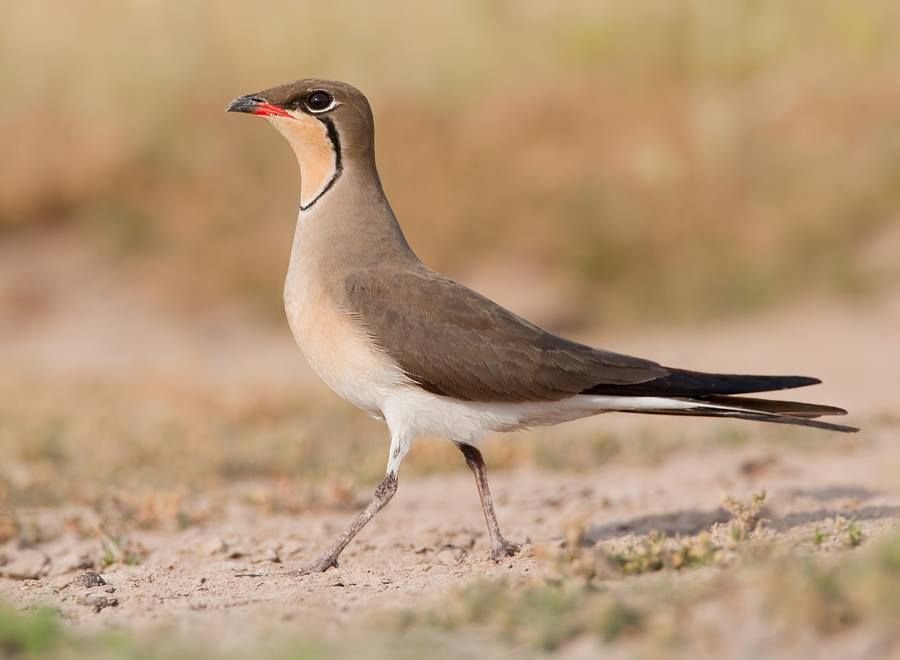
Collared Pratincole
Glareola pratincolaA graceful long-winged pratincole that skims over wetlands and open plains in search of flying insects.
The Collared Pratincole (Glareola pratincola) is a medium-sized wader of the family Glareolidae. It combines plover-like ground movement with swallow-like aerial feeding, often hunting insects over open country and shallow wetlands. In Tanzania it is recorded around lakes, swamps and lightly vegetated plains, including Lake Manyara, Silale Swamp and the Serengeti region.
Collared Pratincole Quick Facts
What Is the Collared Pratincole?
The Collared Pratincole (Glareola pratincola) is a medium-sized pratincole in the family Glareolidae and order Charadriiformes. Its compact body, long pointed wings and distinctive dark collar give it a characteristic appearance, while its powerful flight allows it to forage both over land and in the air.
It is a migratory species across much of its range, using a broad belt of wetlands, floodplains, dry open country and sparsely vegetated areas. Different populations move between breeding and non-breeding areas as rainfall and seasonal food availability change.
In Tanzania, it can be encountered as part of the country’s diverse wetland and savanna bird community, with documented photographs and records from Lake Manyara, Silale Swamp, the Serengeti region and other open or lightly vegetated sites.
How to Identify a Collared Pratincole
The Collared Pratincole is easiest to recognize when perched or flying by its long, pointed wings, slim profile and strongly contrasting head and throat pattern.
- Crest Upperparts: Brownish-grey to earthy brown upperparts that blend well with dry ground and sparse vegetation.
- Plumage Collar and throat: A dark collar frames a pale buff or yellowish-buff throat, especially obvious in breeding plumage.
- Collar and throat Wings: Long, narrow and pointed, giving the bird a fast, swallow-like flight style.
- Wings Underparts: Generally pale, with subtle warm tones around the breast and throat.
- Underparts Tail and rump: Pale rump with a dark-tipped tail visible in flight.
- Tail and rump Legs and bill: The legs are short and the bill is short and broad-based, suited to rapid insect capture.
Distinguishing from Other Eagles
It can be separated from other pratincoles by the combination of its dark collar, buff throat, overall brown mantle and its use of open lake margins, floodplains and sparsely vegetated ground.
Behavior & Social Life
Collared Pratincoles are social birds and may gather in loose groups where suitable feeding or roosting habitat is available. Their behaviour changes dramatically between the ground and the air, with fast aerial manoeuvres used to catch insects.
Daily Activity
- Foraging Foraging: Often takes insects in the air, especially around dusk, and may also pick small invertebrates from the ground.
- Flight Flight: Fast, agile and swallow-like, with long pointed wings well suited to repeated aerial hunting sorties.
- Vocalization Vocalization: Calls are typically sharp, ringing or chattering notes used between birds in flight or around feeding and breeding areas.
Migration
The species is mainly migratory or seasonally mobile. In Tanzania, birds may be encountered where seasonal water and insect abundance create favourable feeding conditions.
Habitat & Distribution
The Collared Pratincole uses open landscapes where insects can be captured efficiently and where low vegetation leaves room for landing and take-off:
- Woodland Lakeshores and marsh edges with sparse vegetation and exposed ground.
- Forest edges Floodplains and seasonally flooded grasslands where insect activity is high.
- Cultivated areas Open plains, short grassland and lightly cultivated or disturbed areas when suitable feeding conditions exist.
- Scrubland Distribution: The species has a large distribution spanning parts of Europe, the Middle East and Africa, with populations moving seasonally between breeding and non-breeding areas.
Distribution: Tanzania Distribution
Tanzania Distribution
Tanzania provides important seasonal habitat for Collared Pratincoles, with documented records from Lake Manyara, Silale Swamp, the Serengeti region and Nyasirori Plain. Records are especially associated with open wetland margins and sparsely vegetated ground.
Collared Pratincole in Tanzania
Collared Pratincoles are best sought where shallow water, mud, short grass and open ground come together. Tanzanian records show that the species can occur at several productive wetland landscapes:
Lake Manyara
A documented Tanzanian location for Collared Pratincole, including an immature bird. Search open margins, shallow wet areas and sparsely vegetated ground.
Birding detailsSilale Swamp
Flight records from Silale Swamp show how the species uses wetland landscapes as feeding habitat, particularly where open space supports aerial insect hunting.
Birding detailsSerengeti National Park
Collared Pratincoles have been photographed in the Serengeti, including groups and pairs. Look around open plains, seasonal wetlands and lightly vegetated ground.
Birding detailsNyasirori Plain
The species has also been photographed at Nyasirori Plain, illustrating its ability to use open, sparsely vegetated landscapes beyond lake margins.
Birding detailsSafari Methods
- Safari Methods
- Game drives through open plains and wetland edges.
- Birdwatching – scan exposed ground for perched birds, then watch overhead for fast feeding flights.
Best Time to See Them
Look for Collared Pratincoles when insects are active and when seasonal water leaves a mosaic of shallow wetlands and open ground. Early morning and late afternoon can be especially productive for birding, while calm conditions make aerial feeding easier to observe.
Diet & Feeding
carnivore The Collared Pratincole is primarily an insectivorous bird, using its agile flight to exploit airborne insects over open country and wetlands.
Food Sources
- Beetles
- Grasshoppers and crickets
- Termites and other flying insects
- Spiders and other small invertebrates
Hunting Behavior
Spiders and other small invertebrates: Taken opportunistically on or near the ground.
Breeding & Life Cycle
Collared Pratincoles are generally monogamous and may breed in pairs or loose colonies where suitable open ground is available.
Nesting
- Nest
- Eggs
- Incubation
Chicks
Incubation: Both adults can participate in incubation and parental care; incubation is roughly around three weeks, varying with conditions.
Conservation Status
Least Concern The Collared Pratincole is assessed as Least Concern globally.
Its very broad distribution and use of a range of open habitats currently keep it well outside the global threatened categories, although some local populations can be affected by changes in wetland condition and disturbance.
Key local pressures can include:
- Habitat loss or alteration
- Pesticide exposure
Comparisons
The Collared Pratincole is sometimes confused with other pratincoles or swift-looking waders. The key differences below help separate it in the field:
| Feature | Collared Pratincole | Rock Pratincole | Black-winged Pratincole |
|---|---|---|---|
| Size | 22-25 cm | 21-24 cm | 20-24 cm |
| Wingspan | 60-70 cm | 50-55 cm | 58-64 cm |
| Collar | Dark collar and buff throat | Dark throat/upper breast with variable collar | Distinct dark underwing and collar pattern |
| Flight | Fast, swallow-like insect hunter | Fast aerial hunter near rocky rivers | Fast migrant over open wetlands |
| Habitat | Open plains, floodplains, lake margins | Rocky riverbanks and rapids | Open dry country and wetland margins |
| Diet | Flying insects and small invertebrates | Insects and aquatic invertebrates | Insects and other small prey |
Did You Know?
Collared Flight
Its long pointed wings give it a fast, agile flight style that can look surprisingly swallow-like.
Ground Nest
The nest is usually little more than a shallow scrape on open ground, making camouflage essential.
Insect Specialist
Much of its feeding is directed at insects, especially during productive periods after rain.
Seasonal Traveller
Many populations move seasonally between breeding and non-breeding areas rather than remaining in one place all year.
Wetland Edge
Open lake margins and seasonal floodplains can provide ideal feeding habitat.
Tanzania Records
Tanzanian photographs and records include Lake Manyara, Silale Swamp, Serengeti and Nyasirori Plain.
There is something almost swallow-like about the Collared Pratincole in flight: a bird shaped for speed, turning open plains and wetland margins into an aerial feeding ground. On the ground it can seem modest and cryptic, but once airborne its pointed wings, rapid manoeuvres and hunting style reveal why watching pratincoles is such a rewarding part of African birding.
Gallery
Frequently Asked Questions
The Collared Pratincole (Glareola pratincola) is a medium-sized member of the pratincole family Glareolidae, recognized by its dark collar, buff throat, long pointed wings and agile insect-catching flight.
In Tanzania, documented records include Lake Manyara, Silale Swamp, the Serengeti region and Nyasirori Plain, especially around open wetlands and sparsely vegetated ground.
It mainly eats insects and other small invertebrates, often catching flying prey in the air and sometimes taking prey from the ground.
Yes. The global conservation category is Least Concern, although local habitat change, pesticide exposure and disturbance can affect some populations.
The name reflects the dark collar-like band around the pale throat and neck area, a useful field mark in breeding plumage.
Breeding usually involves a shallow scrape on open ground, often with 2 eggs. Adults share parental duties and chicks are mobile soon after hatching.
Look for a slim brown wader with long pointed wings, a dark collar, pale buff throat and fast swallow-like flight over open country or wetlands.
No. It is seasonally mobile and migratory across much of its range, so its presence in Tanzania is linked to seasonal movements and favourable habitat conditions.
References & Further Reading
- BirdLife International / BirdLife DataZone – Collared Pratincole (Glareola pratincola) conservation and range information.
- Tanzanian Birds & Butterflies – Collared Pratincole: Tanzania photographs and records from Lake Manyara, Silale Swamp, Serengeti and Nyasirori Plain.
- Convention on Migratory Species (CMS) – Collared Pratincole: taxonomy, geographic range and Least Concern assessment.
- African Bird Club – Collared Pratincole: field records, identification and distribution within the African region.
- Biodiversity Explorer – Collared Pratincole: habitat, insectivorous diet, migration and breeding ecology.
- BTO BirdFacts – Collared Pratincole: current conservation listing and species background.
- BirdLife South Africa – Collared Pratincole: regional Red List context and conservation information.