

.png)
Ruff
Calidris pugnaxA wader of extraordinary contrasts – from drab non-breeding plumage to spectacular breeding displays that rival the most flamboyant birds.
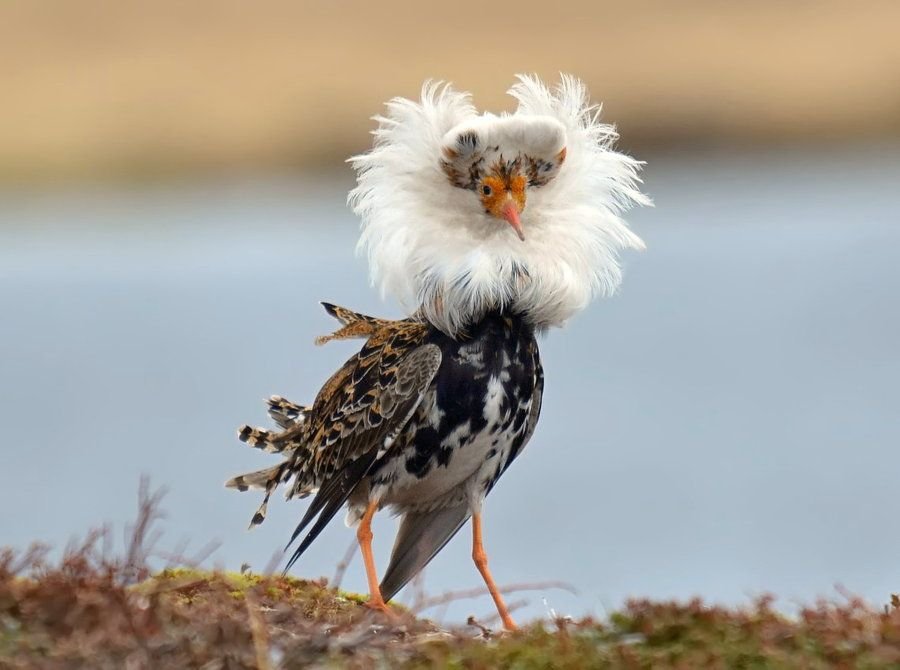
The Ruff (Calidris pugnax) is a medium-sized wader in the family Scolopacidae, a highly sexually dimorphic bird with extraordinary breeding plumage. Males develop elaborate collars ('ruffs') and ear tufts in a remarkable range of colours, gathering at leks to perform spectacular courtship displays. This fascinating bird is a non-breeding migrant in Tanzania, arriving from October to March.
Ruff Quick Facts
What Is the Ruff?
The Ruff (Calidris pugnax) is a medium-sized wader belonging to the family Scolopacidae, which includes sandpipers, snipes, and phalaropes. It was first described by the Swedish naturalist Carl Linnaeus in 1758 under the binomial name Tringa pugnax. The species was formerly placed in the genus Philomachus but was moved to Calidris following genetic studies.
The Ruff is a highly sexually dimorphic bird, with males being significantly larger than females and developing extraordinary breeding plumage. The name "Ruff" refers to the elaborate collar of feathers that males develop during the breeding season, which comes in a remarkable range of colours including black, white, chestnut, and combinations thereof. The species is also known as the "Combatant" in some languages, referring to the males' aggressive courtship displays.
Ruffs are long-distance migrants, breeding in northern Europe and Asia and wintering in Africa, southern Asia, and Australia. They are non-breeding visitors to Tanzania, arriving from October to March.
How to Identify a Ruff
The Ruff is a distinctive wader, but its appearance varies dramatically between breeding and non-breeding plumage, and between males and females. Here are its key identifying features:
- Size: A medium-sized wader. Males are significantly larger (26-32 cm) than females (20-25 cm).
- Non-breeding plumage: Both sexes are grey-brown above with whitish underparts, a small head, and a relatively long neck. They look similar to a Reeve (female) in winter.
- Breeding male: Develops spectacular ruffs (collars) and ear tufts in a wide range of colours – black, white, chestnut, and combinations. The facial skin becomes brightly coloured with orange or red warty patches.
- Breeding female (Reeve): Much smaller and less colourful, with a grey-brown appearance, but with a more patterned back and breast.
- Bill: Relatively long, slender, and slightly curved.
- Legs: Long, variable in colour from orange to greenish.
- In flight: Shows a white oval on the rump and white wing bars.
Distinguishing from Similar Species
The Ruff can be confused with the Reeve (female Ruff) and other small waders. In non-breeding plumage, it resembles a common sandpiper but is larger with a longer neck and bill. The breeding male is unmistakable with its elaborate ruff and ear tufts. The female is similar to the Sharp-tailed Sandpiper but is larger and has a more slender bill.
Behavior & Social Life
The Ruff is a fascinating bird with complex social behaviour, particularly during the breeding season. In Tanzania, they are seen in flocks during the non-breeding season.
Lekking Behaviour
- Display sites: Males gather at traditional display grounds called leks, where they perform elaborate courtship displays to attract females.
- Displays: Males puff out their ruffs, erect their ear tufts, and perform a series of postures, wing fluttering, and jumping displays.
- Aggression: Males are aggressive towards each other, engaging in fights and displays of dominance.
- Three male types: There are three types of males: territorial (defend a lek territory), satellite (do not defend territories but sneak matings), and faeder (look like females and also sneak matings).
Foraging Behavior
- Foraging: Ruffs forage by probing the mud with their bills in shallow water and wet grasslands. They use a slow, deliberate walk to search for food.
- Feeding: They feed on insects, worms, small crustaceans, molluscs, and seeds.
Vocalization
The Ruff has a soft, low call, often described as a "gwut" or "grrt" sound. During the breeding season, males produce a variety of sounds during display.
Habitat & Distribution
The Ruff is found in a variety of wetland habitats across its range, with a preference for shallow water and soft mud.
Key habitat types include:
- Freshwater wetlands – shallow lakes, ponds, and marshes.
- River deltas and floodplains – with soft mud.
- Rice paddies and flooded fields – important foraging habitats.
- Coastal areas – salt marshes and estuaries.
Distribution: The Ruff has a huge range, breeding across northern Europe and Asia from Scandinavia to eastern Siberia. It winters in Africa, southern Asia, and Australia. The African wintering population is concentrated in the Sahel region, East Africa, and southern Africa.
Migration: Ruffs are long-distance migrants. They breed in the northern hemisphere summer and migrate south to wintering grounds in Africa and Asia.
Tanzania Distribution
In Tanzania, the Ruff is a non-breeding migrant, arriving from October to March. It is found in wetlands, shallow lakes, marshes, and rice paddies across the country. It has been recorded in Serengeti National Park (particularly in the lake and wetland areas), Ngorongoro Conservation Area (in Lake Magadi and other wetlands), Tarangire National Park, and Ruaha National Park.
Ruff in Tanzania
The Ruff is a fascinating non-breeding migrant that can be seen in Tanzania's wetlands during the northern winter. Here are the best locations to see it:
Serengeti National Park
Found in the Serengeti's lake and wetland areas, particularly around Lake Ndutu, Lake Magadi, and the seasonal floodplains. Often seen in flocks foraging in shallow water.
Serengeti safariNgorongoro Crater
Recorded in the Ngorongoro Conservation Area, especially in the Lake Magadi area of the crater floor. Often seen in the shallow alkaline waters foraging alongside other waders.
Ngorongoro safariTarangire National Park
Found in the permanent and seasonal water bodies within the park, particularly during the dry season when water is scarce and birds congregate.
Tarangire safariRuaha National Park
A non-breeding migrant recorded in Ruaha's wetland areas along the Great Ruaha River and in seasonal pools.
Ruaha safariSafari Methods
- Game drives near lakes, ponds, and wetlands.
- Birdwatching – look for the grey-brown waders with long necks, often foraging in shallow water in small flocks.
- Wildlife photography – the Ruff's subtle beauty and flocking behaviour make it an interesting subject for photographers.
- Boat safaris – where available, boat-based viewing offers excellent opportunities to observe Ruffs foraging.
Best Time to See Them
Ruffs are present in Tanzania from October to March, during the northern winter. The dry season (June to October) is generally best for wildlife viewing, though Ruffs are most abundant during the wet season when wetlands are full.
Diet & Feeding
The Ruff is a carnivore with a varied diet that reflects its wetland habitat.
Food Sources
- Insects: Aquatic insects, larvae, and adult insects.
- Worms: Earthworms and other soil-dwelling worms.
- Crustaceans: Small crustaceans such as shrimp and water fleas.
- Molluscs: Small snails and freshwater mussels.
- Seeds: Occasionally takes seeds and small plant material.
Foraging Behavior
The Ruff forages by probing the mud with its bill, walking slowly through shallow water and wet grasslands. It uses its long bill to detect and extract prey from the soft substrate.
Breeding & Life Cycle
The Ruff is a lekking species with a complex social structure.
Lekking System
- Display sites: Males gather at traditional display grounds called leks, where they perform elaborate courtship displays.
- Male types: There are three types of males: territorial males defend lek territories, satellite males do not defend territories but try to sneak matings, and faeder males look like females and also sneak matings.
- Breeding season: In the northern hemisphere, breeding occurs from May to July.
Nesting
- Nest site: A shallow scrape on the ground in a wet meadow or marsh, lined with grass and leaves.
- Clutch: 3 to 5 eggs.
- Incubation: 20 to 23 days, done exclusively by the female.
Chicks
Chicks are precocial (born covered in down and able to move around soon after hatching). The female cares for the chicks, feeding them and protecting them. Young fledge at 25 to 30 days old.
Conservation Status
The Ruff is assessed as Least Concern on the IUCN Red List.
Population: The global population is estimated at between 1,500,000 and 3,500,000 individuals. The population trend is decreasing.
Justification: This species has an extremely large range and hence does not approach the thresholds for Vulnerable. The population size is very large, and the population decline is not thought to approach the thresholds for Vulnerable.
Threats: While the species is not currently threatened globally, it faces local threats including:
- Habitat loss: Drainage of wetlands and conversion of grasslands.
- Agricultural intensification: Use of pesticides and herbicides.
- Climate change: Changes in wetland hydrology.
- Declining European population: The European breeding population is declining.
The Ruff is listed on CITES Appendix II and is protected by various international agreements, including the African-Eurasian Waterbird Agreement (AEWA).
Comparisons
The Ruff is sometimes confused with other waders. Here are the key differences:
| Feature | Ruff | Reeve (female Ruff) | Common Sandpiper |
|---|---|---|---|
| Size | Male 26-32 cm; Female 20-25 cm | 20-25 cm | 19-22 cm |
| Plumage (breeding) | Male has spectacular ruff; female is grey-brown | Grey-brown with patterned back | Brown with white underparts |
| Bill | Long, slender, slightly curved | Long, slender | Short, straight |
| Legs | Long, variable colour | Long | Short, yellow |
| Behaviour | Lekking, flocks in winter | Solitary or in flocks | Solitary, bobs tail |
Did You Know?
Lekking Behaviour
The Ruff is a lekking species, with males gathering at display sites to perform elaborate courtship displays to attract females.
Three Male Types
There are three types of males: territorial males, satellite males, and faeder males (which look like females) – a unique social system.
Extreme Sexual Dimorphism
Males are up to 60% larger than females, one of the most extreme examples of sexual size dimorphism in birds.
Spectacular Ruffs
Breeding males develop elaborate collars (ruffs) and ear tufts in a wide range of colours – no two males look exactly alike.
Long-Distance Migrant
Ruffs breed in the northern hemisphere and migrate to Africa, southern Asia, and Australia for the winter.
Declining in Europe
Despite being globally Least Concern, the Ruff's European breeding population has declined significantly.
There is a quiet drama in the Ruff that few other waders can match. In its breeding plumage, the male transforms into a creature of extraordinary beauty – a kaleidoscope of colours and patterns, each bird unique, each display a masterpiece of evolution. And yet, in the quiet wetlands of Tanzania, where these birds spend their winters, they are modest and unassuming, blending in with the other waders that share their habitat. It is a reminder that the most remarkable transformations are often the ones that happen far from home, in the quiet corners of the world where the pace of life is slower and the rhythms of nature are unchanged.
Gallery
Frequently Asked Questions
The Ruff (Calidris pugnax) is a medium-sized wader in the family Scolopacidae. It is a highly sexually dimorphic bird, with males being much larger than females and developing extraordinary breeding plumage with elaborate collars ('ruffs') and ear tufts during the breeding season.
Ruffs are non-breeding migrants in Tanzania, found in wetlands, shallow lakes, marshes, and rice paddies from October to March. Key locations include Serengeti National Park, Ngorongoro Conservation Area, Tarangire National Park, and Ruaha National Park.
The Ruff feeds on insects, worms, small crustaceans, molluscs, and seeds. It forages by probing the mud with its bill in shallow water and wet grasslands.
No. The Ruff is listed as Least Concern on the IUCN Red List. It has a large range and a large population, though the European breeding population is declining.
In non-breeding plumage, the Ruff is a medium-sized, long-necked wader with grey-brown upperparts, white underparts, and a small head. During the breeding season, males develop spectacular ruffs and ear tufts in a wide range of colours.
The Ruff is a medium-sized wader. Males measure 26-32 cm (10-13 in) and weigh 100-300 g. Females (reeves) measure 20-25 cm (8-10 in) and weigh 50-150 g, making them significantly smaller.
The Ruff is a lekking species. Males gather at display sites (leks) and perform elaborate courtship displays to attract females. The female (reeve) builds a nest on the ground in a shallow scrape, lays 3-5 eggs, and incubates them for about 20-23 days. Chicks fledge after 25-30 days.
In Swahili, the Ruff is known as Mwamba-kombe or Kiluwiluwi.
References & Further Reading
- BirdLife International – Ruff: IUCN Red List assessment, Least Concern status, population estimate, range.
- Wikipedia – Ruff: Description, distribution, habitat, diet, breeding, conservation.
- eBird – Ruff: Identification, distribution, sightings.
- Avibase – Ruff: Taxonomy, subspecies, distribution.
- Biodiversity Explorer – Ruff: Biology, ecology, distribution.
- Oiseaux.net – Ruff: Photo records from Tanzania.
- International Wader Study Group – Ruff: Migration, conservation, research.