








 Ngorongoro Conservation Area
 Volcanoes National Park










African Buffalo
Syncerus caffer
African Buffalo — Quick Facts
Important notice
This profile describes a species associated with the Mount Kilimanjaro ecological landscape. Checklist or locality records do not confirm a sighting on every route, camp or altitude. Route records are listed only when verified; none are asserted here.
Introduction
The African buffalo is a large, powerful bovine recorded in Kilimanjaro’s northern and western forests. Historical accounts also describe small herds in the lower moorland and alpine zones. These are documented localities, not a promise of current abundance or a guarantee of sightings.
How to Identify the Animal
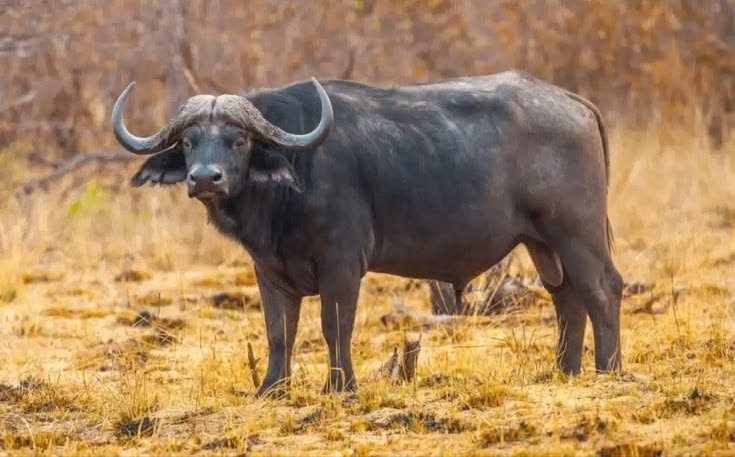
A large, powerfully built bovine with heavy shoulders and a dark brown to nearly black coat in mature animals. Both sexes carry broad horns that curve outward and upward; mature males develop a heavy horn boss. Herds may contain females, calves and younger animals, while mature bulls may live separately or in small groups. Horn shape and body size vary with age and sex.
Habitat and Distribution on Mount Kilimanjaro
The 1995 Kilimanjaro review documents buffalo through forest on the northern and western slopes, in lower moorland and visiting the alpine zone. It records small herds on the Shira Plateau at about 3,500 metres, in Lent Valley at about 4,200 metres, and tracks around 4,500 metres near Lava Tower. The paper notes that buffalo are grazers and that available grassy areas may limit their numbers. A 2019 study includes an African buffalo record in its dataset; a single record does not imply a large or widespread current population. All high-elevation details here are historical locality records.
Diet and Feeding Behaviour
Primarily a grazer, feeding on grasses in forest clearings, grassland and moorland. Seasonal and local availability shapes where buffalo feed.
Behaviour and Social Life
Buffalo are social herd animals, with females and calves forming the core of groups and mature bulls sometimes living separately. Adults can be highly protective of calves and potentially dangerous when threatened. Historical Kilimanjaro accounts describe buffalo as wary and largely nocturnal; that is a historical observation, not a verified description of current behaviour.
Communication and Calls
Herd members use low calls, body signals and scent cues to maintain contact and coordinate movement. No Kilimanjaro-specific vocal study is claimed.
Reproduction and Breeding
Calves are born after a gestation of roughly eleven months in the wider species. No Kilimanjaro-specific breeding season or local reproductive data are asserted.
Ecological Importance
As large grazers, buffalo influence vegetation structure and return nutrients through dung. They also form part of the prey base for large predators. No quantified Kilimanjaro ecological effect is claimed.
Conservation Status
The African buffalo is assessed globally as Least Concern by IUCN. No subspecies is assumed for Kilimanjaro here, and the global category is not a local population estimate. Historical poaching pressure is mentioned in the 1995 review as a past observation only.
Wildlife Watching on Kilimanjaro
Buffalo are powerful wild animals and must be treated with serious caution. Observe only from a safe distance, never approach, feed or block their movement, especially when calves are present, and follow guide and park instructions at all times.
Route and Habitat Occurrence
This species is recorded at mountain or habitat level. No route-specific occurrence is claimed without a verified locality record.
Honest Expectations
Encounters depend on habitat, timing, weather and animal behaviour. No wildlife sighting can be guaranteed on a Kilimanjaro trek.
Frequently Asked Questions
About African Buffalo on Kilimanjaro
What is the scientific name of the African buffalo?
Syncerus caffer.
Which family does it belong to?
Bovidae.
How is it identified?
A heavy dark-brown body, broad curving horns and a large horn boss in mature males.
Are buffalo found on Kilimanjaro?
Historical accounts document them in northern and western slope forests.
Were they recorded high on the mountain?
Yes. Historical records include the Shira Plateau, Lent Valley and tracks near Lava Tower.
What elevation is the Shira Plateau record?
About 3,500 metres, historically observed.
What about Lent Valley?
Small herds were historically observed there at about 4,200 metres.
Were tracks recorded near Lava Tower?
Yes, around 4,500 metres in the historical review.
Does that mean buffalo are common there now?
No. These are historical records, not a current population estimate.
What does a 2019 record mean?
It documents a record in the study dataset; it does not prove a large current population.
What do buffalo eat?
Mainly grasses in suitable open and forest-edge habitats.
Are buffalo social?
Yes. Herds usually centre on females and calves; mature bulls may live apart.
Are they dangerous?
Yes. They are powerful and can defend themselves and calves aggressively.
What does the historical salt-cave behaviour refer to?
The 1995 paper describes buffalo entering caves with crystallised sodium bicarbonate deposits and chewing the mineral.
Can visitors expect to see that behaviour?
No. It is a documented historical observation, not something to expect.
Are buffalo confirmed on every climbing route?
No. Route-specific occurrence is not claimed.
Should visitors approach for photographs?
No. Keep a safe distance and follow guide instructions.
What is the global conservation status?
Least Concern on the IUCN Red List.
Is a subspecies assumed for Kilimanjaro?
No. No subspecies is asserted here.
Where can I read more?
See the Bovidae family page and Grimshaw, Cordeiro & Foley (1995).



Sources and Further Reading
Research foundations
Grimshaw, J.M., Cordeiro, N.J. & Foley, C.A.H. (1995). The Mammals of Kilimanjaro. African Journal of Ecology.
Elevational Distribution and Ecology of Small Mammals on Africa's Highest Mountain (2014 field study).
Tanzania National Parks — Kilimanjaro National Park official information.
UNEP-WCMC — Kilimanjaro World Heritage Datasheet.
Discover Kilimanjaro’s Wildlife
Explore the mountain responsibly with African Majestic Adventure and learn about its animals with local guides.