








 Ngorongoro Conservation Area
 Volcanoes National Park










Harvey’s Duiker
Cephalophus harveyi
Harvey’s Duiker — Quick Facts
Important notice
This profile describes a species associated with the Mount Kilimanjaro ecological landscape. Checklist or locality records do not confirm a sighting on every route, camp or altitude. Route records are listed only when verified; none are asserted here.
Introduction
Harvey’s duiker is a small, reddish-brown forest antelope recorded on Kilimanjaro’s northern and western slopes. It is associated with drier forest and the lower parts of the ericaceous zone, and is typically secretive in thick cover.
How to Identify the Animal
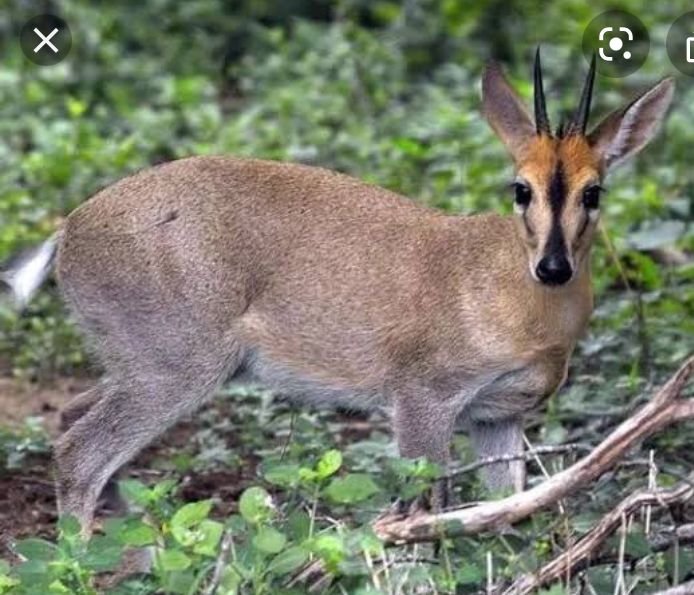
A medium-sized duiker, generally around 10–14 kg, with a rich red-brown coat, dark or grey legs, a black facial line or blaze and a black crown tuft. It lacks a black dorsal stripe. Coat tone and facial markings can vary between individuals.
Habitat and Distribution on Mount Kilimanjaro
The 1995 Kilimanjaro review reports Harvey’s duiker as common in drier forest on the northern and western slopes and in the lower parts of the ericaceous zone on those slopes. It states that its status elsewhere on the mountain was not known. The 2025 IUCN SSC Antelope Specialist Group guide gives a wider habitat range of coastal forest, thickets, gallery forest and montane forest including bamboo, to about 2,400 metres across the species' range. That wider elevation limit should not be applied automatically to Kilimanjaro.
Diet and Feeding Behaviour
It browses leaves, young shoots, buds and fallen fruit in forest and thicket. No Kilimanjaro-specific food-plant list is asserted here.
Behaviour and Social Life
Generally shy and secretive, often moving through dense lower vegetation. It is typically difficult to observe for long, even where it is reasonably common.
Communication and Calls
No distinctive species-specific call is firmly documented for this profile. Short alarm signals and scent cues are typical of duikers, but no detailed vocal description is claimed.
Reproduction and Breeding
General duiker reproduction involves a single young, but local breeding information for Harvey’s duiker on Kilimanjaro is not available here.
Ecological Importance
As a small browser in forest and ericaceous habitats, it contributes to vegetation dynamics and forms part of the food web for forest predators.
Conservation Status
The 2025 IUCN SSC Antelope Specialist Group guide lists Harvey’s duiker as Least Concern globally. This is not a local Kilimanjaro population assessment.
Wildlife Watching on Kilimanjaro
Look quietly along drier forest margins and lower heath vegetation on the northern and western sides. Do not expect a sighting, and never feed or disturb animals.
Route and Habitat Occurrence
This species is recorded at mountain or habitat level. No route-specific occurrence is claimed without a verified locality record.
Honest Expectations
Encounters depend on habitat, timing, weather and animal behaviour. No wildlife sighting can be guaranteed on a Kilimanjaro trek.
Frequently Asked Questions
About Harvey’s Duiker on Kilimanjaro
What is the scientific name of Harvey’s duiker?
Cephalophus harveyi.
Which family is it in?
Bovidae.
How big is it?
Generally around 10–14 kg.
What are its main identification features?
A rich red-brown coat, dark legs, a black facial blaze and a black crown tuft, with no black dorsal stripe.
Where is it recorded on Kilimanjaro?
The 1995 review records it in drier forest on the northern and western slopes.
Does it use the ericaceous zone?
Yes, the lower parts of that zone on the northern and western slopes.
What was known about its status elsewhere on the mountain?
The 1995 review said its status elsewhere was not known.
Does it occur in bamboo habitat?
The wider species range includes bamboo, but no Kilimanjaro bamboo record is claimed here.
How high does it live across its range?
The 2025 guide gives about 2,400 metres across the wider range, not as a Kilimanjaro figure.
What does Harvey’s duiker eat?
Leaves, shoots, buds and fallen fruit in forest and thicket.
Is it easy to see?
No. It is secretive and usually stays in dense cover.
Is it confirmed on southern routes?
No. The documented Kilimanjaro records here are northern and western.
How does it differ from the common duiker?
Harvey’s duiker is a reddish forest duiker with a black facial blaze; the common duiker is greyer with a narrow dark facial stripe.
Does it have a distinctive call?
No sufficiently documented species-specific call is claimed here.
What is its conservation status?
Least Concern globally according to the 2025 antelope guide.
Is that its Kilimanjaro status?
No, it is a global category.
Does it live in groups?
It is usually seen alone or in a small family group.
Can visitors approach it?
No. Watch quietly from a distance and never feed wildlife.
Are sightings guaranteed?
No. Encounters depend on habitat, behaviour and timing.
Where can I read more?
See the Bovidae family page and Grimshaw, Cordeiro & Foley (1995).


Sources and Further Reading
Research foundations
Grimshaw, J.M., Cordeiro, N.J. & Foley, C.A.H. (1995). The Mammals of Kilimanjaro. African Journal of Ecology.
Elevational Distribution and Ecology of Small Mammals on Africa's Highest Mountain (2014 field study).
Tanzania National Parks — Kilimanjaro National Park official information.
UNEP-WCMC — Kilimanjaro World Heritage Datasheet.
Discover Kilimanjaro’s Wildlife
Explore the mountain responsibly with African Majestic Adventure and learn about its animals with local guides.