

.png)
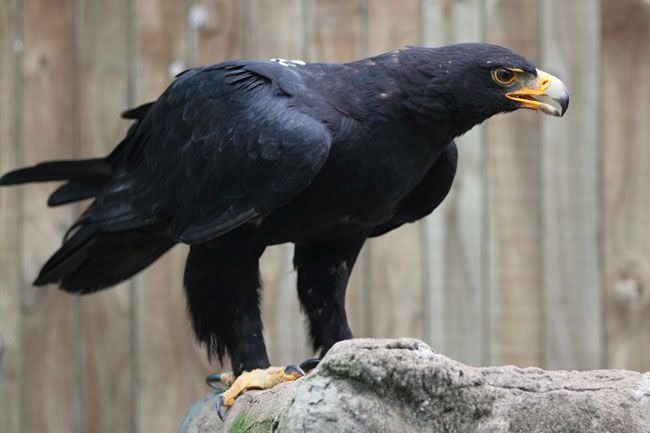
Verreaux's Eagle in Tanzania
Aquila verreauxii — Black Eagle · rocky specialistWhat Is the Verreaux's Eagle?
The Verreaux's Eagle (Aquila verreauxii), also known as the Black Eagle, is a powerful African raptor specialized for life around cliffs, mountains, kopjes and rocky escarpments.
Its ecology is tightly linked to Rock Hyraxes — signature prey that shares the same rocky terrain — though it also takes other mammals, birds, reptiles and carrion. In Tanzania it is documented in rocky landscapes such as Ngorongoro, Yaida Valley, Naisera, Oldonyo Sambu, Gol Mountains and Soitorgoss.
Scientific Classification
How to Identify a Verreaux's Eagle
- Very dark/black plumage with pale white/cream shoulder and back markings.
- Contrasting white V-like upper-back pattern and white rump/tail markings visible in flight.
- Broad wings, hooked bill, powerful talons and feathered legs.
Relying only on black colouration is insufficient for identification.
Why Is It Called the Black Eagle?
The bird's very dark plumage is responsible for the nickname — but not every dark African eagle is a Verreaux's Eagle.
Why Associated With Rocks?
Cliffs, kopjes, mountains, escarpments and rocky nesting sites together with hyrax prey make rocky ecology the central page theme.
Male vs Female
Females are generally larger and heavier than males with broadly similar plumage. No bachelor-group or sex-specific lifespan claims are used.
How Does a Verreaux's Eagle Hunt a Rock Hyrax?
- Watches from cliffs and perches, waits for exposed prey, launches and seizes with talons.
No strike force, guaranteed success rate or universal hunting speed is invented.
Daily Behaviour and Social Life
Verreaux's Eagles are primarily diurnal. Typical activities include cliff and perch observation, soaring, hunting, feeding, resting, preening, pair interaction and territorial defence. No diurnal or hourly timetable is used.
Social System
Generally solitary or territorial breeding pairs that can maintain long-term bonds. Adults defend territories containing nest, hunting grounds and prey resources. No Group Living or dominance interactions.
Communication
- Vocal calls, aerial displays, posture, pair interaction and territorial behaviour.
- No scent communication.
Movement
Generally resident; juveniles may disperse and adults may make local movements within territories. Not routine long-distance migrants.
Habitat: Cliffs, Kopjes and Rocky Landscapes
- Core: cliffs, escarpments, rocky mountains, kopjes, gorges, rocky valleys and open mountainous country.
- Adjacent: open savanna and dry/open woodland.
Woodland is not the sole or core habitat. Core requirements are rocky terrain, nesting sites, prey availability and territory — permanent water is not defining, though birds may drink at sources.
How Does the Verreaux's Eagle Hunt?
- Scans rocky slopes from cliffs or rock perches, watching for movement.
- Launches rapidly, uses powerful talons to capture prey and returns to a safe perch or feeding site.
Speed is not the central hunting feature.
Why Are Rock Hyraxes So Important?
The Rock Hyrax is the signature prey: hyraxes live around rocky terrain, so the same environment provides hunting and nesting opportunities and prey availability determines territory quality.
Tanzania-specific: Tanzania Birds has Verreaux's Eagle records associated with hyrax at Soitorgoss.
Global Distribution
The species has a broad African distribution associated with rocky and mountainous landscapes. Tanzania is one important part of its range — phrases such as "Tanzania is the best place" or "found primarily in Tanzania" are not used.
Verreaux's Eagle in Tanzania
In Tanzania, the species is documented in Ngorongoro, Yaida Valley, Naisera, Oldonyo Sambu, Gol Mountains and Soitorgoss — all rocky and mountainous landscapes suitable for the species. Population totals are not invented and equal sighting frequency is not claimed.
Where to See Verreaux's Eagles in Tanzania
Ngorongoro Conservation Area
Country: Tanzania | Region: Northern Tanzania
Crater rim cliffs and rocky escarpments.
Good specialist opportunity in rocky habitat
Gol Mountains
Country: Tanzania | Region: Northern Tanzania
Rocky mountainous terrain and gorges.
Good specialist opportunity in rocky habitat
Oldonyo Sambu
Country: Tanzania | Region: Northern Tanzania
Rocky outcrops and kopjes near Arusha.
Good specialist opportunity in rocky habitat
Yaida Valley
Country: Tanzania | Region: Northern Tanzania
Rocky valley with cliffs.
Good specialist opportunity in rocky habitat
Soitorgoss
Country: Tanzania | Region: Northern Tanzania
Rocky landscape with hyrax-associated records.
Good specialist opportunity in rocky habitat
Naisera
Country: Tanzania | Region: Northern Tanzania
Rocky kopjes and escarpments.
Good specialist opportunity in rocky habitat
Good specialist opportunity in suitable rocky habitat, but sightings depend on territory occupancy, prey availability, weather and viewing conditions — no High Sightings guarantee.
Birding Methods
- Game drives, specialist birdwatching, mountain/rocky landscape observation, wildlife photography and binocular/telephoto viewing.
Best Time to See Them
Verreaux's Eagles can be encountered year-round in suitable Tanzanian habitat. Dry-season visibility may improve some open landscapes, but there is no universal June–October guarantee.
Verreaux's Eagle in Pictures
A closer look at the Verreaux's Eagle in its natural East African habitat — its striking appearance, habitat and behaviour are best appreciated up close.
Where to Spot the Verreaux's Eagle on Safari
Plan your trip around the destinations and safaris where the Verreaux's Eagle is easiest to see. Explore the parks, itineraries and tour packages by destination below.
What Does the Verreaux's Eagle Eat?
Rock Hyraxes are primary, but the diet is broader — not "carnivore" alone and hyrax is not the only prey:
- Rock Hyraxes
- Small mammals, hares, mongooses and small antelope where documented; birds and reptiles; carrion opportunistically.
Verreaux's Eagle Breeding and Nesting
No gestation, birth or parental feeding:
- Territorial pair with a large stick nest on a cliff or ledge, with possible reuse.
- Usually 1–2 eggs with approximately 43–44 day incubation.
- Asynchronous hatching and sibling competition — usually one chick successfully fledges.
Where Does the Verreaux's Eagle Build Its Nest?
On cliff ledges, rocky outcrops, protected rock shelves, gorges and mountainous terrain — a large stick platform. Active nest coordinates are not published.
Why Does Usually Only One Chick Survive?
Asynchronous hatching creates an age and size difference; competition for food gives the younger chick a disadvantage. It is not described as parents intentionally killing the younger chick.
Verreaux's Eagle Chick Development
- Dependent hatchling with parental feeding and gradual feather development.
- First flight after substantial development with continued parental dependence after fledging. Exact fledging age is not invented unless source-verified.
Natural Threats
Adult Verreaux's Eagles have few natural predators due to their size and aggression. Threats include nest predators, egg predation, chick predation and nest disturbance — adults have few natural predators.
Conservation Status: Least Concern
Global IUCN Status: Least Concern. Regional declines may be discussed separately but do not change global status.
Threats include persecution, prey reduction, nest disturbance, poisoning, infrastructure risk and habitat degradation. Least Concern is not presented as meaning no local conservation issues. The connection between rocky habitat, hyrax prey, nesting cliffs and connected hunting territory is emphasized, with emphasis on keeping away from nests and using long lenses. Generic African Parks/WWF/TAWIRI claims are removed unless species-specific.
Verreaux's Eagle Facts
Verreaux's Eagle vs Tawny Eagle
| Feature | Verreaux's Eagle | Tawny Eagle |
|---|---|---|
| Scientific name | Aquila verreauxii | Aquila rapax |
| Plumage | Very dark/black with white shoulder | Tawny/brown variable |
| Habitat | Cliffs/kopjes/rocky | Open savanna/grassland |
| Prey | Rock Hyrax specialist | Opportunistic, termites to carrion |
Verreaux's Eagle vs Martial Eagle
| Feature | Verreaux's Eagle | Martial Eagle |
|---|---|---|
| Size | 75–96 cm, 2.3 m wingspan | 78–96 cm, larger, powerful |
| Plumage | Black with white V | Dark brown, spotted underparts |
Verreaux's Eagle vs African Hawk-Eagle
| Feature | Verreaux's Eagle | African Hawk-Eagle |
|---|---|---|
| Habitat | Rocky cliff specialist | Woodland and forest edge |
| Build | Broad wings, rocky hunter | Agile woodland hunter |
Verreaux's Eagle vs Bateleur
| Feature | Verreaux's Eagle | Bateleur |
|---|---|---|
| Tail | Medium length | Very short |
| Habitat | Cliffs/mountains | Savanna, low soaring |
Why the Verreaux's Eagle Is an Iconic Rocky-Landscape Raptor
- Unusual cliff specialization and tight relationship with hyraxes.
- Ecological role and birdwatching significance as a rocky-landscape flagship.
Photographing the Verreaux's Eagle
- Cliff perch, soaring, pair and courtship, hyrax hunting and white shoulder markings.
- Cliff nest from distance and rocky silhouette with kopjes, escarpments, cliffs and mountains as backgrounds.
Never disturb nests; use long lenses and no climbing toward nests.
Frequently Asked Questions
The Verreaux's Eagle (Aquila verreauxii), also known as the Black Eagle, is a powerful African raptor specialized for life around cliffs, mountains, kopjes and rocky escarpments, closely associated with Rock Hyraxes.
Its very dark/black plumage is responsible for the nickname, though not every dark African eagle is a Verreaux's Eagle.
It depends on cliffs, kopjes, escarpments, gorges and rocky mountains for nesting sites and hunts Rock Hyraxes that live in the same terrain.
Accipitridae within Accipitriformes, genus Aquila.
Approximately 75–96 cm long with a wingspan of about 2.3 m and mass around 3–4 kg, varying by sex and individual.
Rock Hyraxes are signature prey, plus small mammals, hares, mongooses, small antelope where documented, birds, reptiles and carrion opportunistically.
No. Hyrax is primary, but the diet includes other mammals, birds, reptiles and carrion.
Hyraxes live in rocky terrain, so the same environment provides hunting and nesting opportunities and prey availability determines territory quality; Tanzania Birds has hyrax-associated records at Soitorgoss.
By scanning rocky slopes from cliffs or rock perches, watching for movement, launching rapidly, seizing with powerful talons and returning to a perch.
It watches from cliffs, waits for exposed prey, launches and seizes with talons — without invented strike force or guaranteed success.
A broad African distribution associated with rocky and mountainous landscapes; Tanzania is one important part of its range.
Cliffs, escarpments, rocky mountains, kopjes, gorges, rocky valleys and open mountainous country, with adjacent open savanna and dry woodland.
Ngorongoro Conservation Area, Gol Mountains, Oldonyo Sambu, Yaida Valley, Soitorgoss and Naisera — all rocky/mountainous landscapes.
Yes. Ngorongoro's crater rim cliffs and escarpments are documented habitat.
Yes, at Oldonyo Sambu and other rocky outcrops near Arusha where suitable habitat exists.
Yes. The Gol Mountains' rocky mountainous terrain is suitable habitat.
Yes. Yaida Valley's rocky valley with cliffs supports records.
Generally solitary or territorial breeding pairs that maintain long-term bonds, defending territories containing nest, hunting grounds and prey.
Pairs can maintain long-term bonds, with adults defending long-term territories.
Generally resident; juveniles may disperse and adults may move locally within territories, but they are not routine long-distance migrants.
A large stick platform on cliff ledges, rocky outcrops and protected rock shelves in gorges and mountainous terrain.
Usually 1–2 eggs.
Approximately 43–44 days.
Asynchronous hatching creates an age/size difference and competition for food, disadvantaging the younger chick — not described as parents intentionally killing it.
Persecution, prey reduction, nest disturbance, poisoning, infrastructure risk and habitat degradation, though global status remains Least Concern.
Globally Least Concern; regional declines are discussed separately and do not change the global assessment.
Least Concern globally.
Global status summarizes across the range; local populations can still suffer from hyrax decline, disturbance, poisoning or rocky-habitat pressures.
Year-round in suitable rocky habitat; dry-season visibility may improve some open landscapes, but there is no universal June–October guarantee.
Yes. Cliff perches, soaring, pairs, courtship, hyrax hunting and white shoulder markings against kopjes and escarpments — using long lenses and never disturbing nests.
Related Safari Packages & Tours
Book a safari to see the Verreaux's Eagle and the rest of Africa's incredible wildlife with our expert guides.
References & Further Reading
- Tanzania Birds: Ngorongoro, Yaida Valley, Naisera, Oldonyo Sambu, Gol Mountains, Soitorgoss records; hyrax association at Soitorgoss.
- ITIS / BirdLife: Aquila verreauxii — Accipitridae, Accipitriformes — Least Concern.
- Ornithological literature: 75–96 cm, 2.3 m wingspan, cliff nesting, 1–2 eggs, 43–44 d incubation, asynchronous hatching.
- About these facts: measurements and timings are approximate ranges.
Sightings are never guaranteed and depend on local conditions.