








 Ngorongoro Conservation Area
 Volcanoes National Park










Pangani Small-eared Galago
Otolemur garnettii panganiensis
Pangani Small-eared Galago — Quick Facts
Important notice
This profile describes a species associated with the Mount Kilimanjaro ecological landscape. Checklist or locality records do not confirm a sighting on every route, camp or altitude. Route records are listed only when verified; none are asserted here.
Introduction
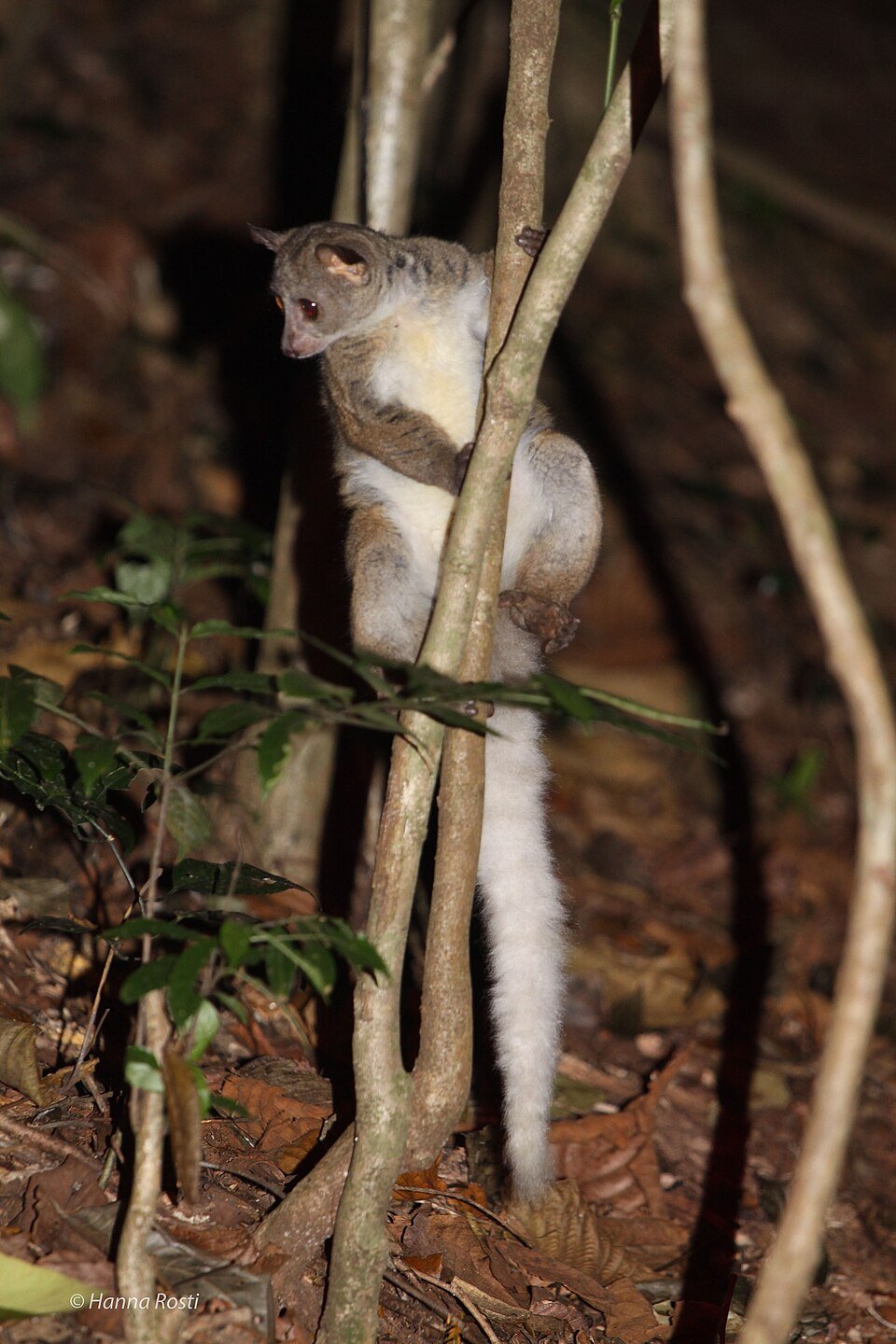
The Pangani small-eared galago is a nocturnal primate of the galago or bushbaby family. It has large forward-facing eyes for night vision, prominent ears, powerful hind limbs and a long tail that helps balance as it moves through trees. Modern Kilimanjaro field research recorded this taxon at two study plots in 2016, with three video records at elevations between 1,800 and 2,370 metres.
How to Identify the Animal
A furry-coated galago with large eyes, prominent ears, a long tail and strongly developed hind legs. It climbs and leaps through vegetation with agility, and its calls are often more noticeable than the animal itself. This page follows the taxon name used in the modern Kilimanjaro field record, Otolemur garnettii panganiensis, rather than substituting a general 'bushbaby' label.
Habitat and Distribution on Mount Kilimanjaro
The documented Kilimanjaro evidence comes from fieldwork conducted in 2016 and reported in a 2018 doctoral thesis. The research recorded the taxon at two study plots, with three video records, between 1,800 and 2,370 metres. These are observations from sampled plots, not a complete distribution or population estimate. The galago is associated with wooded and forest vegetation in the wider species, but no specific forest locality or climbing route is assigned to either plot. The taxon also appears in the thesis results table but is not listed in the final peer-reviewed 2019 paper's main list of wild non-flying mammals; that difference in evidence strength is stated here. Absence of records from other plots does not prove absence there.
Activity and Movement
Nocturnal activity is typical, with most foraging and movement after dusk. Strong hind limbs support climbing and leaping, while large eyes and acute hearing help locate food and detect predators at night. The 2016 Kilimanjaro evidence consists of video records at sampled plots and should not be read as a full activity study.
Diet and Feeding Behaviour
Fruit, insects, tree gums and other small food items, with diet varying by availability. No specific Kilimanjaro food item is claimed.
Behaviour and Social Life
Primarily nocturnal and arboreal. Galagos rest in cover during the day and become active after dark, moving through branches and leaping between supports. Social contact often centres on calling, grooming and shared travel through suitable vegetation. These are general species behaviours, not observations recorded specifically on Kilimanjaro.
Communication and Calls
Galagos use distinctive vocal calls for contact, alarm and spacing, supported by scent marking and body posture. No Kilimanjaro-specific call recording is claimed here.
Reproduction and Breeding
General galago biology includes mating, gestation, birth of usually one or two young and maternal care in sheltered resting sites. No Kilimanjaro breeding season or local breeding site is asserted.
Ecological Importance
By feeding on insects and plant material, galagos participate in woodland and forest food webs and form prey for nocturnal predators. No quantified local ecological role is claimed.
Conservation Status
Conservation assessments should be applied at the taxonomic level discussed; the global assessment for Otolemur garnettii is Least Concern. That global category is not a Kilimanjaro population estimate, and no local trend is asserted.
Wildlife Watching on Kilimanjaro
Nocturnal and difficult to observe, so visitors should not expect a sighting during a daytime climb. Do not shine powerful lights directly into an animal's eyes, chase, touch or feed it, disturb animals in trees or at resting places, and follow park rules and qualified guide guidance.
Route and Habitat Occurrence
Modern evidence: southern-slope study plots from the 2016 survey, three video records at two plots, 1,800–2,370 metres. No occurrence is claimed on Machame, Marangu, Lemosho, Shira, Rongai, Northern Circuit, Umbwe, Mweka or Kilema.
Honest Expectations
The taxon was recorded by modern field research at two sampled plots between 1,800 and 2,370 metres. This is research evidence, not proof of presence on every route or a guarantee of a visitor encounter.
Frequently Asked Questions
About Pangani Small-eared Galago on Kilimanjaro
What is the Pangani small-eared galago?
A nocturnal primate in the galago family documented by Kilimanjaro field research.
What is its scientific name?
Otolemur garnettii panganiensis.
Which family is it in?
Galagidae, the galagos or bushbabies.
How is it identified?
By its large forward-facing eyes, prominent ears, furry coat, long tail and strong hind limbs.
Is it a bushbaby?
Yes. Galagos are commonly called bushbabies.
Where was it recorded on Kilimanjaro?
At two study plots during fieldwork conducted in 2016.
At what elevations was it recorded?
Between 1,800 and 2,370 metres in the study data.
What evidence was recorded?
Three video records from two study plots.
Was it photographed or filmed?
The research recorded three video records; no still photograph is claimed here.
When was the fieldwork done?
In 2016, reported in a 2018 doctoral thesis.
Is it in the 2019 peer-reviewed paper?
It appears in the thesis results table but not in that paper’s main list of wild non-flying mammals.
Does this mean it lives on every route?
No. The records apply to sampled plots only.
What does it eat?
Fruit, insects, tree gums and other small food items.
Is it nocturnal?
Yes, it is primarily active at night.
How does it move?
It climbs and leaps through trees using powerful hind limbs.
How does it communicate?
Through vocal calls, scent and body posture; no Kilimanjaro call recording is claimed.
How does it reproduce?
General galago biology includes a small number of young and maternal care; no local breeding data.
What is its conservation status?
The global assessment for Otolemur garnettii is Least Concern.
Is that a Kilimanjaro population status?
No. Global status is not a local estimate.
Can visitors see one while climbing?
No sighting is guaranteed; galagos are nocturnal and hard to observe.


Sources and Further Reading
Research foundations
Grimshaw, J.M., Cordeiro, N.J. & Foley, C.A.H. (1995). The Mammals of Kilimanjaro. African Journal of Ecology.
Elevational Distribution and Ecology of Small Mammals on Africa's Highest Mountain (2014 field study).
Tanzania National Parks — Kilimanjaro National Park official information.
UNEP-WCMC — Kilimanjaro World Heritage Datasheet.
Discover Kilimanjaro’s Wildlife
Explore the mountain responsibly with African Majestic Adventure and learn about its animals with local guides.