








 Ngorongoro Conservation Area
 Volcanoes National Park










Yellow Baboon
Papio cynocephalus
Yellow Baboon — Quick Facts
Important notice
This profile describes a species associated with the Mount Kilimanjaro ecological landscape. Checklist or locality records do not confirm a sighting on every route, camp or altitude. Route records are listed only when verified; none are asserted here.
Introduction
The yellow baboon is a large, intelligent African primate recognised by its elongated muzzle, powerful build and yellowish-brown coat. It lives in organised social troops and spends much of its time foraging on the ground, although it also climbs trees for resting and protection. Research on Mount Kilimanjaro recorded yellow baboons in lower-elevation habitats between approximately 920 and 984 metres.
How to Identify the Animal
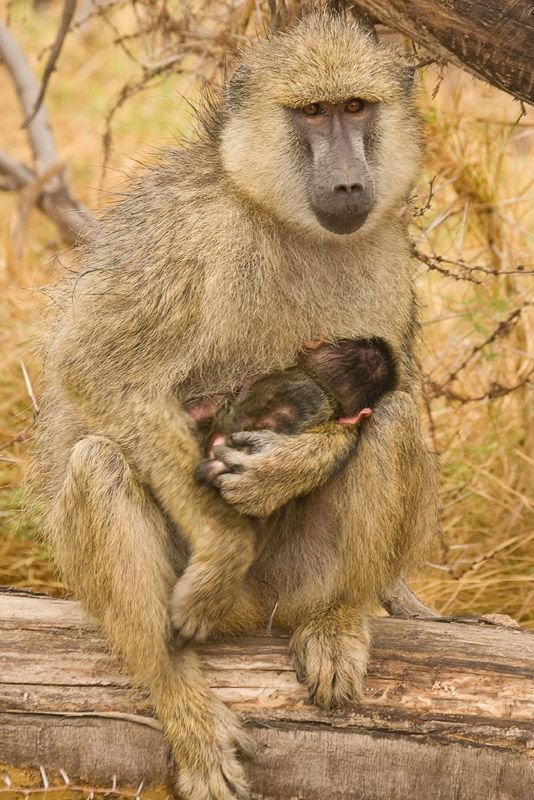
A robust primate with powerful limbs, a yellowish-brown or olive-brown coat, a long projecting muzzle, bare dark facial skin, prominent cheek pads and a long tail. Males are generally larger than females. Its yellowish coat and facial structure help separate it from other baboon species, but not every baboon seen in northern Tanzania is automatically a yellow baboon — olive baboons also occur in the wider region.
Habitat and Distribution on Mount Kilimanjaro
The Kilimanjaro mammal study recorded yellow baboons at study plots between approximately 920 and 984 metres across three plots, demonstrating occurrence in the lower-elevation part of the studied landscape. The species generally uses savanna, woodland, shrubland and suitable forest-edge habitats, but not every habitat type is confirmed at every Kilimanjaro locality. These are study-plot observations, not the species' complete elevation range, and they do not justify describing yellow baboons as common in high montane forest, moorland or alpine desert.
Diet and Feeding Behaviour
An opportunistic omnivore. Food can include fruits, seeds, grass and other vegetation, roots and underground plant parts, leaves and flowers, insects, other small animals and eggs when available. Baboons use their hands and strong jaws to obtain different foods. This is the general species diet, not a list of foods documented individually in the Kilimanjaro study.
Behaviour and Social Life
Troop living defines baboon society, with social hierarchies, grooming, strong mother-young relationships, cooperation and social learning. Groups forage mainly on the ground and climb trees for resting and safety, using group movement and vigilance to reduce risk.
Communication and Calls
Baboons use barks, grunts, screeches, threat calls and alarm calls alongside facial expressions, body posture, grooming and other social contact. Different vocalisations signal threat, distress and social intention within the troop.
Reproduction and Breeding
General reproduction includes mating, pregnancy, birth of usually one infant, maternal care and gradual infant development within the troop’s social network. Breeding was not specifically documented at the Kilimanjaro research plots.
Ecological Importance
Yellow baboons contribute through fruit feeding and seed movement, consumption of plant material, predation on insects and small animals, and their place as prey or competitors in wider food webs. No exaggerated local ecological effect is claimed.
Conservation Status
The global IUCN status is Least Concern. That does not mean every local population is free from habitat pressure or human-wildlife conflict. General pressures include habitat conversion, conflict near farms and roads, and feeding by people. No Kilimanjaro population trend is asserted.
Wildlife Watching on Kilimanjaro
Yellow baboons are associated with lower-elevation landscapes and are not expected near the summit. Observe from a safe distance, never offer food, secure your own food and rubbish, and follow guide instructions. Feeding baboons can create dangerous dependence and conflict.
Route and Habitat Occurrence
The field study records come from lower-elevation plots and are mountain research records, not proof of sightings on Machame, Marangu, Lemosho, Shira, Rongai, Northern Circuit, Umbwe, Mweka or Kilema. Where study localities cannot be tied to a tourist route, no route assignment is made.
Honest Expectations
Yellow baboons were documented in lower-elevation Kilimanjaro study plots at approximately 920–984 metres. That is a research observation range, not a complete species elevation range. They are not expected in upper alpine zones and sightings depend on locality and conditions.
Frequently Asked Questions
About Yellow Baboon on Kilimanjaro
What is a yellow baboon?
A large African primate with a yellowish-brown coat, long muzzle and complex troop society.
What is its scientific name?
Papio cynocephalus.
Why is it called a yellow baboon?
Its coat is typically yellowish or olive-brown.
How can I identify one?
By its robust body, long muzzle, dark facial skin, cheek pads, yellowish coat and long tail.
How large can yellow baboons grow?
Males are substantially larger than females; exact sizes vary across their range.
What do yellow baboons eat?
Fruits, seeds, grass, roots, leaves, flowers, insects and other small animal foods.
Are they omnivores?
Yes, they feed on both plant and animal resources.
Do they live in troops?
Yes, troops can contain many individuals with structured relationships.
How do baboons communicate?
Through barks, grunts, screeches, threat calls, facial expressions, posture and grooming.
Are they active by day?
Yes, they are mainly diurnal.
Where do they live in Africa?
In savanna, woodland, shrubland and forest-edge habitats in eastern Africa.
Have they been recorded on Kilimanjaro?
Yes, in lower-elevation research plots.
At what elevations were they recorded?
Approximately 920–984 metres in the study.
Do they live in upper mountain zones?
No upper-zone occurrence is claimed here.
Can climbers expect to see them?
No. Sightings depend on locality and conditions.
How do they care for their young?
Mothers provide the main care, with support from the troop’s social network.
Are yellow baboons dangerous to people?
They are powerful wild animals and can defend themselves if approached or fed by people.
What is their conservation status?
Least Concern globally according to IUCN.
Why should visitors never feed baboons?
Feeding changes behaviour, encourages conflict and can lead to aggressive encounters.
What should I do if I encounter a troop?
Keep a safe distance, secure food, do not approach and follow your guide.
Sources and Further Reading
Research foundations
Grimshaw, J.M., Cordeiro, N.J. & Foley, C.A.H. (1995). The Mammals of Kilimanjaro. African Journal of Ecology.
Elevational Distribution and Ecology of Small Mammals on Africa's Highest Mountain (2014 field study).
Tanzania National Parks — Kilimanjaro National Park official information.
UNEP-WCMC — Kilimanjaro World Heritage Datasheet.
Discover Kilimanjaro’s Wildlife
Explore the mountain responsibly with African Majestic Adventure and learn about its animals with local guides.