








 Ngorongoro Conservation Area
 Volcanoes National Park










Eastern Black-and-white Colobus Monkey
Colobus guereza caudatus
Eastern Black-and-white Colobus Monkey — Quick Facts
Important notice
This profile describes a species associated with the Mount Kilimanjaro ecological landscape. Checklist or locality records do not confirm a sighting on every route, camp or altitude. Route records are listed only when verified; none are asserted here.
Introduction
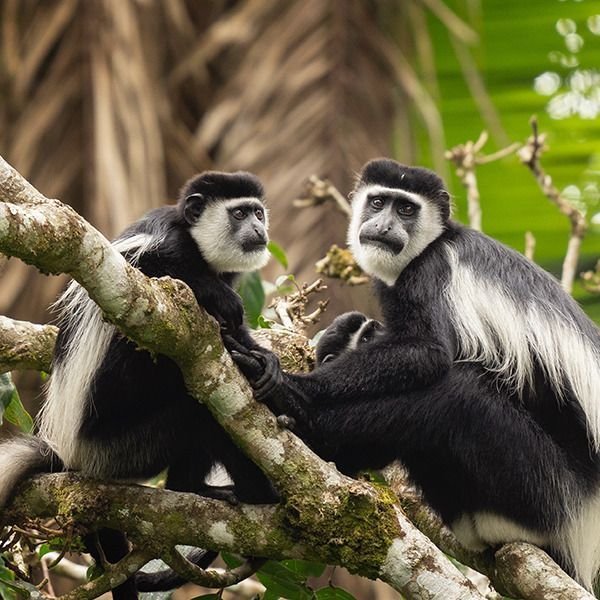
The Eastern black-and-white colobus is a striking forest primate recognised by its black body, contrasting white facial markings and long flowing mantle of white hair. It is highly adapted to life in the forest canopy, where it feeds mainly on leaves and other plant material. Kilimanjaro research recorded this colobus at approximately 2,770 metres, within the mountain’s montane forest environment.
How to Identify the Animal
A black-bodied monkey with white facial markings, a long white mantle along the sides and back, a long tail with a prominent white tuft and slender limbs adapted to canopy movement. Its flowing white mantle makes it distinct from other Kilimanjaro monkeys. An authentic image of the eastern black-and-white colobus, not an unrelated colobus species, should be used to represent it.
Taxonomic Note
The name Colobus guereza caudatus has historically been used for the Kilimanjaro colobus. Some modern taxonomic treatments recognise it as a separate species, Colobus caudatus, based on its geographic isolation and distinct characteristics. Under that species-level treatment, the IUCN assessment lists Colobus caudatus as Vulnerable. The broader Colobus guereza is often assessed as Least Concern, but that category should not be applied to the distinct Kilimanjaro taxon without explaining the difference.
Habitat and Distribution on Mount Kilimanjaro
Kilimanjaro research recorded the black-and-white colobus at approximately 2,770 metres in one study plot. UNESCO/UNEP-WCMC material also identifies the eastern black-and-white colobus among the primates of Kilimanjaro’s montane forest. The species is strongly associated with forest habitat. One plot is not a complete distribution map or evidence of regular sightings on all forest trails, and the study elevation is not the species' full elevation limit.
Diet and Feeding Behaviour
Primarily folivorous: leaves form the major part of the diet, including young leaves, mature leaves and leaf buds, with flowers, fruits and other plant material also taken when available. A specialised digestive system and fermentation help process fibrous leaves. No specific Kilimanjaro tree species are claimed as foods here.
Behaviour and Social Life
Arboreal living, social groups, group resting, grooming, canopy movement, mother-infant relationships and territorial or group interactions are reported in the wider species. Long limbs and specialised body structure help colobus monkeys move between branches.
Communication and Calls
Roaring calls, alarm calls, contact vocalisations and other social sounds, together with body posture and facial expressions, help groups communicate across forest canopy. Vocalisations can carry through forest habitat.
Reproduction and Breeding
General colobus reproduction includes mating, gestation, usually one infant, maternal care and infant development within the group. No breeding site was recorded in the Kilimanjaro study.
Ecological Importance
Leaf consumption, nutrient cycling through feeding and waste, occasional seed consumption and participation in forest food webs connect this monkey to forest ecology. It depends on healthy forest structure; no unmeasured local ecosystem effect is claimed.
Conservation Status
Under the species-level treatment Colobus caudatus, the global IUCN assessment is Vulnerable. Forest loss and degradation are important pressures, and fragmentation can isolate populations and reduce suitable habitat. A global category does not provide a current Kilimanjaro population estimate.
Wildlife Watching on Kilimanjaro
Colobus monkeys are associated with montane forest and are best observed quietly in suitable forest habitat. Watch from a distance, do not shout to attract them, never throw food into the forest and follow guide instructions. Sightings on any particular route are not promised.
Route and Habitat Occurrence
The available Kilimanjaro field study records one plot at approximately 2,770 metres. This is a documented mountain observation, not proof of presence on every route. No named climbing route is claimed without route-specific evidence.
Honest Expectations
The colobus has a documented Kilimanjaro research record at approximately 2,770 metres from one plot and is associated with montane forest. It is not guaranteed to be seen during a climb, and its taxonomic treatment and conservation category are explained on this page.
Frequently Asked Questions
About Eastern Black-and-white Colobus Monkey on Kilimanjaro
What is the eastern black-and-white colobus?
A distinctive forest monkey with a black body, white facial markings and a flowing white mantle.
What is its scientific name?
Historically Colobus guereza caudatus; some modern treatments use Colobus caudatus.
Is it the same as the guereza colobus?
It has traditionally been treated as a guereza form, but some modern taxonomy recognises it as a separate species.
Why is it called black-and-white colobus?
Its black body contrasts with white facial markings and white mantle hair.
How can I identify it?
By its black coat, white mantle, white facial markings and white-tipped tail.
What is the white mantle?
Long white hair along the sides and back that gives the species its striking appearance.
Does it have a thumb?
Colobus monkeys have a greatly reduced thumb, an adaptation to leaf-feeding and canopy movement.
What does a colobus eat?
Mainly leaves, with buds, flowers and some fruit.
Why is it called a leaf-eating monkey?
Leaves form the major part of its diet and its digestion is specialised for fibrous plant food.
Does it live in trees?
Yes, it is highly arboreal.
Does it live in social groups?
Yes, groups are typical.
How does it communicate?
Through roaring calls, alarm calls, contact sounds, posture and facial expressions.
Where does it live in Africa?
In forest habitats of eastern Africa, including the Kilimanjaro and Meru region under the species-level treatment.
Has it been recorded on Kilimanjaro?
Yes, in research plots and forest-habitat accounts.
At what elevation was it recorded?
Approximately 2,770 metres in one study plot.
Does it inhabit Kilimanjaro montane forest?
Yes, it is associated with that habitat.
Can climbers expect to see it?
No sighting is guaranteed.
What is its conservation status?
Vulnerable under the Colobus caudatus assessment; the broader guereza category is not applied without explanation.
Why is forest protection important?
The species depends on forest structure, and fragmentation reduces suitable habitat.
How should visitors observe colobus monkeys?
Quietly, from a distance, without feeding, shouting or following them.
Sources and Further Reading
Research foundations
Grimshaw, J.M., Cordeiro, N.J. & Foley, C.A.H. (1995). The Mammals of Kilimanjaro. African Journal of Ecology.
Elevational Distribution and Ecology of Small Mammals on Africa's Highest Mountain (2014 field study).
Tanzania National Parks — Kilimanjaro National Park official information.
UNEP-WCMC — Kilimanjaro World Heritage Datasheet.
Discover Kilimanjaro’s Wildlife
Explore the mountain responsibly with African Majestic Adventure and learn about its animals with local guides.